
Strasbourg, 26 November 2026
- Importers will have to prove equivalent monitoring standards from 2030
- Aim is to improve security of supply in a strained market
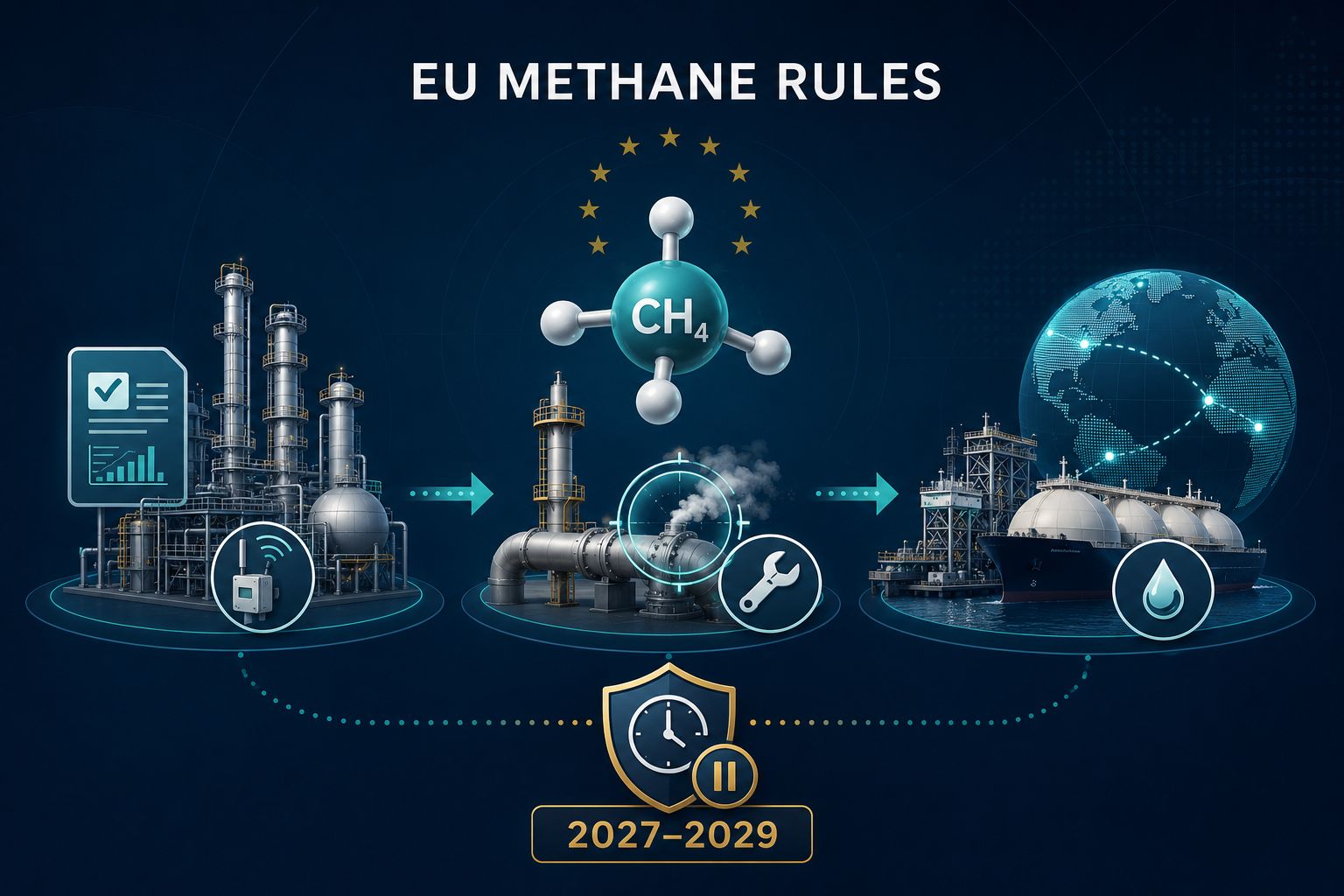
On Thursday, Parliament endorsed an agreement with member states to delay methane monitoring and reporting rules for oil, gas and coal importers by two years.
The Commission proposed postponing certain importer obligations, due to apply from 1 January 2027, and methane intensity reporting, due by August 2028, following warnings by importers that they may not be able to secure enough compliant supplies given the strained energy markets and rising prices due to the conflict in the Middle East.
On 19 November Parliament and Council negotiators agreed on the need to postpone the new requirements, albeit with a longer, two-year postponement. Under the deal, importers of crude oil, natural gas and coal will have until May 2030 to show that supply contracts concluded or renewed since 4 August 2024 involve only fuel subject to monitoring, reporting and verification measures equivalent to EU rules.
Next steps
Parliament is dealing with this file under its urgent procedure. The agreement was confirmed by plenary with 341 votes to 224, with 31 abstentions. It will now have to be formally endorsed by the Council of Ministers before publication on the Official Journal.
Background
The regulation on reducing methane emissions in the energy sector entered into force on 4 August 2024. It sets rules for measuring, reporting and verifying methane emissions, for finding and repairing leaks, and for limiting venting and flaring and it is the world’s first comprehensive legislation that also regulates methane emissions related to imports of oil, gas and coal.
Further information
MEPs Ehler and Wechsler (EPP/CDU): Statement by on the postponement of the Methane Regulation
Strasbourg, 26 November 2026
The European Parliament today definitively approved the two-year postponement of the import requirements under the EU Methane Regulation.
Christian Ehler (CDU), spokesperson for industrial and energy policy of the European People’s Party (EPP) Group, and Andrea Wechsler (CDU), member of the Committee on Industry, Research and Energy (ITRE), issued the following statement:
“With winter approaching, the significance of this decision should not be underestimated. Postponing the import requirements under the EU Methane Regulation will help keep European homes warm this winter. This pragmatic decision was urgently needed, as it is the only way to ensure that essential energy resources can be extracted in and imported into Europe with legal certainty.
At the same time, our position remains unchanged: we stand by our climate targets, including the reduction of methane emissions, but with realistic and practicable rules.”
Translated from German into English by ChatGPT, prompted by Insight EU.
Source – CDU/CSU by email
—
Donazzan and Timgren (ECR): Right-wing majority delivers two-year methane delay
Strasbourg, 26 November 2026
A right-wing, pro-business majority in the European Parliament has backed a two-year postponement of key requirements under the EU Methane Regulation. The agreement gives importers of natural gas, crude oil and coal, as well as EU operators, more time to comply with the legislation. It also sets a binding deadline for the European Commission to complete the outstanding technical rules and verification requirements.
ECR ITRE Shadow Rapporteur Elena Donazzan said:
“Today is a good day for European industry. The Commission offered one year; we in ECR helped secure two. We are giving businesses the time they need to comply while reducing unnecessary risks to Europe’s energy supplies.
“Europe needs affordable energy, competitive industries and rules that actually work. Today’s vote is a victory for common sense.”
ECR ENVI Shadow Rapporteur Beatrice Timgren said:
“Europe cannot afford an energy crisis of its own making. With energy prices already high, imposing requirements that businesses cannot yet meet risks making the situation worse.
“During the negotiations, ECR helped secure a two-year postponement and a binding deadline for the Commission to complete the missing technical rules. Today’s vote is about making environmental legislation workable while safeguarding Europe’s energy supplies and competitiveness.”
The text was adopted by 341 votes in favour, 224 against and 31 abstentions.
Source – ECR Group by email
SPD: Procrastination jeopardises climate action – Right-wing majority votes to postpone methane requirements
Strasbourg, 26 November 2026
With the Methane Regulation, the European Union has introduced an effective instrument to reduce methane emissions into the atmosphere. In doing so, the Union is deploying a crucial instrument to achieve its climate targets and thereby contribute to protecting people from extreme heatwaves and ultimately saving lives.
A right-wing majority in the European Parliament has now voted to postpone the methane requirements. Companies are required to regularly inspect their oil and gas facilities for leaks, repair them and largely prevent methane emissions through venting or flaring.
From 2027, importers of crude oil, natural gas and coal were also to be required to demonstrate that their foreign suppliers comply with standards for monitoring and controlling methane emissions equivalent to those applicable to European producers. This latter requirement has now been postponed following a controversial vote in the European Parliament. Ahead of the vote, the conservative EPP Group had joined forces with far-right political groups to delay the application of the relevant EU rules.
Jens Geier, energy policy spokesperson for the Social Democratic Party of Germany (SPD):
“It is deeply regrettable that the EU’s methane rules have been weakened under pressure from the fossil fuel lobby. When originally adopted, the agreements were supported by a broad parliamentary majority spanning the political spectrum from left to right.
As SPD Members of the European Parliament, we warn against using the current energy crisis as a pretext for rolling back climate protection measures.
Germany’s Federal Network Agency and the European Union Agency for the Cooperation of Energy Regulators (ACER) do not expect any supply shortages this coming winter. The argument that the Methane Regulation jeopardises security of supply therefore does not hold up.
As methane is a climate killer, increased emissions could lead to even more severe summer heatwaves in the future, with consequences for people. For this reason, we should prevent methane from escaping into the atmosphere at wellheads and through pipeline leaks. The short-sightedness of the conservatives, coupled with the right wing’s campaign against climate action, is putting the health of millions at risk.”
Background
According to the Intergovernmental Panel on Climate Change (IPCC), fossil methane has approximately 82 times the global warming impact of CO₂ over a 20-year period. Methane is responsible for around one-third of global warming to date.
According to estimates by the International Energy Agency (IEA), around 70% of methane emissions in the fossil energy sector could be avoided using existing technologies, such as infrared cameras to detect leaks, the replacement of leaking valves and the capture of escaping gas.
Almost one-third of emissions could even be eliminated at no additional net cost to energy companies.
Against this backdrop, the EU requires operators of facilities within the Union to reduce methane emissions. The Regulation entered into force in 2024. The adopted amendment concerning importers is expected to enter into force before the end of the year.
Translated from German into English by ChatGPT, prompted by Insight EU.
Source – SPD by email