
Paris, 10 September 2026
At the International Space Summit in Paris, EU Commission President Ursula von der Leyen called for joint European investment in launchers, satellite systems and space security. Executive Vice-President Henna Virkkunen outlined plans for EU-wide satellite services and direct-to-device connectivity.
10 takeaways
- Von der Leyen calls for Europe to act at scale: Ursula von der Leyen said the EU Commission, the European Space Agency and national governments must pool demand, investment and capabilities to secure Europe’s place in the global space economy.
- Space economy could reach $1.8tn: The global space economy is expected to grow from around $630bn to approximately $1.8tn by 2035, creating major opportunities for European industry.
- Europe seeks independent access to space: The EU Commission and ESA plan a new European vision for access to space, bringing together public demand and using European institutions as anchor customers for European launchers.
- EU proposes fivefold funding increase: The next EU long-term budget would allocate €131bn to defence, security and space, while the €5bn Scaleup Europe Fund would support strategic technologies and potential European champions.
- Single Market reforms target fragmentation: The proposed EU Space Act and a Single Market for satellite communications would establish common rules and support companies seeking to operate across all 27 EU countries.
- Competition policy should reflect global markets: Von der Leyen linked updated EU Merger Guidelines to the need for European companies to reach global scale, citing the proposed Airbus, Thales and Leonardo joint venture Bromo.
- IRIS² is being accelerated: The EU plans to expand its secure multi-orbit communications constellation to more than 350 satellites, with the first launches scheduled from 2029.
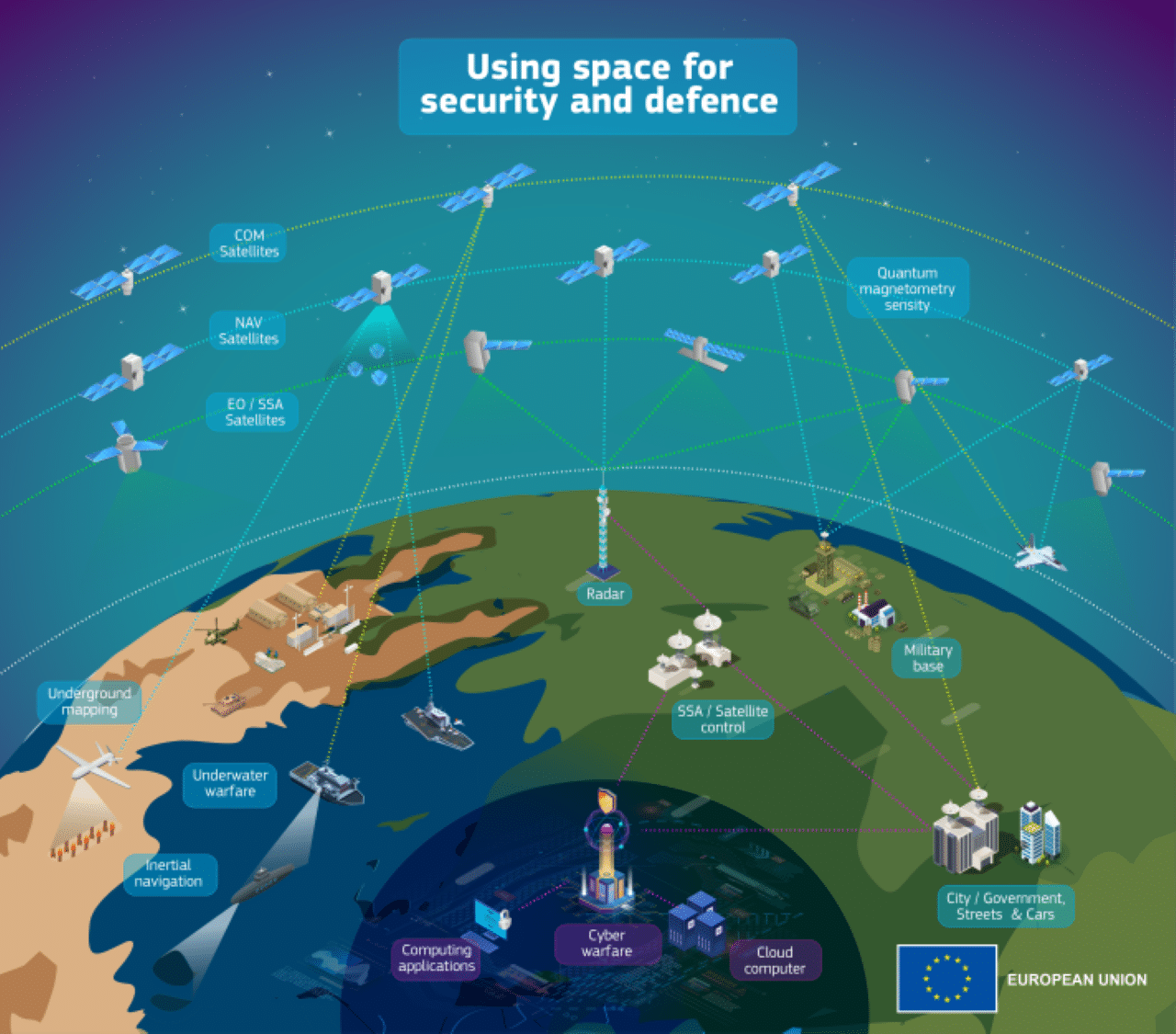
- A European Space Shield is planned: The initiative would combine European capabilities to counter jamming and spoofing, improve space-based early warning and protect satellites and other critical infrastructure.
- Virkkunen proposes an EU-wide satellite regime: Henna Virkkunen said the Mobile Satellite Services proposal would replace 27 national authorisation systems with a single EU process for services using the 2 GHz spectrum band.
- Direct-to-device connectivity is a strategic priority: Virkkunen wants Europe to catch up in satellite-to-device services. One-third of the available spectrum would support secure government communications, while part of the commercial spectrum would be reserved for EU operators and half would remain open to non-EU providers.
Speech by EU Commission President Ursula von der Leyen at the International Space Summit
Paris, 10 September 2026
“Check against delivery!”
Merci beaucoup cher Emmanuel pour cette impression, Sophie est géniale et sympa.
Dear President, cher Emmanuel, Ladies and gentlemen,
Thank you for bringing us together in this extraordinary Grand Palais. It was built at the turn of the last century to showcase the innovations transforming the world. I cannot think of a better place for today’s summit. We are discussing the innovations taking place now above us, in our orbits and beyond. Because since the turn of this century, space-based capabilities have transformed our daily lives. They connect us across continents. Guide us wherever we go. And help us understand our nature and how it is changing.
Europe has been at the heart of this transformation. We see that in the capabilities we have built together – and in the difference, they make to people’s lives. This summer, as emergency teams across Europe and beyond rushed to respond to wildfires, Europe’s Copernicus system was there to help. Our satellites provided near real-time data to track the fires and direct support where it was needed. They helped identify areas most at-risk before fires broke out. This helped us to preposition 800 firefighters in high-risk areas – standing ready to reinforce local teams from the first critical hours on. This is just one example. In recent weeks, Copernicus has supported the response to the devastating floods in Nepal. And every day, it allows scientists to track the impact of climate change, from the melting ice of the Arctic to the forests of the Amazon. These data are free and open to the world – they help us respond to the biggest challenges we share. And Copernicus is not alone. Galileo is used by more than 4.5 billion devices worldwide. It guides our cars and planes. It provides the precise timing that our financial systems or our electricity grids depend on. It helps emergency services locate people when every second counts. Now we are strengthening it further, with a constellation of satellites in low Earth orbit. And from the very start, cooperation was built into Galileo, to work with GPS in order to give users more reliable services. Galileo and Copernicus are not just for Europe. They are European investments that have become global public goods. And we are proud of them.
Ladies and gentlemen,
These systems are so deeply woven into our lives that it is easy to forget how ambitious they once seemed. When Galileo was first proposed more than 25 years ago, some questioned why Europe needed its own system at all – when GPS already existed. But Europe’s leaders understood that some capabilities are too important to depend on others. So, they chose to build together what no Member State could build alone. To think decades ahead. To invest at scale. To act as one Europe. Today Galileo underpins our economy and gives Europe the freedom to act independently. And that same choice is before us again. Because space is entering a new age. Humans are returning to the moon. Satellites are becoming cheaper and more capable. Artificial intelligence is transforming what we can do with the data gathered in space. And, as Russia’s war against Ukraine shows, what happens in our orbits is ever more central to our security. Space is again a great frontier for our prosperity, security and independence. And just as the capabilities we depend on today are the result of choices made decades ago, the choices we make now will shape our place in space for decades to come.
The opportunity in front of us is enormous. The global space economy is expected to almost triple by 2035 – from around USD630 billion today to around USD1.8 trillion. Europe begins from a position of strength. We have cutting-edge technologies, world-leading talent, and a strong space industrial base. But strength today is no guarantee of leadership tomorrow. To remain at the forefront Europe must act together, invest at scale, and turn our market into a competitive advantage. Let us have a closer look at these points.
First, we must act as one Europe. The Commission, the European Space Agency and national governments – we must pool our strengths. Our industries are calling for clear and predictable demand, to give them the certainty they need to invest and scale. Nowhere is that clearer than for space transportation. With Ariane 6 and Vega-C, Europe has its own launch capabilities. And across our continent, a new generation of innovative companies are growing. Just this weekend, a German start-up backed by EUR 10 million in European Innovation Council funding, launched the first ever commercial rocket into orbit from continental Europe. Now we must build on this momentum. That is why, with the European Space Agency, we are committing to a new European vision on access to space. To bring together European demand and act as anchor customers for European launchers. This is how we keep a competitive space-transport-industry in Europe, and keep our independent access to space.
Second, we need investment at scale. With our Cassini Investment facility, we are mobilising 2 billion EUR in risk capital for European space companies. This is supporting innovation here in Europe. Be it firms tracking ships that evade conventional systems. Or companies developing reusable spacecraft to carry cargo into orbit and one day perhaps people. Our new EUR 5 billion Scaleup Europe Fund goes further. It invests in strategic technologies where Europe needs global champions, including space. And in our proposal for Europe’s next long-term budget, space is at the heart of the European Competitiveness Fund. We have proposed EUR 131 billion for defence, security and space – five times the funding available today. We must maintain our ambition and get this across the line. Because – again – the technologies we finance today will determine our competitiveness tomorrow.
Third, we must turn the scale of Europe into an advantage. Our companies are no longer competing primarily at a national or European scale. They are competing with companies on a global level. Our policies need to reflect that reality. That starts with our Single Market. We have proposed a ‘Single Market in satellite communications’, with spectrum assigned at European level. Our EU Space Act replaces fragmentation with a common European framework for safety, resilience and sustainability. So that a European entrepreneur can build and operate from day one in a market of 450 million people.
And we are updating our competition policy. We have proposed updated Merger Guidelines – so that they recognise that European companies need scale to invest and compete globally. This is precisely what Airbus, Thales, and Leonardo are trying to achieve with their proposed joint venture called Bromo. These are the types of industrial champions we need if Europe is to lead in the space economy of tomorrow.
Ladies and gentlemen,
The ability to access and act in space not only underpins our prosperity, it increasingly determines our security and independence. Nowhere is this clearer than in Ukraine. Satellite communications keep soldiers connected, while satellite imagery reveal movements hundreds of kilometres away. And we increasingly see it in our Union itself. We see navigation signals jammed and spoofed, disrupting civilian aircraft. Cyberattacks on satellite networks knocking critical infrastructure offline. And drones hovering in our airspace, using technologies dependent on navigation from above. The message is clear: our security on Earth increasingly depends on our security in space. That is why we are building IRIS², a multi-orbit constellation for secure communication. Last month, we decided to accelerate the system, by expanding it to more than 350 satellites. This gives additional capacity for defence, security and emergency services. The first satellites will launch from 2029. Until then, we are already bringing together existing capacity to provide secure communications. Because in a crisis, Europe must have connectivity on our own terms.
Ladies and gentlemen,
Space-based systems become increasingly fundamental to our economies and our security. Therefore, we need to protect them. That is the purpose of our European Space Shield. The Space Shield brings our capabilities together into a comprehensive European system. With better awareness and greater defences against jamming and spoofing. With joint action to fill critical capability gaps. From space-based early warning to the protection of our satellites. No Member State can build these capabilities alone. But together, Europe has the scale to do it.
Ladies and gentlemen,
I have spoken today about Europe’s role in this new space age. About investing in the capabilities to strengthen our economy and our independence. But independence does not mean isolation. Independence means – having a choice. The orbits above us are a shared resource. And we have a shared responsibility to protect them. That is why I welcome the UN Group on Space Situational Awareness established here today. And it is why, through our Space Act, Europe is working to set strong universal standards for the safe, secure and sustainable use of space. Because space belongs to no single country. Astronauts who return from orbit often speak of the humbling experience of seeing our planet from above. As Thomas Pesquet put it, Earth is an “oasis in the cosmos.” A beautiful but fragile home, shared by us all. That view from space should guide us. From Copernicus to Galileo, Europe’s greatest achievements have been built based on cooperation. That is the European way. Strong enough to act independently but confident enough to work with others. Because the greatest possibilities of space will only be realised when we work together. That is the spirit we bring to this new space age.
Thank you. And long live Europe.
Source – EU Commission
Remarks by Executive Vice-President Henna Virkkunen at International Space Summit in Paris
Paris, 10 September 2026
“Check against delivery”
Ladies and Gentlemen,
Good afternoon. Thanks for inviting me to open this panel setting the scene for the discussions that will follow.
Europe benefits from very good basic coverage with mobile services, thanks to our infrastructure and high population density. We have most probably less challenges with uncovered areas than other parts of the world.
Nevertheless, today satellite connectivity is not only about connecting white spots in remote areas, complementing fibre and mobile networks. It is also about providing an essential back-up when terrestrial networks are disrupted and it is about supporting the seamless provision of services across borders to people and devices alike.
And space is an integral part of our digital policy backbone. It has become a critical asset in this respect, providing for Europe’s economic competitiveness, strategic resilience and autonomy. Satellite connectivity is evolving fast, notably with new developments in the area of direct-to-device (D2D) connectivity. The market is highly dynamic, and global competition is accelerating.
Against this background, Europe needs to create the right conditions for the industry to build the space infrastructure of the future, to innovate and to scale up globally in a sustainable and competitive way.
The recently adopted proposal for a Regulation for Mobile Satellite Services in the 2 GHz band is an important tool to steer the market in this direction. It follows the market-based approach, supporting competition and private investment, and serving Europe’s strategic autonomy and interests, in a way which is mutually beneficial for the private and public sector.
The Regulation proposes an open selection procedure, allowing competition for this highly valuable piece of spectrum from within and outside the EU, to drive investment and innovation. At the same time, it takes stock of the strategic value of this piece of spectrum for Europe’s security and sovereignty and its potential to help us diversify and strenghten our strategic autonomy.
How does this translate concretely into our proposal?
Firstly, we dedicate one third of the available spectrum to secure governmental communications. Secondly, we allow the operator of this part of the spectrum to combine it with spectrum for commercial services.
We are not reserving it in favour of a particular undertaking. On the contrary, we propose an open selection procedure which will give the opportunity to a fully European entity to put together an ambitious deployment project serving both the public and private needs.
While secure governmental services are necessary for Member States’ security-sensitive functions, they can at the same time serve as an anchor client, guaranteeing the financial viability of the project. In such a way, they can support the entire commercial and industrial ecosystem.
This brings me to my second point. This spectrum is a unique opportunity for us to help rebuild our satellite ecosystem. While Europe used to be very strong in satellite, the truth is that we are far behind in particular as regards Direct-to-Device.
We cannot afford to rely only on non-European actors. We need to diversify and the reservation of one third of the available spectrum for EU operators for commercial services serves this purpose. It also allows to combine this block with the one for secure communications services in a way which can tap into the potential for dual civil/governmental use.
We are not re-inventing the wheel. This is how major competitors around the globe have been operating. Our objective is to bring together the EU industry, from satellite manufacturers to satellite and telecom operators and equipment vendors, around an ambitious market-based project that will allow Europe to catch up.
This does not mean that we are closing ourselves in. Europe will always be open for business to the rest of the world: half of the commercial spectrum is available also for players from outside the EU.
I come now to one of the most important parts of the proposal, one that conditions its success more than anything else. Satellite networks and satellite services are by definition cross-border. Satellite networks don’t stop at national borders like terrestrial networks. Mobile satellite services, by definition, are designed to be provided irrespective of borders. They are pan-European, if not global.
The MSS proposal thus proposes a more consistent European approach to satellite connectivity. It tackles fragmentation by proposing a single EU authorisation process, carried out by the Commission, in close collaboration with the Member States.
This is common sense. We have a unique opportunity of a band that is available all over the EU, and for which we can select at EU level operators that can provide seamlessly innovative services across the EU. Th ey can scale up, they can innovate.
Let’s not artificially fragment the market with 27 national authorisation regimes.This is for me one of the most crucial points of this proposal. And I ask the support from all of you to ensure that this becomes a reality.
So, to conclude replying to the main question of this panel: I am convinced that Direct to Device is not science fiction and we are doing all we can to make sure that it will become soon a reality in Europe.
I hope these few words will stimulate fruitful discussion from this excellent line-up of panellists.
Source – EU Commission
Background: The International Space Summit in Paris, 9‑10 September 2026
On 9 and 10 September 2026, Paris is aiming for the stars by hosting the first International Space Summit. It will bring together nearly 120 foreign delegations, at the invitation of the President of the French Republic and his Special Envoys, astronaut Thomas Pesquet and business leader Hélène Huby.
“At a time when we are rightly fighting fanaticism and overt egoism, we must also dream rationally, informedly […], and we must know how to invest in this dream, which helps us to improve our knowledge of the world and the universe. […] The viable space model is this one.” – Emmanuel Macron, President of the Republic
The objectives of the International Space Summit
This summit aims to promote frank and direct dialogue, as well as outlooks and avenues for work and action through high-level talks, announcements and workshops. Strategic reflection on the future of space must be a global endeavour, which will be reflected by statements by States, international organizations and private stakeholders.
This facilitation of dialogue also contributes to the convergence of agendas, in areas including the growing use of low orbits, structuring the space economy, major scientific fields, Moon exploration and skill development. These topics are too often addressed separately, when they are in fact closely linked and should be approached jointly and clearly, as parts of the same system.
Summit priorities in the space sector
The summit will primarily focus on the following four priorities.
- In space, security takes on another dimension, and its preservation must be taken into account to ensure the sustainability of operations.
- The space economy will be a major theme. The sector is now at the heart of structural issues related to competitiveness and technological development.
- Space is a common good and we cannot let it become a lawless zone. We must begin to consider how to ensure its comprehensive and responsible management for the future.
- Lastly, space remains a fundamental project that inspires and mobilizes young people, scientific research, exploration of the universe and technological progress. Returning to the Moon and exploring Mars will surely contribute, more or less directly, to meeting the needs of our planet to preserve the delicate balances that allow it to support life.
More information
- Hélène Huby, Special Envoy of the President of the Republic
- Thomas Pesquet, Special Envoy of the President of the Republic
Source – Foreign Ministry of France