
New Delhi, 9 September 2023
“We are One Earth, One Family, and we share One Future.
“We, the Leaders of the G20, met in New Delhi on 9-10 September 2023, under the theme ‘Vasudhaiva Kutumbakam’. We meet at a defining moment in history where the decisions we make now will determine the future of our people and our planet. It is with the philosophy of living in harmony with our surrounding ecosystem that we commit to concrete actions to address global challenges.
G20 cooperation is essential in determining the course the world takes. Headwinds to global economic growth and stability persist. Years of cascading challenges and crises have reversed gains in the 2030 Agenda and its Sustainable Development Goals (SDGs). Global greenhouse gas (GHG) emissions continue to increase, with climate change, biodiversity loss, pollution, drought, land degradation and desertification threatening lives and livelihoods. Rising commodity prices, including food and energy prices are contributing to cost of living pressures. Global challenges like poverty and inequality, climate change, pandemics and conflicts disproportionately affect women and children, and the most vulnerable.
Together we have an opportunity to build a better future. Just energy transitions can improve jobs and livelihoods, and strengthen economic resilience. We affirm that no country should have to choose between fighting poverty and fighting for our planet. We will pursue development models that implement sustainable, inclusive and just transitions globally, while leaving no one behind.”
Address by President Charles Michel at the opening session of the G20 summit in New Delhi
I would also like to join in the warm words of thanks for your hospitality, but also for your leadership during the Presidency of the G20. This comes at a time when the world is facing Herculean challenges.
On the one hand, climate change is having a daily impact all over the world.
And on the other hand, the digital transformation is changing the way economic development is envisaged in the future.
The COVID crisis has put humanity to the test, revealing weaknesses and vulnerabilities.
And for some time now, a war unleashed by a permanent member of the Security Council against Ukraine. A war that is putting to the test a rules-based world that is the legacy of the United Nations Charter, which considers sovereignty and territorial integrity to be principles that guarantee peace, security and stability.
At One Earth, we want a better future for the generations that follow us. We must fight for peace with nature, the fight against climate change.
But we must also fight against those who start wars completely irresponsibly. This has an impact beyond the security of the European continent. It has an impact around the world. It affects energy, inflation, and worsens energy security.
And I would like to emphasise the exemplary mobilisation of the United Nations, of Secretary General Antonio Guterres, with the support of Turkish President Erdogan to put in place an agreement in the Black Sea to ensure that this crossroads for the transit and export of food products can be preserved. And what cynicism, Mr Russian Representative, you did not accept this because not only have you decided to pull out of this agreement on the Black Sea, but at the same time you are attacking the port infrastructures. You are blocking the ports that give access to the Black Sea, and even to the Danube.
And to add insult to injury, Russia is offering 1 million tonnes of grain to African countries in a parody of generosity. What cynicism and contempt for African countries, when we know that the Black Sea agreement has so far delivered more than 30 million tonnes of exports, mainly to the most vulnerable countries. And that the solidarity routes, alternative routes developed by the EU and with the EU, have already enabled 40 million tonnes of grain to be exported.
1 million tonnes offered — as if it were a gift. This is absolutely appalling cynicism. On the other hand, there are those who are really fighting to come to the aid of the most fragile and vulnerable populations.
So you have understood why we firmly support the United Nations Charter and the just peace proposed by President Zelenskyy and inspired by the United Nations Charter.
I would like to mention one final point.
You can count on the EU. Climate change and the fight against poverty are two challenges that we must address together, in parallel, and we know that more resources and more funding are needed. The EU fully supports the initiatives put forward by Antonio Guterres for the reform of the multilateral development banks — more inclusiveness, private sector involvement, more financial capacity and more inclusiveness.
Mr President of the AU, Mr President of the Comoros, the EU did not hesitate and immediately supported your candidacy as soon as it was announced. That is why we are happy, with my colleagues around the table, to welcome you to the G20.
Thank you again, Prime Minister, for your leadership.
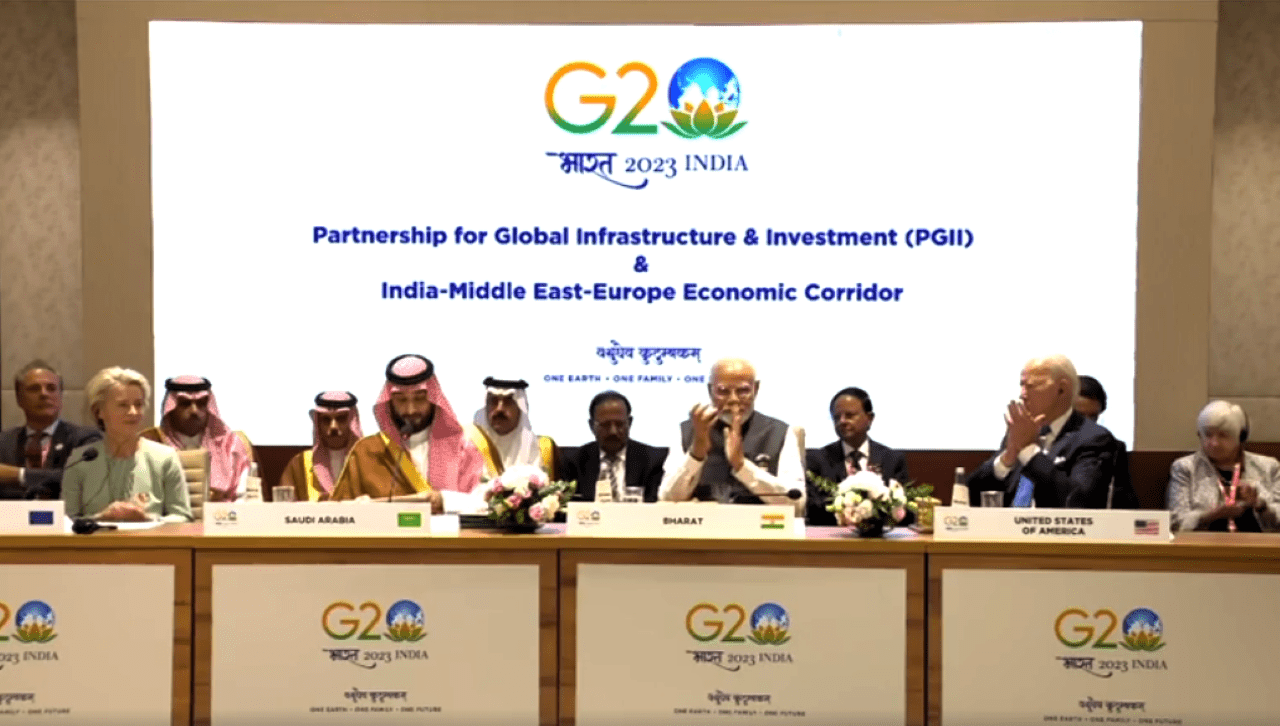
President von der Leyen marks the EU’s commitment to the Partnership for Global Infrastructure and Investment (PGII) during the event hosted at the G20 in New Delhi
President von der Leyen spoke today at the G20 event on PGII hosted by Prime Minister Modi and President Biden. (statement soon available here)
She emphasised the EU’s key contribution to two new flagship PGII projects:
The India – Middle East – Europe Economic Corridor, launched during the event. An agreement formalising this project was signed by the EU, the United States, India, Saudi Arabia and the United Arab Emirates (UAE).
The Corridor will link the three regions through state-of-the-art connectivity infrastructure, helping to bring the economic relationship between them to a new level and providing improved access to goods, energy and data to citizens and businesses.
The Trans-African Corridor will enhance the transport connections between the Katanga region of the Democratic Republic of Congo (DRC) and the so-called “Copper Belt” in Zambia, to the Lobito port in Angola. The EU is joining forces with the US to promote this Corridor (see separate joint statement by the EU and the US).
The EU is a key actor in PGII through its flagship Global Gateway programme. Global Gateway will activate 300 billion euros of investments in critical connectivity projects during the period 2021-2027, half of which is destined for Africa.
Source – EU Commission