
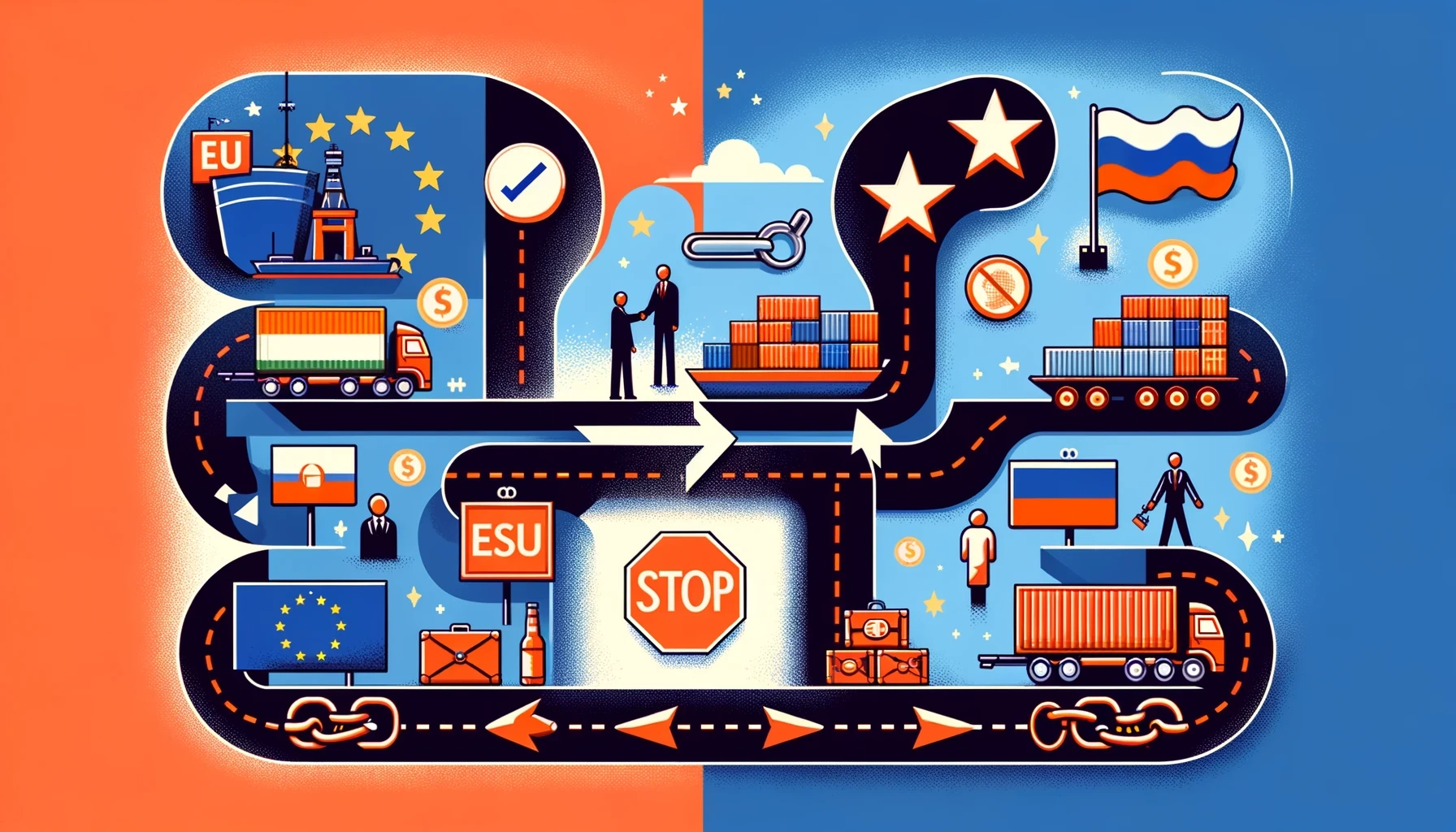
Brussels, 18 July 2025
Russia’s war of aggression against Ukraine: EU Council adopts 18th package of economic and individual measures
The EU just approved one of its strongest sanctions packages against Russia to date. Each sanction weakens Russia’s ability to wage war. The message is clear: Europe will not back down in its support for Ukraine. The EU will keep raising the pressure until Russia ends its war.
Kaja Kallas, EU High Representative and chair of the Foreign Affairs Council
The Council adopted today a 18th package of economic and individual restrictive measures hitting hard on Russia’s energy, banking and military sectors, as well as trade with the EU, and ensuring accountability for Russia’s continued war of aggression against Ukraine. Furthermore, the Council complemented the package by agreeing further measures on Belarus.
Today’s package includes economic and individual measures with a view to increasing pressure on Russia and to achieving a just and lasting peace for Ukraine.
The Council has agreed on a significant set of 55 listings, consisting of 14 individuals and 41 entities responsible for actions undermining or threatening the territorial integrity, sovereignty and independence of Ukraine, bringing the total number of individual listings to over 2 500.
Energy
With today’s package, the EU is curtailing Russia’s energy revenues through a number of different measures. The EU is lowering the price cap for crude oil from USD 60 to USD 47.6 per barrel, to align it with current global oil prices and is introducing an automatic and dynamic mechanism to modify the oil price cap and ensure that this price cap is effective. Oil exports still represent one third of the Russian government’s revenues.
The EU is also imposing further sanctions across the shadow fleet value chain. An additional 105 vessels will be subject to a port access ban and a ban on the provision of a broad range of services related to maritime transport, bringing the total number of listed vessels to 444. This measure targets non-EU tankers that are part of Vladimir Putin’s shadow fleet circumventing the oil price cap mechanism, which support the energy sector of Russia or which transport military equipment for Russia or stolen Ukrainian grain.
Full-fledged sanctions (asset freezes, travel bans, bans on providing resources) target Russian and international companies managing shadow fleet vessels, traders of Russian crude oil and a major customer of the shadow fleet – a refinery in India with Rosneft as its main shareholder. For the first time, The EU is also listing the captain of a shadow fleet vessel, as well as a private operator of an international flag registry. Lastly, one entity in the Russian LNG sector is also included in today’s listings.
Furthermore, the EU is introducing an import ban on refined petroleum products made from Russian crude oil and coming from any third country – with the exception of Canada, Norway, Switzerland, the United Kingdom and the United States – thereby preventing Russia’s crude oil from reaching the EU market through the back door.
The EU is also imposing a full transaction ban on Nord Stream 1 and 2, including for the provision of goods or services, thus preventing the completion, maintenance, operation and any future use of the Nord Stream 1 and 2 pipelines.
Lastly, the Council decided to end the exemption for oil imports from Russia to Czechia.
Banking
The EU is upgrading the existing prohibition on providing EU-based specialised financial messaging services to certain Russian banks to a full transaction ban. This will apply to 22 additional Russian banks, on top of the 23 banks already subject to the ban.
The EU is lowering the threshold for sanctioning third-country financial and credit institutions and crypto-asset service providers that are frustrating sanction measures against Russia, supporting Russia’s war of aggression or are connected to the System for Transfer of Financial Messages (SPFS), the Russian alternative financial messaging service, developed by the Central Bank of Russia and used to shield Russian banks from the impact of EU sanctions.
The EU is also expanding the transaction ban on third countries’ financial and credit institutions and crypto-asset service providers which, through their actions, frustrate EU sanctions or support Russia’s war of aggression against Ukraine. The transaction ban on third-country operators that circumvent oil-related prohibitions has also been widened.
Additionally, a ban is imposed a ban on carrying out any transaction with the Russian Direct Investment Fund (RDIF) and its sub-funds and companies, and Council has have established an instrument to extend such a ban to certain companies in which the RDIF has invested and to entities providing investment services or other financial services to the RDIF itself. Such companies and financial institutions will be selected by the Council; four Russian entities in which the RDIF has invested are already listed. This measure further limits Russia’s access to global financial markets and foreign currency.
Lastly, the Council is putting in place a new ban on selling, supplying, transferring and exporting software management systems and software with certain uses in the banking and financial sector.
Military industry
With a view to curbing Russia’s military capabilities, the Council is imposing further full-fledged sanctions on suppliers of the Russian military industrial complex, including three entities based in China that sell goods used on the battlefield. These measures aim to further constrain Russia’s access to goods and technologies. Additionally, the package covers eight companies operating in the Belarusian military-industrial complex, which is supporting Russia’s war efforts.
26 new entities will be subject to tighter export restrictions concerning dual-use goods and technologies, including those that could contribute to the technological enhancement of Russia’s defence and security sector. Eleven of these entities are located in third countries other than Russia (seven in China and Hong Kong, and four in Türkiye),and have been involved in circumventing export restrictions, including for unmanned aerial vehicles (UAVs).
Additionally, the EU has agreed further export bans worth more than €2.5 billion. The list of restricted items contributing to the technological enhancement of Russia’s defence and security sector will now include items for the development and production of Russia’s military systems such as computer numerical control (CNC) machines and constituent chemicals for propellants. Furthermore, the existing transit ban via the territory of Russia is expanded to cover selected economically critical goods used for construction and transport.
Accountability
The Council is imposing sanctions on another individual actively involved in Russia’s “military education” of Ukrainian children. This brings the total number of listings in relation to the deportation and indoctrination of Ukrainian children to over 90. The package also lists several Russian proxies in occupied territories, including a person responsible for manipulating Ukrainian cultural heritage, another leading Russian businessperson and a prominent Russian propagandist.
Belarus
In addition to the eight new listings related to the Belarusian military complex, today’s package also further mirrors the measures imposed on Belarus’ trade with those imposed on Russia.
Furthermore, the ban on specialised financial messaging services is upgraded to a full transaction ban and an embargo on imports of arms from Belarus is introduced.
Other
The EU is also introducing measures to protect member states from illegitimate Bilateral Investment Treaty (BIT) arbitration proceedings launched by Russian companies and individuals, including oligarchs and their proxies (i.e. damages recovery provision to be taken by member states, tailored non-recognition provision in the EU for those arbitration proceedings and an obligation on member states to act in BIT proceedings).
The relevant legal acts will soon be published in the Official Journal of the EU.
Background
In its conclusions of 19 December 2024, the European Council reiterated its resolute condemnation of Russia’s war of aggression against Ukraine, which constitutes a manifest violation of the UN Charter, and reaffirmed its continued support for Ukraine’s independence, sovereignty and territorial integrity within its internationally recognised borders. The European Council also reconfirmed the EU’s unwavering commitment to providing continued political, financial, economic, humanitarian, military and diplomatic support to Ukraine and its people for as long as it takes and as intensely as needed. Russia must not prevail.
The European Council reaffirmed its support for a comprehensive, just and lasting peace based on the principles of the UN Charter and international law, in line with the key principles and objectives of Ukraine’s Peace Formula, and underlined the principle that no initiative regarding Ukraine can be taken without Ukraine. To this end, the EU and its member states will maintain their intensive global outreach efforts and will participate in discussions affecting Europe’s security.
The European Union remains ready to step up pressure on Russia, including by adopting further sanctions.
- European Council conclusions, 19 December 2024
- Russia’s war against Ukraine (background information)
- Timeline – Packages of sanctions against Russia since February 2022 (background information)
EU Commission welcomes the Council’s adoption of the 18th Russia sanctions package
Brussels, 18 July 2025
The European Commission welcomes the Council’s adoption of the 18th Russia sanctions package, aimed at further ramping up pressure on the country and supporting EU’s goal of achieving a just and lasting peace for Ukraine.
The new measures focus on five building blocks: cutting Russia’s energy revenues, hitting Russia’s banking sector, further weakening its military-industrial complex, strengthening anti-circumvention measures, and holding Russia accountable for its crimes against Ukrainian children and cultural heritage. With this package, the number of listed vessels in Russia’s shadow fleet reaches a total of 444 vessels, and the number of individual listings exceeds 2,500. This package also includes new sanctions against Belarus.
The 18th package includes the following key elements:
ENERGY MEASURES
- Lowering of the Oil Price Cap for crude oil from 60 to 47.6 USD, and introduction of an automatic and dynamic mechanism for its review in the future. The new system will ensure that the cap is always 15% lower than the average market price for Urals crude in the previous period of six months, resulting in both predictability for operators and downward pressure on Russian energy revenues.
- Transaction ban for Nord Stream 1 and 2: This means no EU operator can engage in any transaction regarding the Nord Stream pipelines.
- Import ban on refined oil products derived from Russian crude: This means a clampdown on refined product imports made from Russian crude that are processed abroad and delivered into the EU. This will prevent Russian crude oil from reaching the EU market in any form.
- 105 additional vessel listings, meaning that a total of 444 vessels in Russia’s shadow fleet are now listed by the EU. 3 LNG tankers have been delisted following firm commitments that these vessels will no longer engage in the transport of Russian energy to the Russian Yamal and Arctic 2 projects. Listed vessels are subject to a port access ban and a ban on receiving services. Alongside the listings of these unseaworthy tankers, the EU is conducting outreach to flag states to ensure that ship registers do not allow these tankers to sail under their flag.
- Full-fledged listings – asset freezes, travel bans – throughout the shadow fleet value chain. These target both Russian and international companies managing shadow fleet vessels, traders of Russian crude oil, as well as a major customer of the shadow fleet, a refinery in India with Rosneft as its main shareholder. For the first time, we are also designating a captain of a shadow fleet vessel as well as an operator of an open flag registry. One entity in the Russian LNG sector is also included in today’s listings.
FINANCIAL MEASURES
- Transforming the ban on provision of specialised financial messaging services with certain Russian banks into a full transaction ban: This means EU firms are banned from doing any business, including providing specialised messaging services subject to this measure so far, with the 23 listed entities.
- Adding another 22 Russian banks to this transaction and messaging ban, bringing the total to 45. No EU operator will be able to engage with any of the listed banks directly or indirectly, including providing specialised messaging services.
- Broadening the transaction ban for third-country financial operators, including crypto-asset providers who help circumvent sanctions, support Russia’s war of aggression against Ukraine, or are connected to Russia’s financial messaging service. EU operators are banned from carrying out transactions with any of those financial operators.
- New transaction ban targeting the Russian Direct Investment Fund (RDIF), its subsidiaries, its investments and financial institutions supporting them. The new measures prohibit engaging with any legal person, entity or body in which the RDIF holds any ownership or investments. This will prevent Russia from using the RDIF to access global financial markets, circumvent EU sanctions, obtain foreign currency, sustain its war effort, or increase the resilience of its economy. This package targets 4 companies in which the RDIF has invested, helping economic operators with implementation and compliance.
- Ban on provision of certain banking software: The prohibition on provision of services and software to the Russian Government and to Russian companies will now include key types of banking software.
TRADE MEASURES
The package expands export restrictions and bans to further disrupt and weaken Russia’s military-industrial complex. These include:
- Restrictions on additional advanced technologies;
- Further export bans that correspond to almost €2.1 billion of exports in 2024 terms.
ANTI-CIRCUMVENTION MEASURES
- This package adds 26 entities to the list of those providing direct or indirect support to Russia’s military industrial complex or engaging in sanctions circumvention. This includes 15 entities established in Russia and 11 in other third countries (4 in Türkiye and 7 in China/Hong Kong). Annex IV lists companies which are military end-users, or those which form part of, or have close links to, the Russian military-industrial complex and for which even tighter restrictions apply.
- The transit ban is expanded by adding 8 Combined Nomenclature (CN) codes from the list of Economically Critical Goods – updated on 24 February 2025 – used for construction and transport, two of which are of direct relevance to the energy industry. This means that those goods can no longer transit the territory of Russia when exported from the EU to third countries.
- The package also introduces a dedicated catch-all provision to address the risk of circumvention via third countries of exports of advanced technology items. This will provide Member States with an additional tool to stop and investigate suspicious shipments and prevent the circumvention of sanctions.
TARGETING RUSSIA’S MILITARY CAPABILITIES AND SUPPLY CHAINS
- Today’s package contains 55 additional listings. These listings target the military industrial complex with a view to curb Russia’s military capabilities. To further constrain its access to goods and technologies, listings target the supply chain of the Russian military industrial complex, including through the listing of companies in China supplying goods used on the battlefield. Additionally, the package targets 8 companies operating in the Belarusian military industrial complex, which is supporting Russia’s war efforts.
RUSSIA’S ACCOUNTABILITY
- By adding another individual actively involved in Russia’s “military education” of Ukrainian children, we continue to target those responsible for the indoctrination of Ukrainian children. It brings the total number of designations in relation to the deportation and indoctrination of Ukrainian children to over 80.
- The package is also listing several Russian proxies in occupied territories, including a person responsible for manipulation of Ukrainian cultural heritage, another leading Russian businessperson, and a prominent Russian propagandist.
MEASURES TO PROTECT MEMBER STATES FROM ARBITRATION
- Introduction of protective restrictions concerning the investor-to-state dispute settlement (ISDS): These new measures address the risk of economic damage from investment arbitrations launched by listed persons in relation to EU sanctions. The measures provide further protection for Member States from sanctions-related claims under their bilateral investment treaties (BITs). This includes the possibility for Member States to recover any damages incurred as a consequence of investor-to-state dispute settlement proceedings brought against them.
NEW MEASURES AGAINST BELARUS
In parallel, the package includes additional measures on Belarus, namely prohibiting arms procurement from Belarus, adding a catch-all provision for advanced technology items, transforming the ban on specialised financial messaging services into a full transaction ban, and adding measures to protect Member States from arbitration.
This package also includes additional export restrictions on sensitive goods, technologies and industrial goods. Finally, it adds one (1) entity subject to restrictions and eight (8) additional entities subject to asset freeze.
More information
- Official Journal (text will be available soon)
- Questions and answers
- More information on sanctions
- EU Sanctions Helpdesk
Quote(s)
The EU just approved one of its strongest sanctions packages against Russia to date. Each sanction weakens Russia’s ability to wage war. The message is clear: Europe will not back down in its support for Ukraine. The EU will keep raising the pressure until Russia ends its war.
Kaja Kallas, EU High Representative and Vice-President of the European Commission
This new sanctions package strikes at the heart of Russia’s war machine – targeting its energy revenues, financial sector, and military-industrial complex. The EU stands united in its unwavering support for Ukraine. The pressure is working – Russia’s resources are dwindling, and sustaining its illegal war is becoming increasingly difficult. Unequivocal support for Ukraine is, and will remain, at the very top of our EU list of strategic priorities.
Maria Luís Albuquerque, Commissioner for Financial Services and the Savings and Investments Union
Source – EU Commission
EU Commission: Questions and answers on the 18th package of sanctions against Russia
Brussels, 18 July 2025
LISTINGS
Who have you targeted?
The 18th package of EU sanctions designates 14 individuals and 41 entities under the Ukraine territorial integrity sanction regime and 8 entities under the Belarus sanctions regime. They are now subject to asset freezes and the prohibition to make funds and economic resources available to them. The new listings chiefly aim to disrupt Russian energy revenues and military capacity and hit those responsible for the indoctrination of Ukrainian children, Russian propaganda, and manipulation of Ukrainian cultural heritage. With all these additions, the number of individual listings exceeds 2,500.
How will the listings hit Russia’s revenues?
The 18th package designations further curtail the operation of the shadow fleet by targeting multiple actors throughout its ecosystem. Listings include several companies operating or managing shadow fleet vessels, both Russian and from third countries. Furthermore, two important multinational traders of Russian crude oil, as well as a major customer of the shadow fleet, a refinery in India with Rosneft as its main shareholder, are also targeted. For the first time, we are also designating a captain of a shadow fleet vessel sanctioned by the EU, as well as an operator of an open flag registry. An entity in the Russian LNG sector is also included in today’s listings.
How do you go after the military sector?
We continue to target directly the Russian military industrial complex as well as the support from third countries. To curb Russia’s military capabilities, listings target the supply chain of the military industrial complex, including entities in China transferring goods used on the battlefield. Additionally, the package covers eight companies operating in the Belarusian military industrial complex, which is supporting Russia’s war efforts.
ENERGY MEASURES
What changes were introduced regarding the oil price cap?
The cap has been lowered from 60 to 47.6 USD and an automatic and dynamic mechanism was introduced to set the future price cap for crude oil. The new price cap will apply on 3 September 2025. This will ensure that the cap level is always 15% lower than the average market price for Urals crude in the previous reference period. This system has been designed to make sure that the price cap is adjusted to the realities of oil markets and remains effective under all market conditions.
The cap will be subject to regular review every 6 months by the Commission, as well as extraordinary reviews where duly justified by developments in the oil markets or other unforeseen circumstances. The cap will not change if the fluctuation in the market price over the reference period is less than 5%, providing stability and predictability for operators.
A 90-day transition period applies to existing contracts in compliance with the cap already concluded at the time of the entry into force of the new cap level.
This dynamic system will reduce Russian energy revenues through a significant markdown under the price cap, while making the mechanism more robust for future changes in the market environment. Allowing EU operators to transport Russian oil under the strict conditions of the oil price cap mechanism while firmly sanctioning vessels of the shadow fleet will increase maritime safety and make it harder for Russia to evade the price cap mechanism through the shadow fleet.
What does the transaction ban for Nord Stream 1 and Nord Stream 2 entail?
The package adds a transaction ban on Nord Stream 1 and 2 to prevent the resumption or the establishment of natural gas supplies through those pipelines. This means no EU operator can engage in any transaction regarding the Nord Stream 1 and 2 pipelines. This includes transactions for the completion, operation, maintenance or use of the pipelines or parts of the pipelines. The transaction ban also covers the purchase of natural gas transported via either pipeline.
How will the import ban on refined products made of Russian crude work?
After a transitional period of 6 months, it will be prohibited to EU operators to purchase, import, or transfer into the Union petroleum products obtained in a third country from Russian crude oil, as well as to provide related technical or financial assistance. The Commission will issue guidance on the implementation of this prohibition, in particular as regards the evidence to be provided by operators engaged in the import of refined petroleum products.
Partner countries that imposed prohibitions on imports of Russian oil and petroleum products are exempted from this prohibition. Furthermore, petroleum products imported from a net exporter of crude oil – a country that exports more crude oil than it imports in the previous calendar year – will be considered to have been obtained from their domestic crude oil and not from crude oil originating in Russia. This will be further elaborated in the guidance.
The package also adds the possibility to place a transaction ban on third-country entities that circumvent oil related provisions, prohibiting EU operators from making transactions with such entities.
LISTING OF VESSELS
Which vessels are affected and what is the scope of the measures against vessels?
The EU has listed 105 additional vessels of the Russian shadow fleet. These ships are attempting to evade the oil price cap, and engage in other unsafe shipping practices. These come in addition to the 342 vessels already sanctioned.
A listed vessel is subject to a port access ban, as well as a prohibition from receiving a broad array of maritime and other services. These include financing and financial assistance, including insurance and brokering flag registration, technical assistance, bunkering, ship supply services, crew changes services, and other services including cargo loading and discharge services, fendering and tug services.
This means that such services cannot be provided by EU operators, in ports or outside of territorial waters. The full list of prohibited services is set out in Article 3s of Council Regulation 833/2014.
Why are vessels listed?
EU sanctions enable the EU to list vessels that are directly or indirectly supporting Russia’s warfare against Ukraine. Such vessels can be listed on the basis of criteria such as the transport of military equipment, the transport of stolen Ukrainian goods such as grain, their participation in the shadow fleet transporting Russian oil and their support to the exploitation or development of the Russian energy sector such as the transport of LNG infrastructure or transshipment of Russian LNG.
What outreach is the EU carrying out following the listing of vessels?
Alongside the listings of these tankers, the EU is conducting outreach to relevant states to ensure that ship registers increase their scrutiny, and countries do not allow unseaworthy tankers to sail under their flag or call their ports.
The shadow fleet’s operations not only serve to carry Russia’s oil which is fuelling the Kremlin’s illegal war in Ukraine, they are endangering the maritime environment and the life of those at sea globally due to the risk of oil spills and other ship source pollution. These risks are consistently highlighted in the EU’s exchanges with these countries.
Within the framework of the International Maritime Organisation, the EU and its Member States are working on several initiatives to tackle substandard shipping, for instance to ensure vessels sailing in and around the EU to report insurance information.
Why were three LNG tankers de-listed?
For the first time, the EU has accepted to remove 3 vessels from its list of sanctioned vessels following firm commitments that these LNG tankers will no longer engage in the transport of Russian energy to the Russian Yamal and Arctic 2 projects for which they had originally been commissioned. This action demonstrates the impact of EU vessels designations, and that vessels can be returned to service following firm commitments.
FINANCIAL MEASURES
What is the practical impact of expanding the prohibition to provide specialised financial messaging services to certain Russian banks and financial institutions into a full transaction ban?
The 18th package targets 22 additional Russian banks. EU banks and other economic operators are banned from carrying out any transaction with or provide specialised financial messaging services to these banks, and to the 23 previously sanctioned. The prohibition for these 22 new banks enters into force on 8 August 2025.
Targeting these banks is crucial as they support Russia’s war machine or circumvention of EU sanctions, especially by carrying out cross-border transactions, for which they need EU-based specialised financial messaging services. Among the targets, there are banks operating in the temporarily occupied oblasts of Ukraine, which cannot be tolerated. We also close possible loopholes, as some of those banks are already sanctioned by our allies.
The transaction ban has a narrow range of exemptions, e.g. for divestment from Russia or the wind-down of business activities in Russia, the functioning of diplomatic and consular representations of the Union and of the Member States or of partner countries in Russia, or international organisations in Russia enjoying immunities in accordance with international law, or also for operations of nationals of a Member State who have been resident in Russia since before 24 February 2022.
What has been done in relation to third-country credit and financial operators violating sanctions?
The conditions to sanction banks, financial operators and crypto asset providers that are located in third countries have been simplified. Now the Council can list non-Russian, non-EU banks simply connected to SPFS, the Russian financial messaging system, as well as those in third countries that are frustrating any of the EU sanctions on Russia or those who support Russia’s war of aggression. Two Chinese financial operators are subject to sanctions under the new criteria because they have helped circumvent EU sanctions. EU operators are prohibited from making transactions with these entities.
What is the Russian Direct Investment Fund (RDIF) and why have you decided to target it in the 18th package of sanctions?
The Russian Direct Investment Fund (RDIF) is the Russian sovereign wealth fund established by the Russian government to make and to attract investments in leading and new companies of high-growth sectors of the Russian economy. It is an effort by the Russian authorities to attract and channel domestic and third country funds into the economy, often in companies in the military and defence sectors. RDIF is a significant tool for Russian foreign and economic policy and is used to circumvent restrictive measures and sustain the war economy.
Today’s package enables the EU to prohibit EU operators to carry out any transactions with the Russian Direct Investment Fund (RDIF), its subsidiaries, certain listed entities RDIF has invested in and financial institutions supporting them.
Under this new measure, the EU added bans on 4 Russian companies in which the RDIF has invested. This indicates clearly to EU operators that the listed businesses in which the RDIF has invested are off-limits and indicates to third countries that co-investing with the RDIF can have significant consequences. These measures will prevent Russia from using the RDIF to access global financial markets, circumvent EU sanctions, obtain foreign currency, attract funding and investments and sustain its war effort.
ANTI-CIRCUMVENTION MEASURES
What is the “Catch-all provision” and why was it included in the new measures?
Addressing sanctions circumvention is a top political priority for the EU. The ‘catch-all provision’ aims at addressing the risk of circumvention via third countries of exports of advanced technology items. It provides Member States, and in particular customs authorities and export control authorities, with an additional tool to scrutinise shipments to third countries and allows them to stop and investigate suspicious shipments in case there is a risk of diversion to Russia and prevent the circumvention of sanctions.
TRADE MEASURES
Which are the new export restrictions and bans included with the 18th package of sanctions?
The package adds new export restrictions and bans to further disrupt and weaken Russia’s military-industrial complex. These include:
- Restrictions on additional items and technologies (Annex VII Reg. 833/2014), namely:
- six chemical compounds used to produce solid state propellants and,
- two types of Computer Numerical Control (CNC) machine tools used for the production of battlefield equipment, e.g. of Kh-59 cruise missiles, unmanned aerial vehicles, helicopter components and tanks.
- Further export bans (Annex XXIII) on i) machinery and appliances, notably machinery used in the energy sector, such as gas turbines, ii) chemicals, in particular those used as raw materials in industry; iii) certain metals such as refined copper and articles of copper, aluminium and articles of aluminium, and articles of steel and iv) plastics. They correspond to almost EUR 2.1 bn of EU exports in 2024 terms.
- Listing of 26 entities (Annex IV) due to their close links to the Russian industrial military complex or their involvement in sanctions circumvention to whom tighter export bans apply.
MEASURES TO PROTECT MEMBER STATES FROM ARBITRATION
Why are the provisions on investor-state arbitration (e.g. under bilateral investment treaties (BITs)) needed?
Russia has committed the most severe violations of international law, and our sanctions represent a justified reaction to such violations. With today’s new measures, we add extra procedural safeguards against any illegitimate damages claims and arbitrations brought forward or launched by Russian investors and their proxies for the consequences of our measures. These safeguards are established in full alignment of international law, and they offer the necessary reassurances while sending a strong deterrent message. They are also fully in line with measures on damages and non-recognition already adopted in previous sanctions packages.
ARMS EMBARGO
With today’s package we replicate the arms embargo contained in the Council Decision within the Council Regulation in line with the jurisprudence of the Court of Justice. This mirrors similar actions taken with regard to other sanctions regimes, such as the Libya, Haiti and Central African Republic regimes. Additionally, we also aligned the relevant Belarus sectoral measures.
BELARUS PACKAGE
Which new measures concern Belarus?
The package includes additional measures on Belarus. It replicates the arms embargo contained in the Council Decision 2012/642/CFSP within the Council Regulation 765/2006 in line with jurisprudence of the Court of Justice and prohibits arms procurement from Belarus. The package adds the ‘catch-all’ provision for advanced technology items.
On trade, the measures mirror those imposed on Russia and concern export restrictions on sensitive goods and technologies (Annex Va of Regulation 765/2006), as well as on goods which could contribute to the enhancement of Belarusian industrial capacities (Annex XVIII), machinery (Annex XIVa) and goods subject to a transit ban (Annex XIX). In addition, we have added one Belarusian entity to the list of organisations subject to restrictions (Annex V).
The package further transforms the ban on specialised financial messaging services applicable to four Belarusian banks into a full transaction ban. The package also introduces measures to protect Member States from investor-state arbitration.
Finally, an asset freeze was imposed on 8 additional entities.
GENERAL
Impact of our sanctions
EU sanctions remain at the core of the EU’s strong response to Russia’s illegal and military aggression against Ukraine. They have a clear objective – to undermine Russia’s ability to finance and sustain its war. Economic data clearly indicates that EU sanctions are working.
The Russian economy has spent a significant share of its reserves to boost the economy and military sector. The economy is accordingly slowing down. GDP growth in Q1 2025 was 1.4%, the IMF forecasts GDP in 2026 to be +0.9%. PMI manufacturing data points to contraction.
Russia is now selling its resources at a discount, and buying what it needs at a premium, resulting in a negative impact on its economy. The Russian economy is operating near full capacity, with inflation still being very high. In May 2025 inflation decreased to just slightly below 10% (9.88%) far exceeding its target of 4%.
The Central Bank of Russia cut its key policy rate by 100bps to 20% in June, but the monetary policy remains very tight. Delinquencies are on the rise, both in the household and corporate sectors.
The Government’s deficit is skyrocketing. Russia has also considerably drawn from its National Wealth Fund to finance its budget deficit and to support banks and infrastructure projects. The liquid part of the National Wealth Fund is now lower than one third of what was available before the war.
Moreover, thanks to the EU and G7 energy sanctions and to the REPowerEU policy of diversification of supply and replacement of Russian imports, Russia’s oil and gas revenues have fallen from 100 billion euro in 2022 to 22 billion in 2024. This is a reduction of almost 80% compared to before the war.
Through export restrictions, the Russian economy is cut off from access to dual use goods, critical technologies, and industrial goods essential for its war effort, such as spare parts, machinery, and electronics.
The EU maintains strong international coordination on sanctions within the G7 and with other like-minded partners. As guardian of the EU Treaties, the European Commission monitors the enforcement of EU sanctions by EU Member States.
Russia is constantly looking for ways to evade sanctions. This is clear evidence that such measures are having an impact, but equally it means continued efforts are required in tackling circumvention. EU Sanctions Envoy David O’Sullivan continues his outreach to key third countries to combat circumvention. Working with like-minded partners, we have also agreed a list of Common High Priority sanctioned goods to which businesses should apply particular due diligence, and which third countries must not re-export to Russia. In addition, within the EU, we have also drawn up a list of sanctioned goods that are economically critical and on which businesses and third countries should be especially vigilant.
What is the added value of imposing such sanctions?
The EU stands firmly with Ukraine and its people, and will continue to strongly support Ukraine’s economy, society, armed forces, and future reconstruction. EU sanctions fulfil the EU’s key objective, which is to continue to work for a just and lasting peace for Ukraine.
EU sanctions are at the core of the EU’s response to this unjustified military aggression against Ukraine, as they aim at concrete and measurable results linked to the weakening of Russia’s economic capacity, thereby limiting its ability to finance the war.
Current data show that sanctions have imposed an immediate, high, and growing cost on the Russian economy. This is not only about EU exports to Russia, which have decreased by 60% between 2021 and 2024. This is also about Russia not being able to replace those exports.
Sanctions need to be properly implemented. Ensuring effective and diligent sanctions implementation is key to prevent circumvention. This is primarily the responsibility of the Member States. In this process, the European Commission is fully committed to assisting national authorities and ensuring a consistent implementation across the Union.
More information
- Press release
- European Commission website on Ukraine
- Q&A on restrictive measures
- EU Sanctions Helpdesk
Source – EU Commission