
Strasbourg, 29 April 2026
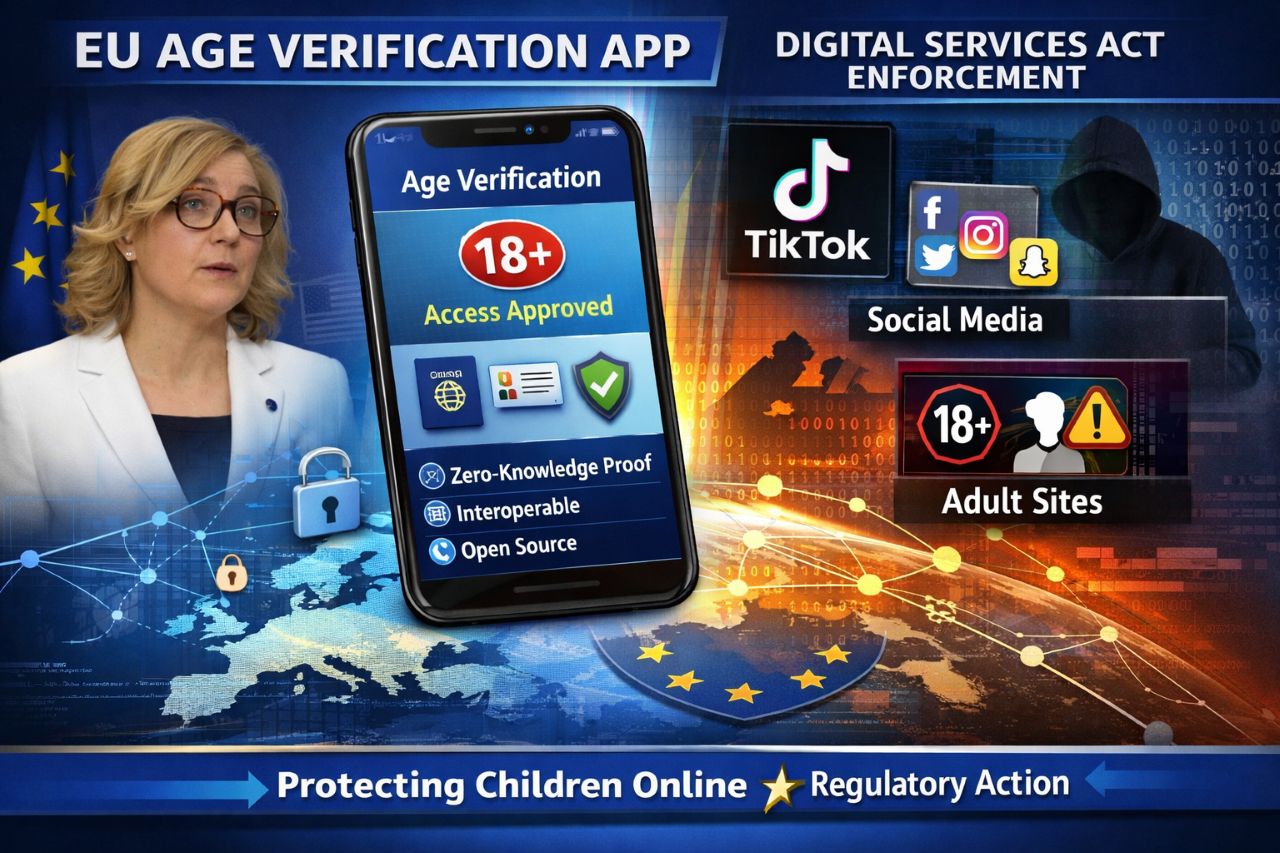
On Wednesday, the EU Commission adopted a recommendation urging Member States to accelerate the rollout of the EU age verification app and make it available by the end of the year. The secure, safe, and privacy-preserving EU age verification app is a key step in protecting children from harmful and inappropriate online content.
The Member States can roll-out the EU age verification as a standalone app or integrate it into a European Digital Identity Wallet. The recommendation also specifies the actions that Member States should take to ensure the swift availability and interoperability of the EU age verification solution.
The Commission has developed a blueprint of the EU age verification app, which enables users to prove they meet a required age threshold without revealing their exact age, identity or any other personal details. It is now for the Member States to customise and produce the app for their citizens.
Protecting children online is a priority for the Commission. Under the EU’s Digital Services Act, online platforms must ensure a high level of privacy, security and safety for minors online.
Henna Virkkunen, Executive Vice-President for Tech Sovereignty, Security and Democracy said:
Effective and privacy-preserving age verification is the next piece of the puzzle that we are getting closer to completing, as we work towards an online space where our children are safe and empowered to use positively and responsibly without restricting the rights of adults.”
Source – EU Commission
Remarks by Executive Vice-President Virkkunen on the EU age verification app
“Check against delivery”
Protection of minors
I will focus on a topic that is very high on Commission’s agenda: protection of children online.
We are already frontrunners in creating a safer online world for minors. For example:
- With the Digital Services Act, its guidelines and enforcement actions.
- Our Action Plan against Cyberbullying.
- And the Better Internet for Kids strategy.
But more needs to be done.
Yesterday we agreed on a next important piece of the puzzle.
After finalising the technical work on the European Age Verification Solution, it is now ready for Member States to customise and roll out.
Why is this solution important?
Because it will help to ensure that everyone has the same online access, dependent on national rules.
It will allow everyone to keep browsing the Internet in full privacy, while ensuring that children do not have access to content that is not meant for them.
Today we have adopted a Recommendation that sets out clear expectations for Member States.
To accelerate the adoption of age verification tools, so that people across Europe can count on safe, secure, privacy-preserving solutions.
At the same time, we will set up an Age Verification Scheme. The scheme sets criteria for those who can provide proof of age, and those who can develop age verification solutions.
Based on these criteria we will assess potential providers and publish lists of providers that meet our high privacy and security standards.
At the informal Telecom Council in Cyprus tomorrow, I will be meeting with Member States to discuss our recommendations.
Preliminary findings on DSA
And the age verification solution goes hand in hand with our DSA enforcement.
Today, the Commission has preliminarily found Instagram and Facebook in breach of the DSA, for failing to prevent minors under the age of 13 from accessing their services.
Meta’s own terms and rules indicate that Instagram and Facebook are not meant for minors under 13.
Yet, our preliminary findings show that Meta is doing very little to prevent children below this age from accessing these platforms.
We know that in the EU some 12 % of children under 13 use Instagram or Facebook. Yet, Meta failed to identify, assess and mitigate the risks for minors.
Poor mitigating measures expose under 13-year-old users to online dangers – such as cyberbullying, grooming, or age-inappropriate experiences.
Our preliminary findings indicate that, when creating an account, minors under 13 can bypass age restrictions easily: by simply entering a false birth date. With no effective controls in place by Meta to check if this self-declaration is correct.
We also concluded that the tool for reporting minors under 13 is not easy to use, and often there is no proper follow-up. The reported minor can simply continue to use the service.
Source – EU Commission
EU Age Verification Blueprint — the dedicated technical portal
This site is the dedicated technical portal for the EU age verification blueprint — the reference technical specification developed by the European Commission, comprising the technical architecture, protocols, interfaces and open-source reference implementation that together constitute the EU reference standard. The blueprint can be implemented by Member States or by any other public or private entity to build an EU age verification solution, whether offered as a standalone application or integrated into a European Digital Identity Wallet.
A pilot roll-out with front-runner Member States is under way in 2026, ahead of general availability. Built upon the robust European Digital Identity Wallet framework, this user-friendly and privacy-preserving solution enables individuals to prove their eligibility for age-restricted online services — including platforms that must protect minors from harmful or illegal content, and services restricted to adults — without disclosing any other personal information. The solution gives parents, teachers and guardians a practical tool, and supports online platforms in complying with Article 28 of the Digital Services Act. Unlinkability is achieved by design through Zero-Knowledge Proof cryptography — see the “Privacy by design” section below.
A core objective of this initiative is to deliver a consistent, secure, privacy-preserving and user-friendly age verification experience that can be easily integrated into a wide variety of digital services throughout the European Union. The modular architecture and adherence to open standards not only ensure interoperability between national systems, but also allow online service providers to adapt the solution to their own technical and regulatory environments.
This website is the developer and integrator hub for the EU Age Verification Blueprint — the open-source reference implementation behind the European age verification app announced on 15 April 2026. It serves two audiences: Member States and vendors building a national EU-compliant age verification solution (for example, by integrating the app into a national EUDI Wallet), and online service providers that need to accept proof-of-age attestations — electronic attestations of attributes within the meaning of Article 3(44) EUDI Regulation, confirming that the holder is above a given age threshold without disclosing the holder’s date of birth or any other personal data beyond what is strictly necessary — issued under the EU AV Profile.
The following video provides an overview of the open-source age verification solution:
Privacy by design: Zero-Knowledge Proofs
The EU Age Verification Solution relies on Zero-Knowledge Proof (ZKP) cryptography to deliver its privacy guarantees. A ZKP allows the user’s application to convince a relying party of a single fact — for example, “this user is over 18” — without revealing the user’s identity, date of birth, issuer-assigned reference or any other attribute. The application’s responses to different relying parties cannot be correlated, so a user cannot be tracked across services, and the relying party cannot build a profile from repeated interactions.
This is what “completely anonymous” means in practice: the relying party learns only the yes/no answer it needs to enforce its age policy; no linkable identifier is ever disclosed, and no biometric scan or document image is transmitted. The cryptographic construction and the trust model are specified in Annex B — Zero Knowledge Proofs for the Age Verification Solution.
Quick Start with hosted test services
For an easy introduction, the project provides pre-configured hosted services that allow you to test the Age Verification App and its core components without the need for complex local setup. In the Getting Started section, you will find step-by-step instructions on how to use these hosted services for demonstration and evaluation purposes. This enables you to experience the full workflow, from onboarding to verification, with minimal effort.’
The blueprint applications are currently available for Android and iOS. Support for additional platforms is considered in future iterations, with the aim of reaching the widest possible range of devices and user groups and keeping the solution digitally inclusive.
Setting up the blueprint components
Detailed descriptions of each component in the Age Verification Blueprint can be found in the Setup section. There, you will find instructions on how to run and configure each service locally, as well as guidance on integrating the individual modules for testing and development purposes.
Pilot Member States
The EU Age Verification Solution is being piloted by a group of front-runner Member States that plan to integrate the app into their national EUDI Wallets: France, Denmark, Greece, Italy, Spain, Cyprus and Ireland. Additional Member States and private-sector relying parties are expected to join during 2026.
An EU-wide coordination mechanism, announced on 15 April 2026, will support the accreditation of national solutions and the cross-border issuance and acceptance of proof-of-age attestations, so that the Union converges on one interoperable solution rather than twenty-seven divergent ones.
Technical Specifications
In the dedicated section on technical specifications, you will find detailed documentation of the system architecture and protocols used within the Age Verification Solution. This information is intended to support developers, integrators and decision-makers in understanding the technical foundations of the Age Verification Solution.
Overall Architecture
An overview of the solution architecture illustrates how the modular components interact within the system and how the Age Verification Blueprint can be integrated into different national or organizational environments. Architectural diagrams and integration patterns help clarify the flow of proof of age attestations and trust relationships.
EU Age Verification Profile
The Age Verification Solution is built to comply with the Digital Services Act (Article 28 on the protection of minors online) and is aligned with the EUDI Regulation (Regulation (EU) No 910/2014, as amended) — and the EUDI Wallet Architecture and Reference Framework (ARF). The AV Profile defines the specific attestation formats, protocols and trust-model bindings that guarantee interoperability across Member States and with relying parties outside the EU.
Roadmap
A dedicated roadmap section provides an overview of upcoming features, planned improvements and the strategic direction of the project. Stay up to date with the latest developments and see what’s coming next.
Support & Contact
For further assistance or to discuss integration options, especially as a member state or official authority, please visit the Support & Contact section. Our team is available to provide guidance, answer technical questions and support your onboarding process.
Source – EU Commission