
Brussels, 10 December 2025
The backbone of European energy system, the grids infrastructure, will be modernised and expanded to unleash its full potential. The Commission’s European Grids Package and the Energy Highways initiative, proposed today, will enable energy to flow efficiently across all Member States, integrating cheaper clean energy and accelerating electrification. This will help lower energy prices and support affordable living for all Europeans. It will ensure secure and reliable supply as Europe moves away from Russian energy imports to achieve energy independence.
The Grids Package marks a new approach to energy infrastructure by bringing a truly European perspective on infrastructure planning, while accelerating permitting procedures and ensuring a fairer division of costs regarding cross-border projects. The new approach will allow the best use of our existing energy infrastructure and, in parallel, accelerate the development of grids and other physical energy infrastructure across the EU.
To future-proof the grid infrastructure, the Commission is proposing additional ways of financing. Cost-sharing and bundling are such examples: increasingly integrated cross-border energy infrastructure deliver benefits beyond the territories where they are built. This makes fair and transparent cost-sharing essential to avoid disproportionate burdens on local consumers. To tackle this, the European Grids Package aims to provide more transparency and fairness in the way costs and benefits are assessed. Bundling infrastructure projects can also make financing easier, for example through the establishment of special purpose vehicles, thereby attracting additional investment.
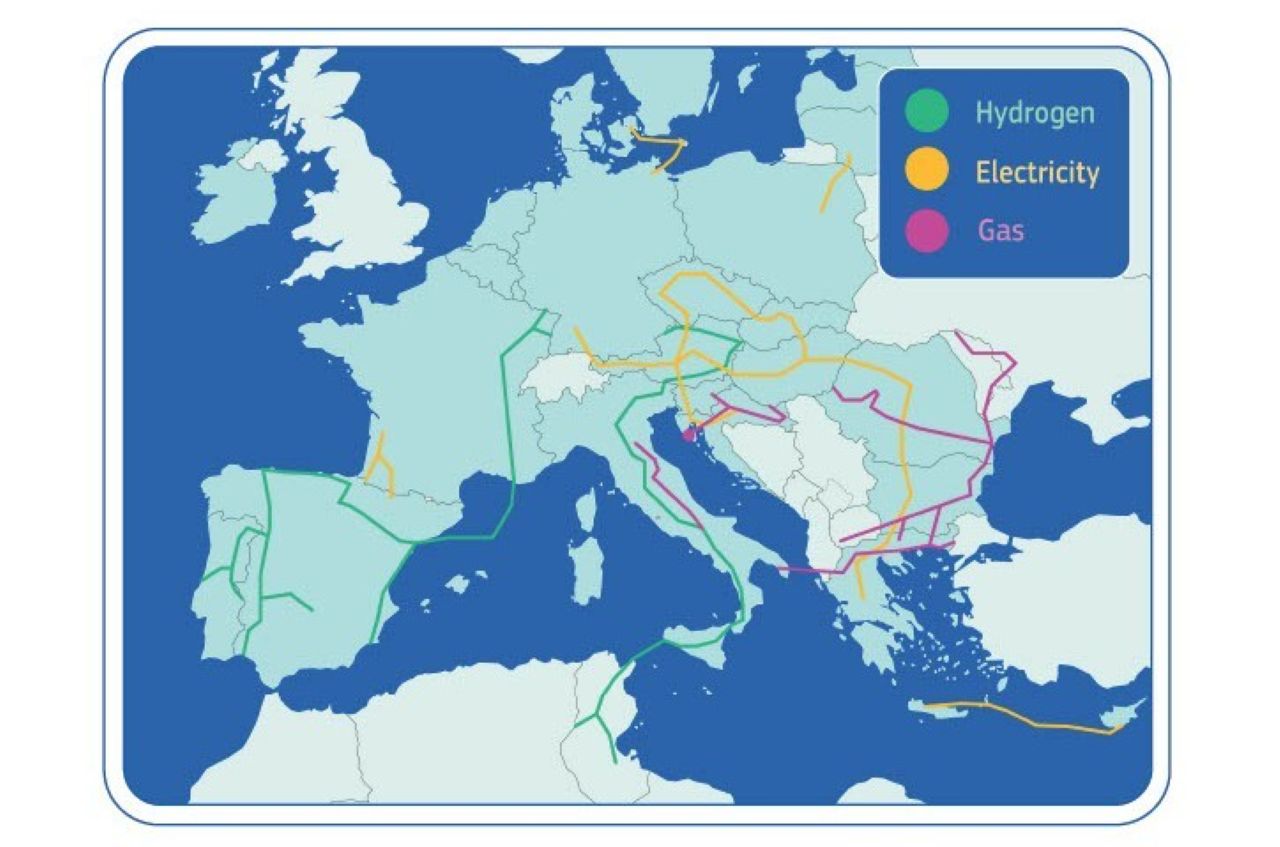
Announced by President Ursula von der Leyen in her State of the Union 2025, the 8 Energy Highways address the most urgent infrastructure needs that require additional short-term support and commitment for implementation. They were selected based on their strategic importance to complete the Energy Union and on the level of political support from the EU needed for their successful implementation.
The Commission is committed to immediately fast-tracking the Energy Highways through enhanced political coordination, drawing on the Regional High-Level Groups, mobilising support of European coordinators and working closely with the Energy Union Task Force, extending outreach beyond EU Member States where necessary. Each project will be prioritised at EU level, and the Commission will support Member States in giving them the same priority nationally.
Next steps
The legislative proposals will now pass to the European Parliament and the Council under the ordinary legislative procedure. In parallel, the Commission will continue collaborating closely with Member States and all relevant stakeholders to implement key cross-border energy infrastructure projects – as recently published under the second Union list on Projects of Common Interest and Projects of Mutual Interest. Such collaboration will be pivotal in view of delivering swiftly on the Energy Highways initiative, as well as on the acceleration of permitting for renewable energy projects, storage projects and recharging stations.
Background
Despite the progress achieved within the current EU legal framework, the EU has not reached the level of interconnectivity among Member States that would enable a genuine Energy Union, as several Member States are not on track to meet the 15% interconnection target by 2030. The cost of inaction is staggering: in 2022, fossil fuels had the largest share of gross available energy use (70%) in the EU, with 98% of all oil and gas used in Member States being imported. This exposes the EU to price volatility and geopolitical risks.
In 2024, industrial electricity prices in the EU reached €0.199 per kWh, compared to €0.082 in China and €0.075 in the US. In the first half of 2025, the average electricity price for EU consumers varied from €0.3835 per kWh in Germany to €0.1040 per kWh in Hungary, while non-household electricity prices ranged from €0.2726 per kWh in Ireland to €0.0804 per kWh in Finland. A key reason for this disparity is the insufficient level of investment in and integration of our infrastructure.
Scaling up financial support is hence key. As part of the 2028-2034 Multi-annual Financial Framework, the Commission proposed a five-fold increase of the CEF Energy budget from €5.84 billion to €29.91 billion. Public funding will be complemented by actions to leverage private investments in the upcoming Clean Energy Investment Strategy.
For more information
- Questions and answers
- Factsheet
- Communication on European Grids Package – Energy – European Commission
- Proposal for revised Trans-European Network for Energy (TEN-E) Regulation – Energy
- Proposal for revised Directive to accelerate permit-granting procedures of infrastructure projects – Energy
- Guidance on efficient grid connections – Energy – European Commission
- Guidance on Contracts for difference – Energy – European Commission
- European grids – European Commission
- PCI interactive map
Quote
The European Grids Package is more than just a policy. It’s our commitment for an inclusive future, where every part of Europe reaps the benefits of the energy revolution: cheaper clean energy, reduced dependence on imported fossil fuels, secure supply and protection against price shocks. It symbolises our determination to overcoming challenges through unity, delivering a true EU response to a challenge of EU importance.
Teresa Ribera, Executive Vice-President for Clean, Just and Competitive Transition
A truly interconnected and integrated energy system is the foundation of a strong and independent Europe. To achieve it, we need an energy infrastructure network of cables, pipes and grids that is up to date, fully interconnected, and that enables clean, affordable, homegrown energy to flow freely and securely to every corner of our Union. This is exactly what we are proposing today: a common European energy project that supports affordable living, economic competitiveness, security and decarbonisation.
Dan Jørgensen, Commissioner for Energy and Housing
Source – EU Commission
Questions and answers on the European Grids Package and the Energy Highways initiative
Brussels, 10 December 2025
Why is the Commission presenting a specific initiative on grids and interconnectors?
Europe faces unprecedented challenges to its security and competitiveness, while feeling the impact of climate change. Affordability of living is a major concern for our citizens and businesses, amid growing geopolitical tensions and trade fluctuations.
Energy infrastructure is the backbone of the energy system, and of Europe itself. Notwithstanding the significant progress made within the current frameworks, there are longstanding obstacles to energy infrastructure development and implementation which are hampering the completion of the Energy Union.
The insufficient integration and underinvestment in our energy infrastructure has a direct impact on energy bills of European citizens. With 98% of all oil and gas used in Member States imported, Europe remains too exposed to price volatility and geopolitical risks.
At the same time, while having one of the most interconnected grids in the world, ageing electricity infrastructure and limited interconnection capacity across Europe create bottlenecks that are holding back fast progress on the clean energy transition and the benefits this transition can bring in terms of affordability and competitiveness.
The Commission is therefore proposing a new approach to energy infrastructure planning and development to tackle the structural challenges of the European energy system. By bringing a truly European perspective to project planning, these proposals will reduce the critical gap between the projects planned and those actually needed to meet our climate and energy goals. It will also ensure that projects are developed faster, with simpler permit-granting procedures, public buy-in, easier access to financing and supply chains and improved security and resilience.
The European Grids Package will enable the EU to deploy the grid capacity needed to unlock significant economic benefits for consumers and businesses, making the EU economy more competitive while progressing on decarbonisation.
These measures follow up on the objectives of the Affordable Energy Action Plan to reduce energy costs and the REPowerEU goal to end the dependence on Russian fossil fuels.
How will this initiative help to complete the Energy Union and benefit European industry and consumers?
The European Grids Package and the Energy Highways initiative address structural issues in EU energy infrastructure planning and implementation, and will support the completion of the Energy Union by ensuring that infrastructure needs are matched by concrete projects happening on the ground.
First of all, these proposals will ensure that Europe maximises the use of existing infrastructure before investing in new capacity. This is key for achieving the energy transition and stronger energy security in a cost-effective manner. Second, they will allow for a faster and more rational development of the energy infrastructure needed to meet our climate and energy objectives.
The Energy Highways initiative, in particular, will address 8 key bottlenecks across Europe which represent the most urgent energy infrastructure needs. By supporting the concrete implementation of projects on the ground, it will enhance overall security of supply, help integrate more renewables into the system, reduce reliance on fossil fuels, thus decreasing energy prices.
The package includes proposals to create a more robust process for cross-border energy infrastructure planning, speed up permitting, ensure more effective mechanisms to share the costs and benefits of cross-border projects, as well as making cross-border infrastructure more resilient and secure.
Taken altogether, these proposals support the development of renewables and clean energy in the EU energy system and help move closer to completing our internal energy market. In turn, this would make energy more affordable and more secure.
Grid development can deliver real added value and cost savings for Europeans: investing €5 billion would reduce system costs by €8 billion, creating a net economic gain of €3 billion. Enhanced market integration could lead to annual cost savings of €40 billion, while boosting cross-border electricity trade by 50% could raise annual EU GDP growth by around €18 billion by 2030.
How will the proposals make the European energy system more resilient?
The rationale behind the European Grids Package is to create a better-connected Europe-wide energy network, reinforcing Europe’s strategic autonomy, security, and resilience, while reducing dependence on imports.
The Package proposes to simplify the process for selecting Projects of Common Interest (PCIs) and Projects of Mutual Interest (PMIs). It also proposes to include projects that make infrastructure smarter and include security upgrades under the Trans-European Networks for Energy Regulation (TEN-E) infrastructure categories, enabling these projects to benefit from EU financial support from the Connecting Europe Facility (CEF).
By increasing interconnectivity across Member States overall, we strengthen the system’s ability to handle shocks, stabilise prices, ensure security of supply, and instil solidarity, particularly during crises.
The Package also strengthens physical and cyber-security of cross-border infrastructure by integrating security considerations early in project planning. It promotes resilience by design, improving transparency regarding ownership to avoid dependencies on unreliable foreign actors and providing support to security upgrades for existing assets.
What are the investment needs for the EU’s energy network as we move towards climate neutrality in 2050? How will the EU contribute?
The Commission estimates that €1.2 trillion will be needed in EU’s electricity grids until 2040, including €730 billion for distribution grids alone, and €240 billion for hydrogen networks. Significant investments are therefore needed to ensure that our grids are fit for the future and achieve climate neutrality by 2050.
As grid infrastructure is mainly financed through tariffs, this poses a challenge for consumers in the short term as they have to bear part of the costs. To address this, Europe is scaling up financial support for energy infrastructure under its proposal for the next long-term EU budget, the Multiannual Financial Framework, which would include a significantly reinforced Connecting Europe Facility.
The current EU long-term budget (2021–2027) already supports energy networks, with the Connecting Europe Facility providing €5.8 billion for cross-border projects. As part of the 2028-2034 Multi-annual Financial Framework, the Commission proposed a five-fold increase of the CEF- Energy budget, from €5.8 billion to €29.91 billion. Domestic grid projects will be eligible for funding under the National and Regional Partnerships Plans and the European Competitiveness Fund.
The European Investment Bank (EIB) is also a key partner in accelerating the rollout of cost-effective grids. The EIB has introduced a counter-guarantee of €1.5 billion to boost EU manufacturing capacity for grid components.
Private investments will also have a key role to play. The upcoming Clean Energy Investment Strategy for Europe, which the Commission intends to put forward next year, will also outline concrete ways to remove barriers and unlock private capital for strategic energy transition investments, such as grids.
How does the Commission propose to have more coordinated planning for Europe’s energy infrastructure?
The Package proposes an EU cross-border energy infrastructure planning process that enables more coordinated identification of needs, ensuring projects are aligned with both current and future European objectives.
To achieve this, the Commission will develop a comprehensive central EU scenario that is cost-effective and that can help to deliver on the EU energy and climate targets. This scenario will be developed every 4 years with the possibility to be updated in case of need. It will be based on input from Member States and the stakeholders concerned and will serve as the basis for energy system operators (European Network Transmission System Operators – ENTSOs and European Network of Network Operators for Hydrogen-ENNOH) to identify the infrastructure capacity needs across the EU. This assessment will also rely on a set of binding principles established in the TEN-E Regulation and a methodology provided by ACER. This approach will support a more rigorous selection of projects that best respond to identified needs and ensures well-coordinated planning at EU level, hence avoiding waste of resources in unnecessary projects.
How will the Commission ensure that there are no gaps in EU cross-border energy infrastructure?
The current grid planning framework developed under the TEN-E Regulation has significantly advanced the coordination and development of cross-border energy infrastructure projects. However, some remaining gaps have been identified, and the existing processes fail to ensure that they are matched with possible projects. For example, ENTSO-E estimates that around half of cross-border electricity needs (41 GW) remain unaddressed by 2030.
To address this, the European Grids Package proposes a new “gap filling” process for the electricity system to be activated by the Commission when when there is an identified need for cross-border capacity that has not yet been met by suitable project proposals.
The process will be steered by the European Commission and triggered only when necessary. The exercise will require strong regional cooperation between the Member States involved.
As a first step, the Commission would invite system operators, and project promoters in some cases, to propose projects that address unmatched infrastructure needs. These would be assessed and discussed at regional level before including them in the transmission operators’ Ten-Year Network Development Plan (TYNDP). If this process does not lead to the identification of a suitable project, the Commission can launch a call for proposals open to any party.
How is the Commission making it faster to grant permits for energy infrastructure and renewable generation projects?
Slow permitting remains one of the most significant barriers to timely deployment of energy infrastructure and generation facilities in the EU. Despite important steps having been taken at EU level in recent years, permitting still accounts for more than half of the total implementation time of electricity Projects of Common Interest and takes on average 5 years for transmission grids, and up to 9 years for renewable energy projects.
The European Grids Package, in coordination with the EU regulatory framework on environmental protection, establishes an EU level framework to simplify and accelerate permitting procedures for all grid infrastructure, renewable energy projects, storage projects and recharging stations. For the first time, it proposes to introduce time limits for the permitting process for all infrastructure projects, storage and recharging stations and further simplifies permitting for small-scale renewable, storage and recharging stations projects. It also ensures processes are fully digitalised and national authorities well-equipped to handle requests effectively.
Furthermore, it introduces a rebuttable presumption that electricity infrastructure is of overriding public, and it streamlines environmental assessments for electricity PCIs and PMIs as well as project types which have lower environmental impacts, such as repowering of wind turbines and refurbishment of grids. It also introduces tacit approval if permitting authorities do not reply by the permitting deadlines. It strikes a balance between the need to protect biodiversity, nature and landscapes while at the same time ensuring the necessary swift transition to a decarbonised energy system and benefit sharing with citizens and local communities.
How will this proposal ensure public acceptance for energy infrastructure development and fair cost-sharing for cross-border projects?
Public participation in project planning, and operation is essential for building trust and achieving EU targets, minimising the risk lengthy judicial challenges. The Grids Package proposes that renewable energy projects over 10MW share benefits with the local population.
It also allows for independent facilitators to support early dialogue and mediation, further reducing the risk of judicial challenges and fostering cooperative development. To address public acceptance concerns, the Commission will also offer a practical toolbox on public inclusion early next year which will facilitate the sharing of good practices on how to involve citizens and promote benefit sharing of renewable energy projects.
Cross-border projects create benefits that extend beyond the host Member States. This package further unlocks this potential by introducing appropriate solutions to distribute costs fairly and equitably, and to avoid disproportionate burdens on local consumers. This is key to enable the necessary cross-border infrastructure development, while maintaining public support.
To achieve this, the European Grids Package includes several proposals:
- First, it aims to provide more transparency and predictability in the way costs and benefits are assessed and shared. This includes more transparency on the benefits offered by the projects, also beyond the host countries and establishing EU-wide principles for a fair and predictable cross-border cost-allocation process.
- Second, it proposes voluntary bundling of cross-border PCIs and PMIs to enable and encourage cost-sharing discussions amongst the Member States concerned and non-EU countries.
- Third, it includes new rules on the use of congestion income – that is the income generated when there is insufficient capacity to couple demand and supply in connected market areas – for financing cross-border electricity infrastructure (PCIs and PMIs) as an incentive to cost-sharing.
By facilitating transparent and equitable cost-sharing, this proposal will allow citizens to fully benefit from the positive impacts of enhanced grid capacity and integrated markets—such as improved price stability, reduced energy costs, and increased security of supply.
How will the Package make access to grids more efficient?
The Package includes guidance on timely and efficient grid connections, with a series of measures offering solutions on coordinated network planning involving society and industry, more efficient use of existing grids, including through network tariffs, connection charges or flexibility, and, finally, transparency of grid hosting capacity and connection procedures.
It presents ways for countries to depart from the ‘first-come first-served’ principle for grid connection requests and, instead, ensure timely and non-discriminatory access to the grid in a way that embraces social acceptance and industrial competitiveness.
What are the “Energy Highways” and how will the Commission support the completion of these projects?
The Energy Highways are key strategic interconnections that will support the completion of the Energy Union by addressing critical bottlenecks in the EU’s energy system.
The initiative was first announced by President von der Leyen in the State of the Union 2025. These projects were identified as key cross-border energy infrastructure under the TEN-E framework, namely Projects of Common Interest (PCIs) and Projects of Mutual Interest (PMIs), as the Affordable Energy Action Plan.
With critical EU support, these projects can improve energy security, reduce dependence on imported fuels and help to integrate more clean energy, hereby helping to lower energy prices.
The Commission will fast-track the Energy Highways with targeted support for the Member States concerned and the project promoters involved, including leveraging financing and measures to further streamline and accelerate permit-granting processes to help bring the projects to a successful conclusion.
These are not the only projects the EU supports and promotes. The core of grids deployment in Europe remains the PCIs and PMIs. On December 2nd, the Commission published the second list of PCIs and PMIs projects which are key to increase EU’s competitiveness, decarbonisation, and enhancing Europe’s energy security and independence.
The 8 Energy Highways are:
- Iberian Peninsula: Electricity interconnections across the Pyreneans to better integrate the Iberian Peninsula (Pyrenean crossing 1 and Pyrenean crossing 2).
- Great Sea Interconnector: Ending electricity isolation by connecting electricity between Cyprus and continental Europe.
- Harmony Link: Strengthening electricity interconnection of the Baltic States, boosting energy security and energy independence from Russia.
- TransBalkan Pipeline (TBP): reverse gas flow to increase the resilience of energy supplies in the Balkan region and eastern neighbourhood.
- Bornholm Energy Island: Transforming the Baltic Sea into an offshore interconnector hub.
- South-East Europe: Improve price stability and energy security in southeastern Europe, including through storage.
- SouthH2 Corridor: The South hydrogen corridor involving Tunisia, Italy, Austria and Germany.
- Southwest hydrogen corridor: from Portugal to Germany
Source – EU Commission
Remarks by Executive Vice-President Ribera and Commissioner Jørgensen at the Press conference on the European Grids package
Brussels, 10 December 2025
“Check against delivery”
Executive Vice-President Ribera
Today, Commissioner Jorgensen and I are presenting to you the European grids package, adopted today by College. We think that this is a package that would allow Europeans to experience much more stable energy prices, lower bills, and greater security.
These Grids, hydrogen and carbon networks, long awaited by many, are more than just steel and cables. They symbolise to what extent we need to be much more united, much more resilience.
They are the missing links to overcome geographical constraints and to allow businesses to compete on equal terms across the Single Market benefitting from the capacity to develop home-grown energy everywhere.
We said since the very beginning that Europe cannot be competitive, resilient or fair without a clean interconnected energy system.
With the list of 235 Projects of Common Interest adopted last week we are building Europe’s electricity, hydrogen and CO2 backbone.
We want to put an end to the energy isolation in different Member States.
Our grids channel affordable energy directly to where it’s needed most, reducing costs for consumers and businesses.
We say that we have entered in the new Age of Electricity and in this age, our grids pave the way for integration of more renewables and support the electrification of our economy, accelerating our shift away from fossil fuels.
By further connecting national grids, we enhance resilience across borders, allowing national systems to mutually support each other.
We are moving from fragmented national plans to a unified EU planning that defines the grid infrastructure needed to deliver on our Energy Union; introducing a cross-border cost allocation mechanism; and
facilitating channels to ensure that we can address the congestion revenues into the deployment of grids to relieve such bottlenecks already identified.
We are embedding resilience by design to ensure our infrastructure can face climate, cyber and physical threats, and accelerating permitting so that we can reduce significantly the times being dedicated to the implementation of the electricity infrastructure. For transmission grids, this will allow a reduction so we don’t need to wait for around 5 years as it is the case right now.
The package brings permitting acceleration measures as it will be explained. We know that while speed is crucial, maintaining a balanced approach is key and that is what it is reflected in the package. This Grids Package is more than just a policy — it’s a commitment for a stronger, interconnected and sustainable Europe.
***
EU Commissioner Jørgensen
Imagine trying to piece together a puzzle, without looking at the box with the picture.
Well, to some extent, that is what we are actually doing right now with Europe’s energy infrastructure.
At the moment, we take a bottom-up approach to planning: we add and align national plans and sectoral strategies, missing a truly European and cross-sector perspective.
Add to that a number of fundamental challenges.
We are not rolling out our grids fast enough.
If we don’t speed up, in 2030 we will lack approximately half of the EU’s new cross border capacity that is needed.
The average implementation time of a transmission grid project is more than 10 years, of which more than half is devoted to permitting. That is way too long. And we need to that to fundamentally change.
Also: We need to step up our security and resilience. Because our strategic connections have also become strategic targets.
In 2022 alone, Europe’s energy infrastructure was hit by 48 successful cyber-attacks.
And we saw it in Russia’s sabotage of Estlink 2 last year.
So at this defining moment for Europe, these are definitely costs we cannot afford. These are challenges we need to solve.
The bottom line is this: if we want a Europe that is clean, competitive, and independent, we need our energy infrastructure to be stronger, more secure, and more connected.
Today, we set out to connect Europe at a speed and a scale that has never been seen before.
First step: we identify and work to advance our 8 Energy Highways – from the Baltic Sea to Cyprus; from South Eastern Europe to the Iberian Peninsula.
These are some of the areas that present significant bottlenecks, holding back the flow of clean and cheap energy throughout our Union.
By progressing with these eight strategic links, we will open a new era of energy independence for Europe, while helping to lower energy prices.
Second: We propose a new way to map and plan our infrastructure.
According to a recent study, more than €560 billion could be saved in the period up to 2050 if Member States coordinate infrastructure planning across sectors and countries better.
Therefore, we propose that the European Commission develops a central scenario for our energy networks: identifying what we need, where we need it, and when we need it. This is how we can deliver.
Yes, this entails more power to the EU. But it is important to say that this is not a zero sum game.
By giving the EU more competences to coordinate and facilitate, we also empower Member States to do what is necessary for them.
And by working together on the basis of a single European map that integrates all sectors, we secure the most rational planning for our entire Union.
In this way, we can deliver cohesive network planning in the most logical and cost-effective way.
But planning is not enough, important as it is. We also need to speed up.
Permitting processes shouldn’t last more than two years, with a maximum of three years for the most complex projects.
Today they are most often much longer. More than five years is not uncommon. Even more than a decade happens.
We will therefore accelerate and simplify procedures for all grid infrastructure, renewable energy projects, storage projects, and recharging stations.
This will be done in a way that does not compromise on environmental protection.
Today, sometimes the green transmission faces opposition from local communities, who can feel excluded from decisions that impact their daily lives and localities.
It is vital to make sure that these communities are fully on board with energy projects for the clean transition.
Public participation and benefit sharing is key for acceptance: projects must benefit local citizens as much as the project investors.
Therefore, we introduce a new obligation for Member States to ensure that a share of the benefits of renewable projects is passed on to local citizens and communities in proximity of the project.
Finally, let me underline that this is also about the security of our infrastructure.
To counter rising threats to our strategic connections, we propose that greater security considerations are fully integrated into the design, approval, and monitoring of cross-border projects.
So, all in all, today I’m proud to say that we embark on a new phase of our common European project.
We are on the threshold of a clean, competitive, and independent future – achieved by ourselves, for ourselves.
It is time to step forward, complete our connection, and unleash the full potential of a true Energy Union.
Thank you.
Source – EU Commission