
Brussels, 27 October 2026
On Tuesday, the European Commission has proposed to further strengthen Frontex, reinforcing its capacity to protect the external borders and turning it into the EU’s central actor for returns.
The EU has made significant progress on migration: illegal border crossings have more than halved over the past two years, and the return rate increased to now over 30 percent. Yet, our common external borders are put to the test by a changed geopolitical and security environment, requiring a stronger and more effective European response.
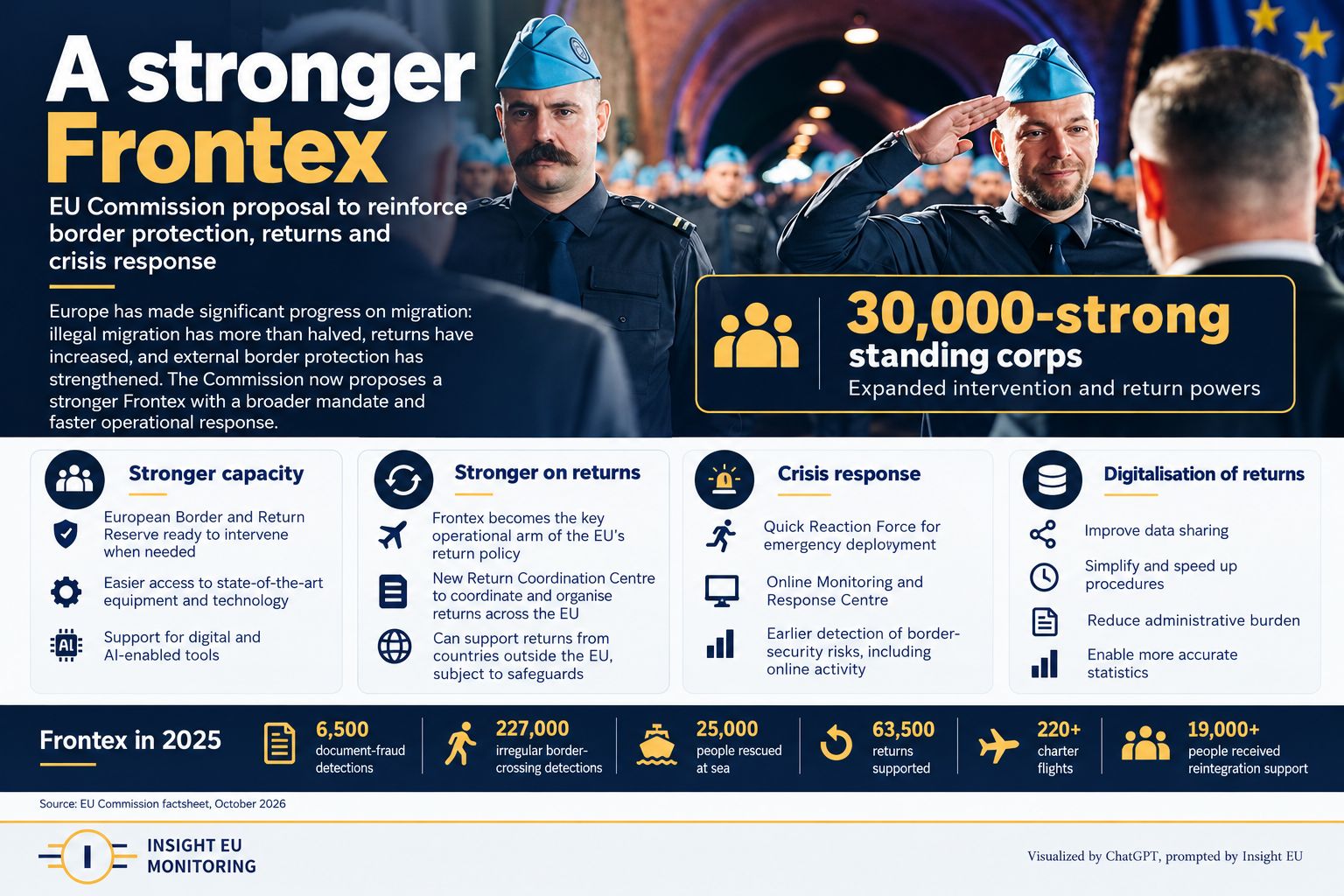
Frontex already plays a critical role in supporting Member States in managing Europe’s external borders and safeguarding the Schengen area. The new rules will build on this role, by further strengthening the Agency’s mandate, enabling it to act more quickly and effectively – and making it easier for Member States to make full use of its tools and services. Key novelties include: a reinforced Standing Corps, including a new European Border and Return Reserve, a Quick Reaction Force to intervene in crisis situations, and a new Online Monitoring Centre for the early detection of potential threats to our borders. Frontex will have a dedicated Return Coordination Centre and it will now be able to help carry out returns from third countries.
Ursula von der Leyen, President of the European Commission, said: “Europe will always stand up for the protection of its borders. Europe decides who comes to our Union and under what circumstances. This is why today we propose to strengthen Frontex. So, it can support Member States whenever and wherever needed. Including on returns, with the mandate and capabilities that this new reality demands.”
To operationalise the new EU rules on returns, the Commission is also proposing today a Regulation to digitalise return, readmission and reintegration. This will simplify and accelerate the management of returns across the EU, reducing administrative burden and providing a single digital interface for the entire return process.
Today’s proposals are delivering on the commitments announced in the 2024-2029 political guidelines and reiterated by President von der Leyen in her State of the Union address this year, to reinforce Frontex, and especially to speed up returns.
A new Frontex Regulation
Member States are primarily in charge of border protection and to return persons without the right to stay. Today’s proposal will ensure a 360-degree approach for Frontex to assist them in that responsibility: Frontex will be able to anticipate challenges faster and provide tailor-made support to Member States where and when they need it. The Regulation sets out three priorities:
Pooled resources and operational capabilities: Frontex pools resources, expertise and operational capacity that no single Member State could sustain alone. To ensure a consistent high standard of border control across the Union, the Commission proposes to:
Gradually increase Frontex’s standing corps to 30,000 officers by creating a new ‘European border and return reserve’ of 17,000 officers who will remain at the disposal of Member States and can be deployed when needed. This comes in addition to doubling Frontex’s own staff and the already existing 7,000 staff seconded from Member States.
Easier access to state-of-the-art equipment and technology. Frontex will be able to acquire, lease and co-own equipment and to carry out, coordinate or participate in joint procurement with Member States. Frontex will be able to act as a central purchasing body, also for digital and AI-enabled tools.
Stronger on returns: Frontex will have a more proactive and strategic role to steer EU-wide return operations, maximising the effectiveness and cost-efficiency of its support, with:
A dedicated Return Coordination Centre to collect and analyse operational information and support planning and coordination. Frontex’s support will cover the full spectrum of the return process, from early identification and voluntary return counselling to carrying out return operations and providing reintegration assistance.
Enabling Frontex to support third countries on returns, both for technical and operational support. Frontex will be able to help organising and carrying out return operations from one third country to another, subject to the conclusion of an agreement with the third country concerned, in compliance with fundamental rights and international standards.
Effective crisis response: Frontex will be able to help detect dangerous trends early and to intervene quickly when there is an emergency or a crisis. This comes also as a lesson learned from this years’ crisis in Ceuta.
A dedicated Online Monitoring and Response Centre with the explicit mandate for Frontex to monitor publicly accessible social media content, detect developments relevant for external border management, and support action against illegal online content linked to border-security risks.
A Quick Reaction Force to be deployed at the external border at very short notice to assist Member States to swiftly address any crisis and emergency at the external borders. The decision to deploy can be taken by Frontex’s Executive Director following a request by a Member State facing an emergency situation.
Improving information exchange in crisis situations, including with an obligation for Member States to report events with potential significant impact on EU borders within 24 hours in the dedicated EUROSUR network.
Digitalisation of returns
Alongside the Frontex Regulation proposal, and following the entry into force of the new Return Regulation on 16 October, the Commission is proposing a new Regulation to digitalise return, readmission and reintegration procedures across the EU. The aim is to modernise the handling of return cases, simplify and speed up administrative procedures through digitalisation, reduce administrative burden, and improve data collection and sharing.
The new rules will also strengthen Frontex’s role in developing a new EU digital architecture for the Member States, and support the new Return Regulation, complying with data protection standards and fundamental rights.
Next steps
It is now for the European Parliament and the Council to agree on the proposals. The Commission will support co-legislators to advance on negotiations for both Regulations.
Background
The European Border and Coast Guard Agency (Frontex) is a decentralised agency that since 2005 supports EU Member States and Schengen-associated countries in the management of the EU’s external borders and the fight against cross-border crime, as well as in the return of non-EU nationals with no right to stay in the EU. Frontex also plays a key role in search and rescue operations, supporting Member States in saving lives at sea.
The current Frontex Regulation entered into force in 2019. Since then, the role of Frontex has continuously grown, in view of the unprecedented challenges from the COVID-19 pandemic, Russia’s war of aggression against Ukraine and the migration weaponisation attempts at the EU’s external borders.
Effective European integrated border management and an efficient return policy are mutually reinforcing and central for the Schengen area. Frontex continuously engages in capacity-building, sharing intelligence and expertise with all Member States and with neighbouring non-EU countries affected by migratory trends and cross-border crime. Always in full respect of fundamental rights and human dignity, which are built into the Frontex mandate and operations.
For more information
- Questions and answers
- Factsheet
- Regulation amending the European Border and Coast Guard Regulation
- Regulation on Digitalisation of case management in the area of return, readmission and reintegration
Quote(s)
Europe will always stand up for the protection of its borders. Europe decides who comes to our Union and under what circumstances. This is why today we propose to strengthen Frontex. So, it can support Member States whenever and wherever needed. Including on returns, with the mandate and capabilities that this new reality demands.
Ursula von der Leyen, President of the European Commission
The EU security depends on our ability to act together, protect our external borders and invest in the capabilities we need to respond to fast-changing threats. A stronger Frontex, with the right tools and robust governance will help make the European Union more secure, more resilient and better equipped for the challenges of tomorrow.
Henna Virkkunen, Executive Vice-President for Tech Sovereignty, Security and Democracy
Our new migration policy is working: illegal border crossings are down, security threats are being stopped at our external borders and returns are increasing. But good policy never stands still. Today we propose that Frontex becomes the central EU actor on returns. In addition, it will be able to act faster. With a quick reaction force that can deploy within 24 hours and spot risks early, before an event becomes a crisis. And finally, Frontex will be stronger, better equipped and organised.
Magnus Brunner, Commissioner for Internal Affairs and Migration
Source – EU Commission
Questions and answers on the Commission proposal to reinforce Frontex: stronger border protection, a greater role on returns and more effective crisis response
Brussels, 27 October 2026
What is the role of Frontex?
Since its creation in 2005, Frontex supports EU Member States and Schengen-Associated countries in the management of the EU’s external borders and the fight against cross-border crime, as well as in the return of non-EU nationals with no right to stay in the EU.
Frontex’ Standing Corps is composed of Frontex personnel and officers seconded from EU Member States and Schengen-Associated Countries.
From its headquarters in Warsaw, Frontex shares expertise with Member States, Schengen Associated Countries and neighbouring non-EU countries affected by migratory trends and cross-border crime. Through the European Border Surveillance System – EUROSUR, Frontex helps monitor the EU’s external borders by collecting and sharing information from national authorities and, where needed, using its own surveillance tools, including aircraft and other technologies.
Frontex also supports Member States in returning people who have no legal right to stay in the EU, from organising return flights, providing return counselling and helping with reintegration through the EU Reintegration Programme.
In addition, Frontex provides support to Member States on the Entry-Exit System (EES) with operational assistance and deployment of standing corps officers. Frontex manages the European Travel Information and Authorisation System (ETIAS) Central Unit, which once operational, will review pre-travel applications for visa-exempt travellers.
With today’s proposal, the Commission aims to further strengthen Frontex both when it comes to border protection and to support Member States on returns.
The Commission is also proposing today a regulation to digitalise return, readmission and reintegration procedures.
Will these operational changes require additional funding for Frontex?
Frontex is currently allocated almost €6 billion budget in the 2021-2027 Multiannual Financial Framework. Today’s proposal brings an ambitious set of objectives to further strengthen Frontex, which require adequate financial resources.
Today’s proposal is in line with the Commission proposal for the Frontex budget in the next Multiannual Financial Framework (MFF) 2028-2034 (€11.8 billion).
Other elements may be covered from other sources in the EU budget, such as the Border Management and Visa Instrument (BMVI).
How will the standing corps increase?
The role of Frontex needs to further evolve, also in view of a changed geopolitical and security landscape and in the face of unprecedented challenges such as migration weaponisation attempts at the EU’ external border.
Increasing the standing corps will be a gradual process. Frontex has currently almost 3,000 staff members who work for the Agency and by 2027 its standing corps will reach 10,000 officers.
The new standing corps will consist of two new elements: (1) The Commission proposes to gradually double Frontex’s own staff to 6,000. (2) A new European Border and Return Reserve will be created, which will reach 17,000 officers. Officers of this European Border and Return Reserve will remain at the disposal of Member States, working as national border guards, and can be deployed to Frontex when the need for their deployment at the external borders arises. They will receive comprehensive training by Frontex. They come in addition to 3) 7,000 officers seconded from Member States to the Agency. Both Frontex own staff and the new European Border and Return Reserve will be increased gradually over the next two MFF periods until 2041.
What is the new Return Coordination Centre?
The new Return Coordination Centre is one of the key elements that will make Frontex the EU’s operational arm on returns. It will allow Frontex to proactively coordinate and organise returns across the EU, always in line with Member States’ needs when it comes to return operations.
This Centre will collect and analyse data on return and reintegration from the Member States, enabling Frontex to provide a better forecast on return needs and strategically organise its resources to support Member States. In practice, Member States will inform Frontex every year by 1 November of their indicative planning as regards return, and their needs for assistance by Frontex. This new process will maximise efficiency and support the coherent implementation of the Common European system for returns.
The Centre’s role will be enhanced also by the implementation of the digitalisation of return process, and use of the relevant digital tools and systems, in close cooperation with eu-LISA and the Member States.
How would the proposal strengthen Frontex’s cooperation with third countries in the area of return?
Today, Frontex can provide technical assistance to third countries, mainly through training and capacity building on the basis of working arrangements.
The proposal introduces a possibility for Frontex to also organise and carry out returns from non-EU countries to other non-EU countries.
The proposal sets out specific conditions and safeguards as well as the type of activities that could be carried out, specific to the situation of the partner country.
For Frontex to be able to carry out returns from non-EU countries to other non-EU countries, a specific agreement needs to be concluded at EU level. These activities need to respect fundamental rights and the principle of non-refoulement.
How will Frontex ensure the respect of fundamental rights in border management?
Frontex has a clearly defined system to guarantee respect for fundamental rights in the context of its operations. Respect for fundamental rights and human dignity is built into its mandate, operational planning and daily activities.
All Frontex officers are trained before deployment, including on fundamental rights, the protection of vulnerable people, and the proportional use of force. The Fundamental Rights Monitors are deployed to operational areas to assess and ensure compliance with fundamental rights in border management and returns.
There are also clear accountability mechanisms. Every officer has a duty to report suspected violations. Individuals can submit complaints directly through the Frontex complaints mechanism. Allegations are examined by the Frontex Fundamental Rights Office. Concerns are documented and followed up, with investigations into serious incidents.
The new rules are also aligned with the legal context set by the Pact on Migration and Asylum. To monitor the respect of fundamental rights during screening and border procedures, Member States must set up independent monitoring mechanisms at the EU external borders.
In today’s proposal, the respect of fundamental rights is equally enshrined: Frontex will continue to support border management at the EU’s external borders, and work with safeguards and oversight in place under EU law.
What is the EU Reintegration Programme?
Frontex already plays a key role in supporting Member States in providing reintegration support and post-arrival assistance to irregular migrants returning from the EU to their countries of origin through the EU Reintegration Programme (EURP).
The programme offers initial assistance upon arrival in the country of return and support through local reintegration partners around the world, to help them reintegrate into society. Examples of assistance provided include support with starting a small income generating activity, accommodation, medical assistance, job counselling, education, legal services and other.
The EURP operates in over 40 non-EU countries, with almost 58 000 people registered for support since its launch in June 2022, showing how Member States are making greater use of Frontex support for returns.
The EU Reintegration Programme will be developed in line with the expanded Frontex’s mandate on returns.
What will digitalising the return case management mean for Frontex?
The proposed Regulation on digitalising return, readmission and reintegration is a key step to further strengthen the EU’s return policy. The new rules will simplify processing individual cases at national level.
New EU-level systems for readmission and reintegration are created, allowing secure information exchange on identification, travel documents, return operations and post-arrival support.
The new digital case management will leverage existing interoperability tools – such as the Schengen Information System and Eurodac. Member States will be able to access the information stored in the interoperable databases thus improving data sharing, make return procedures more efficient and reduce administrative burden.
Frontex will lead the development of the digital architecture, while eu-LISA, in cooperation with Frontex, will provide the secure communication channel between national authorities.
The recent attempts to destabilise EU external borders showed how essential it is to monitor trends that may affect external border management and migration policy.
The Regulation proposes to improve situational awareness on border and pre-frontier area by stepping up monitoring of the online dimension, including with a new Online Monitoring and Response Centre.
In addition, Frontex will be acting as a trusted flagger under the Digital Services Act, flagging illegal content to online platforms, and requesting national authorities to issue removal orders where appropriate. There is an explicit mandate for Frontex to monitor publicly accessible social media content, detect developments relevant for external border management, and support action against illegal online content linked to border-security risks.
The new centre will also work closely with other relevant EU agencies and bodies to ensure coordinated and complementary action.
What is the role of the Quick Reaction Force?
When facing a situation of crisis, instrumentalisation or force majeure, Member States require fast and efficient support from EU Agencies. With the new Quick Reaction Force, Frontex will be able to provide this support instantly (for instance within 24 hours), whenever a Member State requests its deployment.
Standing corps officers would permanently be ready on standby and can be deployed at short notice to respond to urgent and unforeseen operational needs at EU external borders as well as in third countries where Frontex has operations.
It will be composed of standing corps officers who are equipped and trained to be rapidly deployed at short notice.
Such Quick Reaction Force will be deployed upon Frontex Executive Director’s decision following a Member State request for a time-limited deployment of maximum 1 month. If the situation of crisis continues for more than 1 month, a joint operation or rapid border intervention may be activated, making full use of other already existing mechanisms.
For more information
- Press release
- Factsheet
- Regulation amending the European Border and Coast Guard Regulation
- Regulation on Digitalisation of case management in the area of return, readmission and reintegration
Source – EU Commission
Remarks by Executive Vice-President Virkkunen and Commissioner Brunner on strengthening Frontex and the digitalisation of the return process
Warsaw, 27 October 2026
“Check against delivery”
Executive Vice-President Virkkunen
Good afternoon, ladies and gentlemen and welcome to this press point. We are here together with Magnus to share light on the two important milestones on European border management: a revised Frontex mandate and the digitalisation of returns.
The EU must ensure control of its external borders. A significant progress has been made over last years. The EU has established the world’s most advanced border management system. Illegal border crossings are at their lowest levels since 2021—down 55% over the past two years.
Despite falling crossing numbers, migratory pressure remains. Geopolitical developments, hybrid threats, disinformation campaigns, and cyber-attacks on critical infrastructure continue to test border resilience.
Criminal smuggling networks are growing increasingly professional, adapting rapidly and utilizing new technologies and social media to coordinate unauthorized crossings.
Evolving threats require continuous action. Building on lessons from sudden arrivals like in Ceuta in summer 2026, we prioritize crisis anticipation, prevention, and rapid emergency response.
The Commission proposals open a new era for Frontex, with a revised mandate.
Capitalizing on the momentum of the Pact on Migration and Asylum and the newly adopted Return Regulation, the EU is deploying modern digital tools to ensure stronger coordination and effective returns.
Frontex already plays a critically important role in supporting Member States to manage Europe’s external borders. Under the new rules, its mandate will be further reinforced, enabling it to act faster and more effectively. In addition, we will also make sure that Frontex has state-of-the-art equipment and technology at its disposal.
The proposal also seeks to address political and practical constraints identified in the current system. On border management, Member States need more flexible support, stronger operational capacity, improved planning and better access to equipment and surveillance tools.
The proposal also strengthens operational tools and strategic planning. The proposal also equips Frontex to support Member States in crisis and emergency situations more quickly and more flexibly.
It creates a quick Frontex reaction force, strengthens situational awareness and early warning, upgrades EUROSUR, and broadens the Agency’s role in addressing hybrid threats affecting external borders. This is the concrete operational response to the demand for stronger border preparedness and resilience.
We will also create an Online monitoring and response centre to monitor publicly accessible social media content, detect developments relevant for external border management, and support action against illegal online content linked to border-security risks. Together, these tools significantly improve early warning, preparedness and crisis anticipation.
Let me highlight two elements from online aspects that stand out as major steps forward:
First, the proposal gives Frontex clear legal powers to act when identifying illegal content: through notices to the platforms, and – if designated as such by the competent national authority – as a trusted flagger under the DSA And through requests to competent authorities in a Member State to issue orders a platform to provide information or to act against illegal content.
The DSA enforcement framework remains fully respected: Frontex can act within its mandate on detection and signalling and directly engage with and alert platforms of its findings.
Alongside the Frontex Regulation proposal, and following the entry into force of the new Return Regulation on 16 October, the Commission proposes today a new Regulation to digitalise return, readmission and reintegration procedures across the EU.
We want to modernize the handling of the return cases and speed up administrative processes, as well as improve data collection and data sharing.
New EU-level systems for readmission and reintegration are created, allowing secure information exchange on identification, travel documents, return operations and post-arrival support.
This means establishing a common digital backbone, connecting the relevant authorities, processes and tools.
Frontex will play a key role in the new common digital architecture, which will allow to manage the return process in a more efficient, cost-effective manner, simplifying procedures and reducing administrative burden.
The new reality requires new mandate for Frontex. With these two important proposals, we are significantly strengthening our external borders and support we can offer to the Member States.
The digital dimension is not a technical annex to the Frontex reform – it is one of its main political enablers. If the Union wants secure borders, effective returns and credible crisis response, it needs superior situational awareness, faster information flows, stronger interoperability and better operational data management.
Thank you, now over to Magnus.
***
EU Commissioner Brunner
Ladies and gentlemen,
Let me start by saying what we have already achieved together: Our reforms are delivering. Illegal migration is down. Returns are up. Threats are being stopped at the border.
Our reforms of the Pact on Migration and Asylum, the safe countries of origin list and the safe third country concept and the other reforms are working. And our migration diplomacy is important.
And the numbers prove it. As Henna said, illegal border crossings are down significantly, let me give you some concrete figures: Western Balkans: -95% since 2022, Western African andCentral Mediterranean -80% since 2023.
The new return rules are in force since October 16. And also here, our active migration diplomacy is delivering results. The new Entry/Exit System is a significant boost for our security.
In its first year, MS registered over 250 million entries and exits. It turned away 80,000 people with no right to enter the EU directly at the border, which is 220 people every single day. And most importantly: it stopped 2,000 people who posed a security threat, linked to terrorism or organised crime.
This leads me to today’s proposal.
Because protecting our external borders is a fundamental task for any state. It is a precondition for upholding our freedoms and security, so keeping EU citizens safe, but it is also about strengthening trust between Member States.
We can only uphold our freedoms if we protect our external borders effectively.
That is why today, we propose a stronger Frontex. We must act before an event becomes a crisis; and it must be us to decide who can enter the EU, who can stay, and who must leave. We have built strong foundations. Now we are strengthening Frontex, in three concrete ways.
First, of all, Frontex needs to be faster, more agile and better prepared
So we have to make Frontex ready to act before an event becomes a crisis. We have examples of MS facing exceptional situations: hybrid threats – instrumentalisation of migration – mass illegal arrivals fuelled by smuggling gangs and online disinformation: they have unveiled the limitations in the Frontex mandate, sometimes preventing the agency to offer adequate support in such events.
We need to learn the lesson. Therefore, we propose for Frontex to detect dangerous trends early. For the first time, Frontex will have an explicit mandate to monitor social media for content that endangers people or border security.
Have better access to important information, so we can counter events before they become crises.
And very important: if there is a threat to our borders and therefore our security – there will be a quick reaction force to intervene very quickly: We want Frontex to be there in hours, not in weeks!
We have to be clear: Our migration policy is only credible if we actually enforce it.
Since the start of this mandate, the EU has been working to fix this and to put in place a new common system. And this Return Regulation is in force since 16 October. And Frontex already does a lot and provides significant support in returns:
They carried out nearly 63,500 returns last year, chartered more than 220 flights, and assisted almost 20,000 people in reintegration. But still, we can and must do better at returning those who have no right to stay in the EU.
That is why today, we propose to make Frontex the central EU actor on returns. Frontex will be responsible for return-related support from A to Z: strategic planning, more cost-efficient return, and reintegration.
Today, we also propose a new Regulation to digitalise return. This will reduce paperwork and administrative burden. And we will have a clearer picture of what happens to people staying illegally in the EU. And by the way, we are planning to do the same for our asylum procedures – more on that next year.
But we do not stop there: we are also adding a new tool for our migration diplomacy.
Of course, the main objective for Frontex will still be to increase returns from Member States, but we also introduce the ability for Frontex to support third countries on returns. So: carry out returns from third countries to other third countries.
This will only be possible, if there is an international agreement and where this is in the interest of the EU. And finally, to deliver on all this, Frontex will be stronger, better equipped and better organised.
First, there will be more strategic planning to make sure that Frontex support goes where the Member States need it most.
Second, Frontex will train border guards across all Member States so that our external borders are protected everywhere to the same high standard.
And third, Frontex will support in other areas that are key to our border security. For example, with the new visa support office, it will help Member States tackle issues like document fraud.
So why are we doing all of this? Because our borders face new challenges: orchestrated crossings, instrumentalisation, online disinformation, smuggling networks and changing routes, and hybrid threats. You name it.
No Member State can meet these challenges alone. Our response has to be faster, stronger and better coordinated. That is what we deliver with today’s proposal.
Frontex will be ready to respond before an event becomes a crisis. And it will become the central EU actor on returns. Strong external borders, firm and fair procedures, effective returns. That is how we uphold our freedoms, keep our citizens safe and strengthen trust between Member States.
Source – EU Commission