
Brussels, 30 September 2026
More than five million first responders would gain secure communication across services and borders under the EU Commission’s proposed Critical Communication System. European technology, broadband networks and satellite backup would keep emergency teams connected through major crises and outages. Rollout would begin in 2030, with all Member States connected by 2036, subject to EU Parliament and Council adoption.
Today, the European Commission proposed to establish a new EU Critical Communication System to provide Europe’s first responders with secure and resilient communication channels in crisis situations. Relying on critical components built by European companies, the new system enables seamless and stable real-time communication between all first responders, at all times and across all EU borders, even where terrestrial communication systems are unavailable.
Fires, floods, storms, drone threats to critical infrastructure or terrorist attacks need an effective and well-coordinated response from our police, firefighters, medical services and civil protection teams. Today, their ability to communicate with each other is limited – their communications systems are not connected and stop working when they cross a border. This means that emergency services often cannot communicate with other when they work to rescue people, restore security and public safety in crises and emergencies.
Announced by President von der Leyen in the Political Guidelines, the EU Critical Communication System will address these issues, significantly improving daily operational cooperation in the fight against terrorism and crime, and in saving lives in emergency situations, making the EU a safer place.
The next generation of critical communication for first responders
The European Union Critical Communication System will allow first responders to communicate across services and across borders, and to share photos, videos and sound and communicate in a faster and more secure way, both at national level and across Europe. Notably:
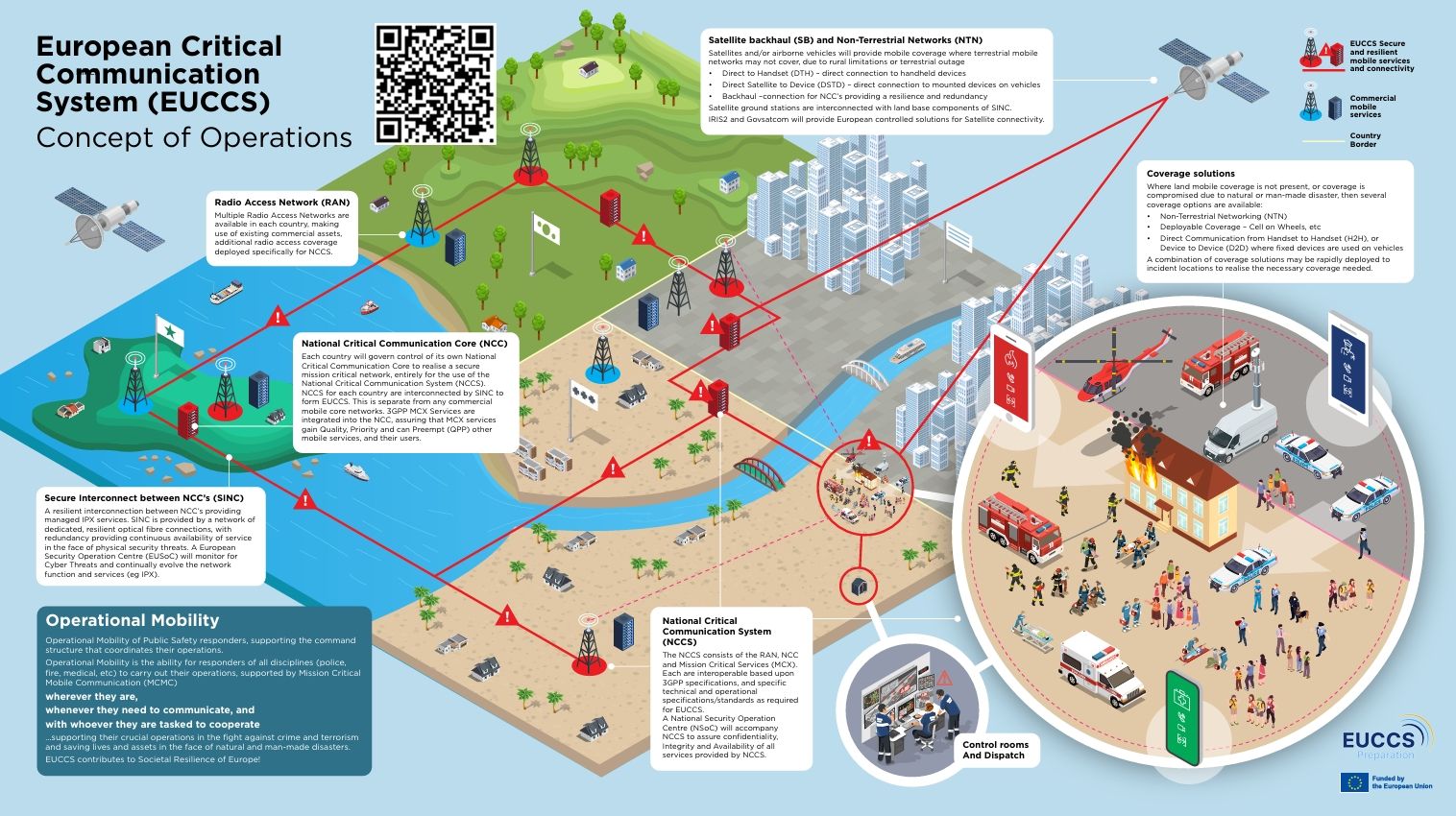
- All Member States will gradually move from narrowband radio systems to broadband technology such as 5G, while EU satellites provide additional back-up for situations when land-bound systems are incapacitated, such as during blackouts.
- The EUCCS will enable first responders to share data, video, messages and geolocation in real-time through a single secure device.
This will improve situational awareness and coordination in case of crises or emergencies.
Security and resilience by design
With emergency events becoming more complex both in nature and scale, this system is designed to remain secure, available and resilient all the time, giving priority to first responders, even when the mobile network is saturated or disrupted. Where no mobile network is available, the system will benefit from the back-up support of EU satellites, as well as from mobile deployable communication units that can restore connectivity for emergency coordination in case of crisis.
The system will be secure, protected against cyber and hybrid attacks using encryption, and a strong protocol. It will be supported by two dedicated entities:
- A European Union Network Monitoring Centre which will provide a secure and resilient optical fibre network, allowing countries to connect through one central point instead of building many separate links with each other.
- A European Union Security Monitoring Centre which will track cyber security risks, assess threats and support Member States.
Reinforcing European strategic autonomy
The proposal provides Member States with a new European-built solution, reducing reliance on foreign technologies and strengthening European tech sovereignty. It puts the EU’s security-by-design approach into practice, ensuring that security is considered from the outset in the systems we develop:
- The system’s critical components (including satellites, the core mobile network, and the mobile broadband technology used) are developed by European companies.
- It makes national investment in critical communication more attractive for Member States, by greatly increasing the reach of the critical communication system from a regional or national tool to one that covers the entire EU and the Schengen Associated Countries and that can serve for coordination across many more services.
- The system is also designed to adapt to the continuous innovation in critical communication and commercial electronic communications. The Commission will support Member States in cooperating with industry and research organisations to ensure the continuous innovation of critical communication in the EU.
While being interconnected at European level, Member States will maintain full control over their national networks and over the governance of the new system, which will be ensured by a Member States’ expert group.
Next steps
It is now for the European Parliament and the Council to adopt the Regulations.
The European Union Critical Communication System is planned to be launched gradually, with a transition period in-built for Member States, starting in 2030.
Background
The EU Critical Communication System was identified as one of the key actions of the European Internal Security Strategy, ProtectEU in April 2025 and the EU Preparedness Union Strategy launched in March 2025. This builds on the recommendations of the Niinistö Report on Preparedness and Readiness of the EU, urging the EU to complete the EU Critical Communication System as soon as possible. This also follows long-standing request from both Member States, as reflected in the Council conclusions of June 2021, and first responders, who need a European critical communication system that works seamlessly across borders.
For more information
- Questions & answers
- Factsheet
- Proposal to establish a European Union Critical Communication System
- European Internal Security Strategy (ProtectEU)
- European Preparedness Union Strategy
- EUCCS
Quote(s)
The European Union Critical Communication System is not just a technological upgrade – it is a vital operational shield. Seamless cooperation requires seamless communication. With the EUCCS, we are making sure our first responders have the tools to share critical data, coordinate real-time instructions, and operate together across borders without interruption, no matter the circumstances.
Henna Virkkunen, Executive Vice-President for Tech Sovereignty, Security and Democracy
Time is precious in a crisis. This summer, I saw firefighters battling flames, protecting communities while every second counted. In those moments, rock-solid communication can save lives. The people who run towards danger must be able to rely on each other, exchange information and stay connected, even when networks go down. With our new Critical Communication System, Europe’s firefighters, police, medics and civil protection teams will have a common secure communication they can count on in any emergency, including across borders. We are helping those who protect us.
Hadja Lahbib, Commissioner for Equality, Preparedness and Crisis Management
Europe’s security depends on our ability to act together. When crisis strikes, our first responders must be able to communicate instantly across agencies, across borders, across Europe. When lives are at stake, Europe must respond as one. Together with European companies we have developed an EU solution, reducing our dependency on foreign technology while reinforcing our resilience against all threats. We protect what matters most — the lives of our citizens – by connecting those who protect us.
Magnus Brunner, Commissioner for Internal Affairs and Migration
Source – EU Commission
EU Commission Questions and answers on the European Union Critical Communication System
Brussels, 30 September 2026
What is the European Union Critical Communication System?
The European Union Critical Communication System (EUCCS) connects national critical communication systems, bringing together different first responders – police, fire departments, emergency medical services and other civil protection organisations – across Member States. It ensures the resilience of the system also in times of crisis by anchoring the principle of priority of critical communications on mobile networks and providing satellite backup where mobile communication is unavailable, by providing a reliable and secure communication system. It allows emergency services and other public authorities to quickly exchange important information, upgrading from voice-only (radio) communication of today to also include text messages, photos, video, geolocation details and other relevant data.
They will better understand what is happening on the ground and can work together hand in hand – nationally and across borders – to save lives.
The EUCCS will cover the whole EU and the Schengen associated countries. It will cover all emergency services: law enforcement, firefighters, civil protection and medical emergency responders. Member States can add further users, notably armed forces, at their own discretion.
The EUCCS builds on ten years of practical experience. It was initiated by the 2015/16 terrorist attacks, when Member States had to grapple with the challenges brought about by separate and incompatible critical communication systems. They launched pilot projects for this system, developed through EU-funded projects and bringing together EU industries and public authorities in an EU solution for EU security.
You can find more information on how the EUCCS will work here.
Why are you proposing this now?
The forest fires of this summer are a stark reminder of the necessity to respond quickly and in coordination, whether the crisis is climate-related, or human-made. Member States will be able to better support one another in times of crisis with the EUCCS.
The EUCCS will allow national agencies covering different services such as police or law enforcement agencies, firefighters, and medical personnel to talk and share data across services and borders without experiencing network disruption. And when first responders go to help in another Member State, they will be able to use their own critical communication service ‘same as home’.
It is one of the key actions of the European Internal Security Strategy, ProtectEU of April 2025 and the EU Preparedness Union Strategy of March 2025. It implements a recommendation of the Niinistö Report on Preparedness and Readiness of the EU, urging the EU to complete the EU Critical Communication System as soon as possible.
This proposal also follows long-standing requests from both Member States – as reflected in the Council conclusions of June 2021 – and of first responders, who need a European critical communication system that works seamlessly across borders.
When can the EUCCS be used?
The EUCCS can be used anytime. It will have multiple applications – from traffic accidents, to natural disasters, a ‘hot pursuit’ across a border, terrorist attacks or drone incidents.
It will allow all emergency services to communicate with each other nationally and across borders and will improve situational awareness and response in crisis.
A pilot version of the system has already been deployed and trialed, mirroring real life situations (for instance fires in border areas, migrant smuggling, and drug smuggling).
The system is designed so that it can also be used by armed forces, should Member States decide to connect their military to the system so that they can coordinate with other emergency services, for example in case of a flood where the military supports rescue efforts alongside civilian services.
How does this improve EU strategic autonomy?
The European Union Critical Communication System reinforces EU strategic autonomy by:
- strengthening critical cyber capacities through encryption, strong protocol and the use of back-up EU satellites, and supporting trusted European technologies;
- reducing dependence on non-EU suppliers (4 EU industrial partners are already involved in the pilot project, with more expected to join in the coming years);
- increasing operational resilience and ensuring continuity during crises, as Member States will be less reliant on external infrastructures and – thanks to network priority, mobile deployable communications units and satellite backup – no longer as vulnerable to network disruptions;
- by harmonising the technological standards, it will create one standard that allows EU companies to build products for the whole EU market, an innovation-friendly environment that encourages European companies to invest in R&D for critical communications and ultimately for EU security.
It deepens the resilience of the Union as a whole by improving communication and cooperation of first responders across borders and agencies using European-made technological solutions.
What are the European Union Network Monitoring Centre and the European Union Security Monitoring Centre?
The EU will set up two central hubs to help link up Member States’ emergency and other critical communication systems more simply and securely.
- A European Union Network Monitoring Centre to oversee whether the system is working properly and is available and reliable. It will host the interconnection between Member States’ national critical communication systems on a secure and resilient optical fibre network, so countries can connect through one central point instead of building many separate links with each other.
- A separate European Union Security Monitoring Centre will analyse cyber and security risks, assess threats and support Member States. It will not directly manage incidents.
How does the system work concretely from a technological perspective?
All Member States will gradually move from narrowband radio systems to broadband technology – Mission Critical Services (MCX).
MCX is a mobile broadband technology that delivers secure, high-priority voice, video and data communications for emergency responders.
Although each European country runs its own emergency communication network, MCX standards make sure these national systems can connect and work together securely as needed. It will make sure that the coverage of commercial mobile networks can be leveraged, while ensuring reliability and priority needed for critical communication.
EU satellite assets will complement the land-based networks and provide additional coverage in remote areas, as well as back-up in case networks are disrupted.
Will the European Union Critical Communication System cooperate with the EU Emergency Response Coordination Centre (ERCC)?
Yes. The ERCC ensures rapid deployment of emergency support and acts as a coordination hub in situations that are not law enforcement related.
When emergency teams are deployed, they often work in different countries together with first responders from other countries.
Currently, they need to find ad-hoc solutions to communicate with each other. With the European Union Critical Communication System, they will be joined up from the get-go when they arrive on the scene.
How do we know whether the technology is operational in real-life situations?
Two trials have already taken place, and more are planned. They are inspired by real-life cases: the European Union Critical Communication System team develops scenarios to test, work on and improve the coordination between the cross-border frontline services.
The objective is to test the collaboration between agencies under pressure, mirroring real-life situations. These real-life trials enabled first responders to test the MCX (Mission Critical Services) technologies, share information, and coordinate simultaneous operations.
When will the EUCCS be operational?
The European Union Critical Communication System will be launched first with a few Member States and then expanded to include the others, reflecting the different stages of transition to broadband communication of Member States’ national critical communication systems. As Member States upgrade their national systems, they can join the EUCCS.
A first group of Member States should connect to the system in 2030, followed by the other Member States in 2033 and 2036, the latter being the final deadline by which all Member States must connect to the EUCCS.
For more information
- Press release
- Factsheet
- Proposal to establish a European Union Critical Communication System
- European Internal Security Strategy (ProtectEU)
- European Preparedness Union Strategy
- EUCCS
Source – EU Commission
Remarks by EU Commission Executive Vice-President Virkkunen and EU Commissioner Brunner on the EU Critical Communication System
Brussels, 30 September 2026
“Check against delivery”
Executive Vice-President Virkkunen:
Good morning, everyone, and welcome to today’s read-out of the College meeting.
Today, we adopted two proposals linked to the establishment of an EU Critical Communication System for first responders.
Today’s proposal is about Europe’s impact in the ground. When Europe faced fire, floods and major security threats, it´s first line responders defended it. Firefighters, doctors, police, entire rescue teams risked their lives so that lives could be saved.
They have done so with the strongest dedication that we could all see. When fire and flood and other disasters are raging we know that time is crucial. Every second counts.
But these heroes are often met with real operational obstacles because natural disasters, major industrial accidents, and security threats do not respect national boundaries. Our immediate operational response cannot afford to either.
When such crises and tragedies occur, we need fast, reliable and secure communication.
While Member States have robust national emergency networks, these systems often stop at the border. This is a critical operational gap when teams are deployed side by side across countries.
This what this proposal is about: We will ensure that our emergency services have the means to exchange critical data and issue real-time operational instructions across borders without interruption. So that they can save lives and have all the support needed.
Concretely – the European Union Critical Communication System, the EUCCS will support more than 5 million first responders across Europe in their daily life-saving work and in major emergency situations.
It will strengthen Europe’s capacity to respond not only to largescale crises or terrorism, but also to everyday incidents: accidents, fires, missing persons cases, and crime.
Our approach is pragmatic: The EU will not create one central system to manage all data. Member States remain fully in control of their own critical communication infrastructures, while ensuring mandatory interoperability at European level. It will include all emergency services.
The system is designed to adapt alongside evolving commercial and critical communication technologies. The Commission will support Member States in cooperating with industry and research organisations to ensure the continuous innovation of critical communication in the EU.
A first group of Member States will begin operations in 2030 and other will follow gradually, with all Member States connected by 2036.
This phased approach reflects the different stages of national transition to broadband critical communications.
EUCCS is built on European-made critical technologies — from satellites to core mobile networks and mobile broadband.
EUCCS is also closely linked to key electronic communications initiatives, including the Digital Networks Act, the MSS Regulation, the Cybersecurity Act 2 and the 5G Toolbox.
We will also align with the EU’s IRIS² programme to leverage secure and reliable satellite connectivity across Europe and beyond.
With EUCCS, our first responders will be able to share data, video, messages and geolocation in real-time through a single secure device.
Thanks to the move to broadband technologies, building on 5G commercial networks, the EUCCS will enable multiple ways to provide critical communication services to Member States.
This means being able to ensure communications when they are most needed, also when terrestrial networks are non-operational.
Satellite communications can fill that gap. It is why we provided that the EUCCS will have access to secure connectivity services provided over satellite.
Europe’s security depends on our ability to act together. When crisis strikes, our first responders must be able to communicate instantly across agencies, across borders, across Europe.
When lives are at stake, Europe must respond as one. We are protecting what matters most — the lives of our citizens — by connecting those who protect us.
Thank you, now over to Magnus.
***
Commissioner Brunner:
Thank you, Henna. Today, we deliver on another proposal that makes our Union stronger. Step by step, we are delivering on our internal security strategy, ProtectEU.
Today, we deliver another key proposal: the EU Critical Communication System. It connects those who protect us.
Wherever there is a crisis, first responders need to have one basic thing: a line of communication.
There are plenty of examples over the last years, where this was not possible.
Take the High Venn fires from this summer: it was in the border region between Belgium and Germany, and the moment a first responder had to cross the border, their radio stopped working.
That is why today’s proposal matters: we are building a common European critical communications system.
It will be seamless, secure and sovereign.
Today’s proposal does two things:
First, it lets first responders share data, video and messages in real time, through a single device.
As in the High Venn this summer, we see wildfires spread across our continent: in Spain, in France, in Greece, in Germany. We already have a system so that firefighters from different countries work together to stop the disaster.
But they still have to look for ad-hoc solutions just to share their location.
With the EUCCS, they share voice, video and position. On one device.
Second, the systems are interconnected.
In February last year, there was a shooting in the Netherlands, 200 meters from the Belgian border.
An active police chase across the border started, where every minute counted. Yet the operational centre in Maastricht could not directly alert its colleagues in Liège, or the Belgian officers on the street.
Cross-border police work is also where the new Europol mandate makes a difference, by supporting Member States.
And the EUCCS gives the officers on the ground the communications to match.
One device. One network. Every agency, every Member State, connected.
A communication system is only as good as its worst day, when everything else is failing.
As Henna mentioned, the EUCCS uses new broadband technology such as 5G, with EU satellites providing back-up where mobile communications are down.
Think of the blackout in Spain and Portugal last year. The lights went out and the phones went dead at the same time.
With the EUCCS, police and emergency services would have stayed connected, because the satellites take over when the ground networks fail.
And we are planning to deploy mobile communications assets – cell towers on a truck, with their own generators – to disaster areas.
Think back to Valencia in 2024. The floods knocked out power and telecommunications, emergency alerts were delayed, and teams from France, Portugal and across Spain arrived with their own equipment, but no common procedures to connect it.
With the EUCCS, this will change.
And we will make sure that the new system is protected against attacks. We will establish two new centres: one to monitor the network, providing one central connection point instead of building many separate links, and one to track cyber security risks and other threats.
This system is built for Europe, by Europe. European companies and technology are building this network, strengthening our autonomy and resilience.
And by setting one standard across our 27 Member States, it creates a genuine market.
That’s what sovereignty looks like in practice – not just protection, but creating a market, jobs and innovation in Europe.
Source – EU Commission
Renew Europe: EU Critical Communication System: Renew Europe backs faster, safer emergency response for all Europeans
September 30, 2026
Renew Europe welcomes the EU Critical Communication System presented today by the European Commission and consider it an essential pillar in reinforcing Europe’s strategic autonomy through advanced, resilient digital infrastructure for emergency response.
Cross-border emergencies demand cross-border solutions. When emergencies strike in our Union, be it forest fires, terror attacks, drones targeting essential infrastructure, every second counts. Renew Europe will, as this legislative initiative reaches Parliament, do our outmost to ensure that the new EU-wide Critical Communication System allows firefighters, emergency medical services and civil protection teams to share critical information faster and more securely, while ensuring that citizens are reached by emergency communication when needed, both at national and European level.
Parliament’s lead negotiator on the Digital Networks Act, Renew Europe’s MEP Michał Kobosko (Unia Centrum/Poland), says:
“With so many hybrid threats, this is a very difficult and challenging moment for Europe. Secure and stable connectivity of critical communication between those who save lives is absolutely crucial. With the system’s critical components based in European companies, our strategic autonomy will be reinforced. Therefore, this Commission project should be considered extremely important and very timely.
As Parliament’s Rapporteur of the Digital Networks Act, I see also a lot of improvements needed as to access to emergency services by EU citizens. Combines, both proposals can make EU safer.”
Source – Renew Europe