
Brussels, 23 November 2026
On Monday, the European Commission has published five roadmaps which outline the key actions that could boost the EU’s preparedness for different health emergencies. The roadmaps identify which medical countermeasures, such as diagnostic tests, vaccines, treatments and personal protective equipment, may be needed in different emergency scenarios, where gaps exist and what actions could improve availability and access, from research and development to production, procurement , stockpiling and deployment.
Commissioner Hadja Lahbib said: “When the next health crisis hits, every day will count. We cannot wait until hospitals are overwhelmed to discover we are short of vaccines, tests or treatments. We need to know what is missing and act now. These roadmaps help us plan ahead and give industry a clear signal of where to invest and ramp up production. Being ready takes all of us working together, long before the first alarm sounds.”
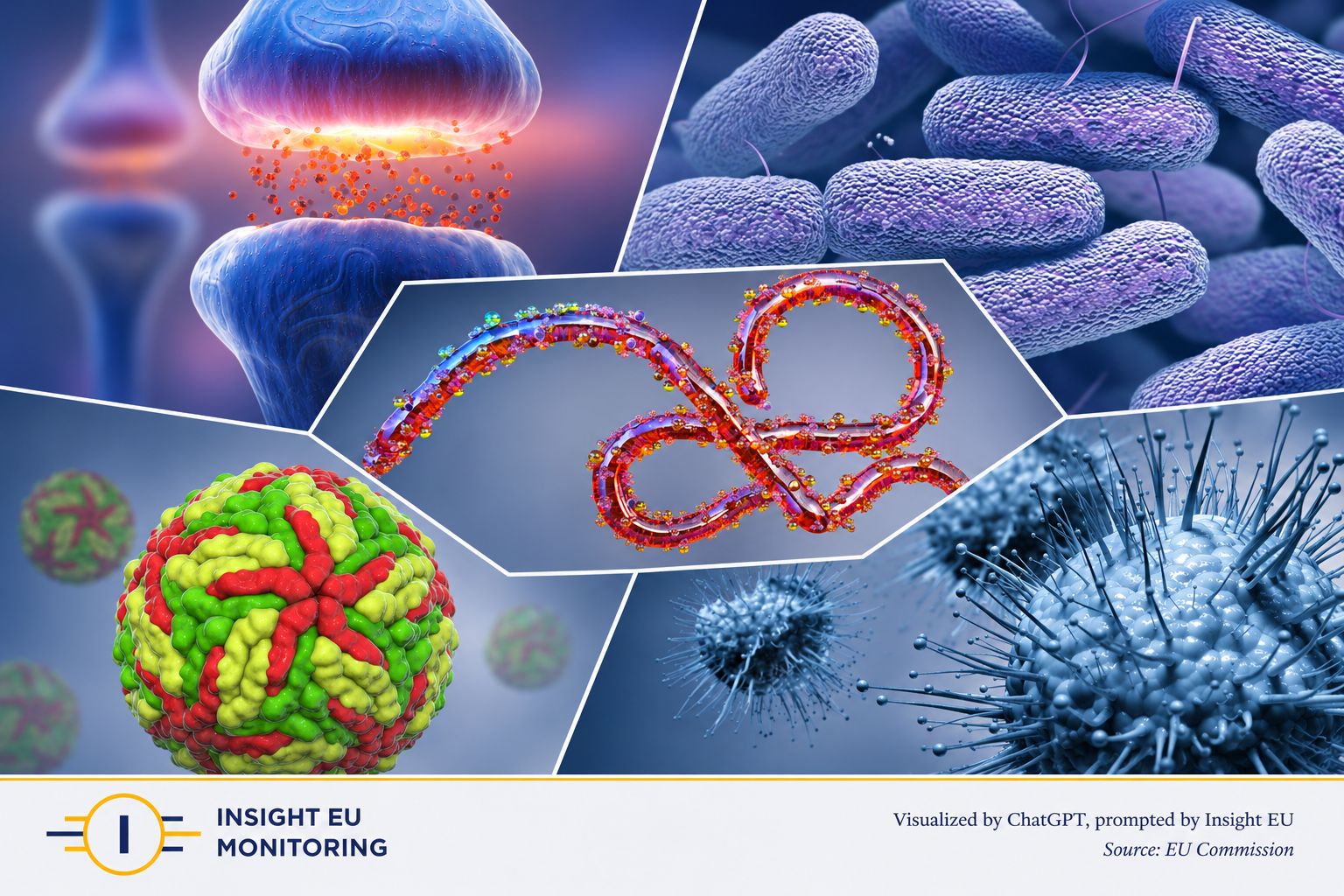
The roadmaps are a key deliverable of the EU Strategy on Medical Countermeasures. They cover five priority threats, each chosen to help prepare for a wider group of threats with similar features. Pandemic influenza serves as a prototype for respiratory threats, Ebola and other filoviruses as a protype for direct-contact threats, dengue as a prototype for mosquito-borne threats, carbapenem-resistant enterobacterales as a protype for antimicrobial resistant bacterial threats, and nerve agents as a prototype for chemical, biological, radiological or nuclear.
Further information and factsheets per roadmap are available on a dedicated website.
MCM Preparedness Roadmaps
As part of the EU strategy on medical countermeasures, the European Commission, through the Health Emergency Preparedness and Response Authority (DG HERA), has worked with a wide array of stakeholders to develop Medical Countermeasure Preparedness Roadmaps for specific health emergency scenarios.
These roadmaps are designed to ensure that Europe is better equipped to anticipate, prevent and respond swiftly and effectively to future health emergencies.
The roadmaps can serve as a reference point for the Commission, EU agencies and bodies, Member States, industry, civil society and international partners to:
- anticipate medical countermeasures (MCM) needs across baseline, escalating and pandemic scenarios;
- identify key gaps and vulnerabilities in current MCM arsenals and supplies; and
- identify actions across the full MCM lifecycle – from intelligence gathering and threat assessment, to research and innovation, manufacturing, procurement and access, stockpiling and deployment – that could strengthen EU preparedness and response against the identified threat scenarios.
Five roadmaps were developed, based on the Commission’s Comprehensive 2025 Health Threat Prioritisation Assessment for Medical Countermeasures. Each roadmap focuses on a specific health threat, chosen as a prototype of a broader category.
It is important to note that the roadmaps do not seek to recommend public health and social measures or determine the public health response. Further, the actions presented should not be understood as commitments to implement specific actions or as establishing funding priorities.
The Roadmaps were developed in close collaboration with Member States and stakeholders. Alongside their publication, the Opinion on MCM Preparedness Roadmaps for specific health emergency scenarios of the HERA Board underpins the value of the Roadmaps as a strategic reference for MCM preparedness planning and prioritisation in the EU, while taking into account evolving threat assessments, national circumstances and differences in resources. The HERA Board also sets a set of horizontal enablers that cover the activities DG HERA is undertaking to ensure MCM are available for patients when needed.
All five roadmaps follow the same three-part structure
- Threat scenarios and MCM needs. Sets out the scenarios and identifies the types of medical countermeasures needed to prevent, mitigate or respond to the risks associated with each scenario.
- Gaps and vulnerabilities. Identifies and assesses gaps in preparedness planning, intelligence relevant to MCMs, and the characteristics and availability of MCMs.
- Current capacities and future actions. Describes existing capacities and initiatives and proposes actions to strengthen preparedness across the MCM lifecycle, from research and innovation to manufacturing, procurement, stockpiling and distribution.
Respiratory threats (Pandemic Influenza)
Influenza viruses can evolve unpredictably, and certain strains can acquire the ability to spread efficiently among humans. A critical driver of pandemic risk is avian influenza.
The circulation of avian influenza viruses in wild birds and poultry, the possibility of transmission to humans and the unpredictable evolution of influenza viruses make sustained MCM preparedness against this pandemic threat essential.
MCM preparedness must allow population-wide deployment, enable rapid adaptation to an unpredictable emerging strain and ensure that routine preparedness capabilities are maintained between pandemics.
Vector-borne diseases (Dengue)
Dengue is a mosquito-borne disease transmitted by Aedes mosquitoes. It is one of the fastest-growing mosquito-borne diseases globally and an increasingly important health threat in Europe. Rising temperatures, changing precipitation patterns, urbanisation and increasing international travel are contributing to the spread of invasive mosquito species and rising the risk of local transmission.
MCM preparedness against dengue and other vector-borne diseases extends beyond vaccines, therapeutics and diagnostics, to encompass goods and services necessary for vector detection and control.
While dengue transmission remains seasonal in the EU, MCM preparedness must account also for the longer-term, as climate change is making the establishment of endemic transmission in parts of Europe an increasingly plausible scenario.
Direct contact diseases (Ebola and other filoviruses)
Ebola and other filoviruses are transmitted from animal reservoirs, particularly bats and other wildlife, and can cause severe and often fatal haemorrhagic disease. Although outbreaks have occurred primarily in sub-Saharan Africa, where they can place considerable pressure on health systems, cases can also be imported into Europe.
MCM preparedness against filoviruses is further complicated by the episodic and unpredictable nature of outbreaks, which makes it difficult to anticipate when and where countermeasures will be needed, and by the limited availability of approved vaccines and treatments for most species.
Antimicrobial resistant threats (Carbapenem-resistant Enterobacterales)
Antimicrobial resistance (AMR) is making bacterial infections increasingly difficult to treat. Among the pathogens of particular concern are Carbapenem-resistant Enterobacterales (CRE), bacteria that have developed resistance to one or more carbapenem antibiotics, reducing the effectiveness of these treatments and complicating patient care.
The epidemiological situation in the EU is deteriorating, with concerning changes in the spread of resistant strains and resistance mechanisms, making CRE an increasingly important public health challenge, particularly in healthcare settings.
MCM preparedness against this threat must serve two timelines at once, as MCMs are needed both for routine healthcare-associated infections today as well as for exceptional surge situations, including conflict scenarios where AMR spreads rapidly amid disrupted hygiene, weakened health systems and rising infection rates.
MCM preparedness therefore hinges not only on overcoming the antibiotic market failure to bring new treatments to patients, but also on strengthening diagnostics, infection prevention and control, and other measures to prevent the spread of AMR.
CBRN chemical threats (Nerve Agents)
Chemical, biological, radiological and nuclear (CBRN) threats are low-probability, high-impact risks with potentially severe consequences for public health, society and the economy, making them a strategic priority for the European Commission.
The CBRN roadmap uses nerve agents as a prototype chemical threat to assess MCM needs under different threat scenarios, identify gaps in availability and define priorities to strengthen EU preparedness. Nerve agents are highly toxic chemicals that can cause quick poisoning upon exposure.
An effective response needs to be comprehensive and quick and would depend on a wide range of medical countermeasures, including diagnostics, antidotes, personal protective equipment and decontamination products.
Ensuring the availability, accessibility and timely deployment of these countermeasures requires close alignment between civil and defence research and development efforts, as well as coordination across the relevant sectors.
Resources
- Medical Countermeasure Preparedness Roadmaps for specific health emergency scenarios
- Factsheet: Pandemic influenza
- Factsheet: Dengue
- Factsheet: Ebola and other filoviruses
- Factsheet: Carbapenem-resistant Enterobacterales (CRE)
- Factsheet: Nerve agents, CBRN
- HERA Opinion on MCM Roadmaps
- MCM Strategy
- 2025 Comprehensive Threat Assessment
Source – EU Commission