
Brussels, 18 September 2026
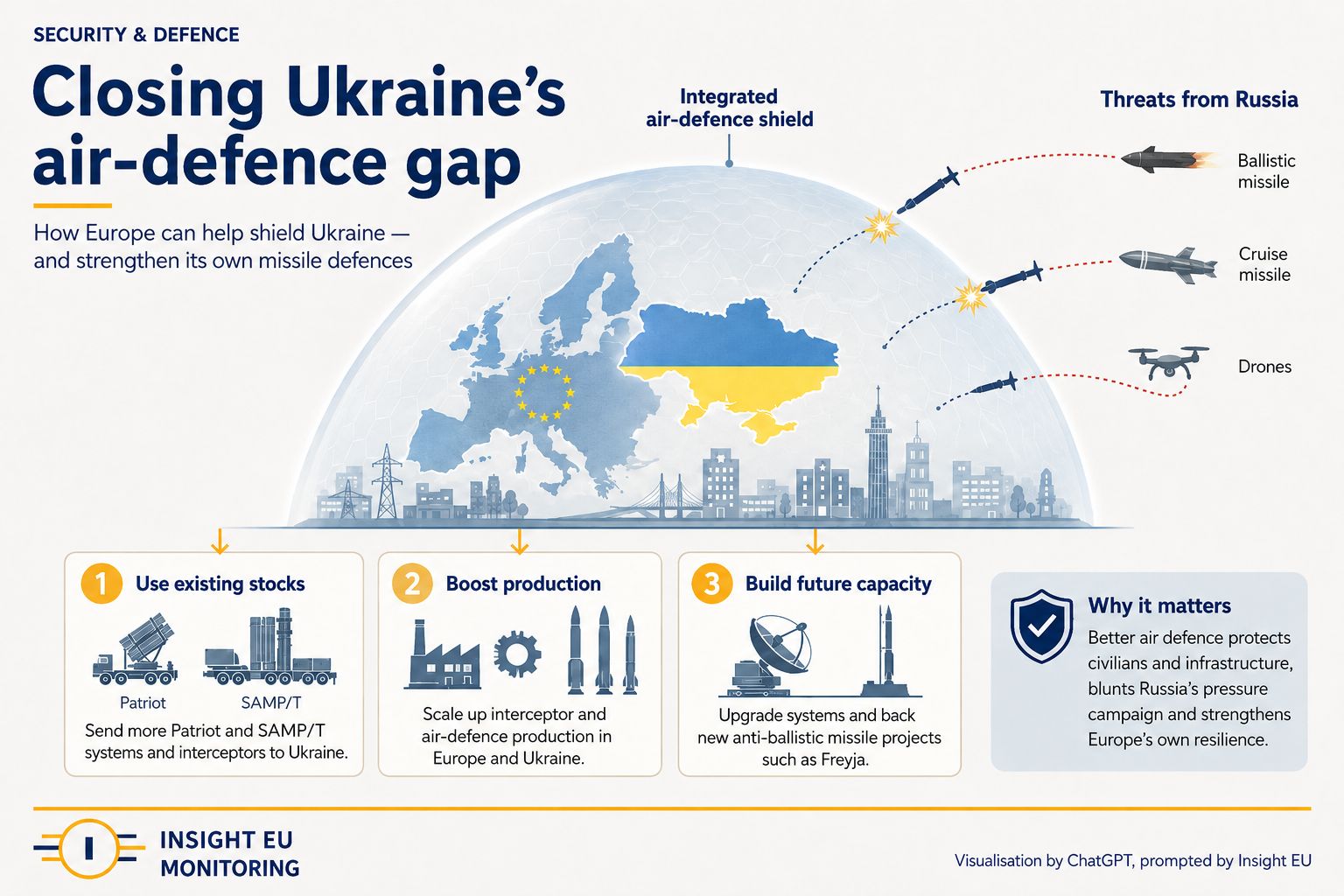
The European Commission will today disburse €3.3 billion to Ukraine for defence procurement under the €90 billion Ukraine Support Loan. The payment covers drones and missiles and will help Ukraine defend its territory and skies against Russia’s ongoing aggression.
Ursula von der Leyen, President of the Commission: “Today, we will disburse €3.3 billion to help procure drones and missiles under the Ukraine Support Loan. Europe will continue to deliver the support Ukraine needs to defend its people and its territory.”
This is the fourth payment made to Ukraine under the Ukraine Support Loan’s defence window. With this disbursement, the Commission will have paid nearly €15 billion to Ukraine this year, covering both defence and broader support. The Ukraine Support Loan includes €30 billion for budgetary aid and €60 billion for defence across 2026-2027.
Ukraine’s military edge depends on the rapid availability of critical products in the required quantities and within very short timeframes. Accelerating EU deliveries through destocking, reprioritising orders and ramping up the production remains crucial.
As announced by President von der Leyen in the State of the Union speech and yesterday’s call with President Zelenskyy, the Commission is ready to use remaining funds from the Security Action for Europe instrument to launch a new joint EU-Ukraine programme. The initiative would develop a European air and missile defence system, building on the existing Freya anti-ballistic system. It would combine Ukraine’s battlefield experience with Europe’s industrial and technological strength.
Next steps
Further payments will follow in line with the rules set out in the Ukraine Support Loan Regulation.
Next week, President von der Leyen will attend the United Nations General Assembly in New York, where she will call for increased support for Ukraine, conveying the message that: “Europe is stepping up. Now others must step up their support too.”
Background
Today’s disbursement follows the Commission decision on 11 September to approve €6.1 billion for Ukraine’s air and missiles defence and other defence needs, including PAC-3 missiles for Patriot systems. In February 2026, the European Parliament and the Council adopted Regulation (EU) 2026/467, establishing the Ukraine Support Loan, providing up to €90 billion in support to Ukraine. This support has two complementary components: strengthening Ukraine’s defence capabilities and defence industrial capacities, and support to maintain essential state functions, public services and economic resilience.
Following Ukraine’s submission of its Financing Strategy in March 2026, the Council adopted an implementing decision on 23 April 2026, allocating up to €45 billion for 2026. This includes €16.7 billion in budget support, split equally between the Ukraine Facility and Macro Financial Assistance, with each amounting to up to €8.35 billion, and €28.3 billion for defence industrial capacities.
The defence component focuses on reconstructing and modernising Ukraine’s defence technological and industrial base, while supporting its gradual integration into the European Defence Technological and Industrial Base.
All funding decisions respond to Ukraine’s evolving needs and are subject to agreed conditions and monitoring. Since 2022, the EU and its Member States have provided €224.5 billion in overall support to Ukraine, including €3.8 billion from the proceeds of immobilised Russian assets.
For more information
- Ukraine Support Loan
- Regulation (EU) 2026/467 – Ukraine Support Loan for 2026 and 2027
- Commission implementing decision validating the use of derogations for drones in Ukraine
- Macro-Financial Assistance
- Macro-Financial Assistance to Ukraine
- Ukraine Facility
- Factsheet – EU solidarity with Ukraine
Quote(s)
Today, we will disburse €3.3 billion to help procure drones and missiles under the Ukraine Support Loan. Europe will continue to deliver the support Ukraine needs to defend its people and its territory.
Ursula von der Leyen, President of the European Commission
Europe stands shoulder to shoulder with Ukraine in its defence against Russia’s illegal war of aggression. This new payment will deliver critical defence capabilities, including drones and missiles. We will continue to work closely with Ukraine and help it defend its sovereignty and protect its people.
Andrius Kubilius, Commissioner for Defence and Space
Source – EU Commission
Read-out by President von der Leyen following her call with President Zelenskyy on 17 September 2026
Brussels, 17 September 2026
“I just had a phone call with President Zelenskyy. Russia is relentlessly targeting Kyiv, trying to make daily life impossible for its inhabitants. We stand with them. And with all Ukrainians.
Tomorrow (18 September), we will disburse another €3.3 billion to Ukraine, to procure missiles and drones.
Last week, we approved EU funding for Patriot systems through our Ukraine Support Loan.
But clearly more is needed. This is why I announced that we were ready to use remaining funds from SAFE to launch a new programme for joint EU-Ukraine defence projects.
We want to develop together a European air and missile defence system, building on our joint anti-ballistic Freya system. So that we can combine Ukraine’s battlefield experience and innovation with Europe’s technology and industrial strength.
Our support goes well beyond defence. We have already mobilised nearly €15 billion for Ukraine this year. More is coming.
We discussed the reforms needed in the Rada to unlock further funding and to keep Ukraine moving forward on its path to our Union.
Next week, I will be at the UN General Assembly in New York. My message to Ukraine’s friends around the world will be simple:
Europe is stepping up. Now others must step up their support too.
Source – EU Commission
Ukrainian Presidency: Volodymyr Zelenskyy and Ursula von der Leyen discussed new security proposals and the problem of financing Ukraine’s defense
Kyiv, 17 September 2026
President of Ukraine Volodymyr Zelenskyy had a phone call with President of the European Commission Ursula von der Leyen.
The Head of State thanked the President of the European Commission for the attention she devoted to Ukraine and security issues in her annual State of the Union Address.
“The initiative to use the remaining SAFE funds to finance new defense projects by Ukraine and the European Union is very timely and truly necessary. It is important to implement it. Of course, we are also ready to cooperate on other security proposals that can strengthen all of Europe and each of our countries,” the President noted.
Volodymyr Zelenskyy and Ursula von der Leyen also discussed the steps needed to ensure Ukraine’s defense resilience. They spoke in great detail about the problem of financing Ukraine’s defense. Solutions to address this issue are being prepared.
The leaders also agreed to meet in New York on the sidelines of the UN General Assembly.
Source – Ukrainian Presidency
Background check on Freya/Freyja and the Ukrainian company Fire Point
Fact-checking by ChatGPT / Insight EU
There are Wikipedia entries on Freya/Freyja and Fire Point. They may be a starting point for a journalistic investigation, but should not be treated as reliable summaries. They combine verified facts, company claims, unresolved allegations and several assertions that are not supported by the cited official documents.
We found no evidence that the entire narrative is a Russian fabrication, but parts of it appear promotional, speculative or overstated.
The most defensible conclusions, as of 18 September 2026, are:
- Fire Point contracts are being examined in a continuing Ukrainian anti-corruption investigation into possible inflated drone-production costs.
- Fire Point itself, its founders and its management had not been designated suspects or charged in that proceeding as of NABU’s 14 May 2026 response.
- A separate Ukrainian state audit found that deliveries, contractual deadlines and payments were being observed, but the audit was not final and did not publicly exonerate Fire Point on pricing.
- The registered shareholding reportedly remains 97.5% Denys Shtilerman and 2.5% Yehor Skalyha. A proposed sale of 30% to the UAE’s EDGE Group had not been approved or completed.
- There is credible evidence of contact between Fire Point and Tymur Mindich, President Zelenskyy’s former business partner and longstanding associate. There is not yet public proof that Mindich owns or beneficially controls Fire Point—or that Zelenskyy has a financial interest in it.
- EU institutions review Ukraine Support Loan contracts for compliance, but no public document establishes that the EU conducted and completed a company-specific integrity investigation of Fire Point.
- NATO participation in the missile-defence coalition is not evidence that NATO certified or cleared Fire Point. NATO has not publicly announced such a check.
1. Investigation into allegedly inflated production costs
What is confirmed
A NABU pre-trial proceeding—reported as case No. 52025000000000048—was opened on 3 February 2025. According to a NABU response dated 14 May 2026 that was published by Shtilerman and subsequently reported, investigators were testing whether officials and defence manufacturers colluded to inflate the production costs used in state contracts for unmanned systems.
The inquiry reportedly covers six manufacturers and includes Fire Point contracts concluded between August 2023 and November 2024. The possible offences fall under provisions concerning large-scale misappropriation and money laundering.
Crucially, NABU reportedly stated that, as of 14 May 2026:
- no Fire Point founder or executive had received a notice of suspicion;
- no indictment had been prepared;
- Fire Point had not been entered in the investigation register as a legal entity subject to criminal-law measures.
This means that Fire Point’s contracts were within the scope of an investigation. It does not mean that NABU had established overpricing by Fire Point. The available NABU letter was made public by the company’s owner rather than published through NABU’s normal case-reporting channel, so the original document should still be obtained directly from NABU for publication-grade verification. Report reproducing the substance of the NABU response
State audit
Alla Basalaieva, head of Ukraine’s State Audit Service, reportedly said in July 2026 that its examination of Fire Point contracts with the Defence Procurement Agency found:
- no missed deadlines;
- goods being delivered;
- payments proceeding;
- some contracts continuing until 2028.
She also stressed that final conclusions could not be drawn before the audit and relevant contracts were completed. This finding relates primarily to contract performance; it is not, on the publicly available evidence, a final forensic finding that Fire Point’s cost calculations were reasonable. Reported State Audit Service findings
Current status
The safest formulation is:
Fire Point contracts remain within the scope of a broader NABU examination of possible production-cost inflation. No public evidence shows that Fire Point, its owners or executives have been charged in that proceeding. A separate state audit found no delivery or payment irregularities to date, but its conclusions were not final.
This proceeding must not be confused with other NABU drone cases. In August 2026, NABU announced additional suspects in a different SSSCIP procurement case involving commercially available DJI and Autel drones purchased at prices allegedly 60–90% above market levels. NABU’s public statement does not identify Fire Point.
More information: NABU’s official announcement
2. Ownership and changes in shareholders
Registered company
The relevant Ukrainian legal entity appears to be:
- ТОВ “ФАЙЄР ПОІНТ” / Fire Point LLC
- EDRPOU: 43913999
- incorporated: 18 February 2021
- registered director: Yehor Vitaliiovych Skalyha
- registered capital: UAH 12 million
The entity therefore predates the commonly cited 2022 “founding” of the defence business. Public reporting says the entity was previously called Centrocast and operated as a casting-related company before its conversion into Fire Point.
The current registry extract identifies Skalyha as the company’s legal head. This conflicts with Wikipedia’s description of Iryna Terekh as CEO; more recent reporting often describes her as CTO or a co-founder. Titles should be checked directly with the company before publication.
More information: Ukrainian registry-derived company record
Reported current shareholders
Multiple reports give the following structure:
| Shareholder | Reported interest |
|---|---|
| Denys Shtilerman | 97.5% |
| Yehor Skalyha | 2.5% |
Associated Press reported Shtilerman as the majority owner and Skalyha as the small minority shareholder. The public evidence I found does not establish Iryna Terekh as a shareholder.
Proposed EDGE transaction
The UAE state-owned defence group EDGE reportedly sought to acquire 30% of Fire Point for approximately $760 million. The application was submitted to Ukraine’s Antimonopoly Committee in December 2025 but returned to the applicants on 14 January 2026. As of early March, no new application had reportedly been filed.
A returned application is not necessarily a substantive prohibition: it can result from incomplete documentation or transaction-structure problems. But it means the transaction cannot be described as completed.
More information: Report based on the Antimonopoly Committee’s information
The search found no reliable public evidence that EDGE, Mindich or another investor subsequently entered the registered shareholding.
Ownership question still unresolved
Registered ownership and beneficial control are not always identical. The unresolved question is whether Shtilerman is the ultimate decision-maker or whether another person exercises informal influence. That remains an investigative hypothesis, not an established fact.
3. Relations with President Zelenskyy
No evidence found establishes a direct financial or ownership relationship between President Volodymyr Zelenskyy and Fire Point, Shtilerman or Skalyha.
The indirect link runs through Tymur Mindich:
- Mindich was a co-owner of Kvartal 95, the television-production business co-founded by Zelenskyy.
- He has been described by credible international reporting as Zelenskyy’s former business partner and longstanding personal associate.
- Mindich later became a central suspect in the separate Energoatom/Operation Midas corruption case.
- Fire Point acknowledges that Shtilerman met Mindich.
- Shtilerman reportedly said Mindich sought to purchase 50% of Fire Point in 2024, but that the transaction was not completed.
- Fire Point has denied that Mindich is or was an owner or beneficiary.
More serious questions arise from reported NABU recordings. According to the Anti-Corruption Action Centre’s account, Mindich discussed Fire Point contracts and a possible EDGE investment with then Defence Minister Rustem Umerov and referred to the business as “ours.” This could indicate influence, attempted intermediation, an unrecorded economic interest—or merely boastful language. The recording alone does not establish ownership.
More information: AntAC’s investigation and underlying links
The proper conclusion is therefore: “Mindich had demonstrable access to Fire Point’s owner and reportedly discussed its contracts and investment plans. His prior relationship with Zelenskyy creates a legitimate conflict-of-interest and influence question. Public evidence does not yet prove that Mindich beneficially owned Fire Point or that Zelenskyy intervened for, controlled or benefited from the company.”
The reported presence of Ihor Fursenko—an associate of Mindich implicated in Operation Midas—as a Fire Point security official would merit separate verification through employment records and the criminal case file.
4. Has Fire Point been checked by the EU?
There are at least three different meanings of “checked”:
Contract-compliance review: apparently yes, where EU money is involved
The EU Commission says it reviews contracts before disbursing Ukraine Support Loan defence funds to ensure compliance with the Regulation and procurement conditions agreed by Member States. The Commission’s €6.1 billion decision covered named suppliers, quantities and delivery schedules, although these were not publicly disclosed for security reasons.
More inforamtion: EU Commission decision and review procedure
That establishes an EU compliance-review mechanism. It does not tell us:
- whether a Fire Point contract was among those reviewed;
- which ownership, integrity or pricing checks were conducted;
- whether the Commission examined the NABU allegations;
- whether Fire Point received an explicit institutional clearance.
The later EU statement about developing a European system “building on” Freya demonstrates political and programme-level interest, not a published clean bill of health for Fire Point.
Financial or anti-corruption clearance: not publicly demonstrated
I found no EU Commission, European Anti-Fraud Office, European Public Prosecutor’s Office or European Court of Auditors document stating that Fire Point’s ownership and pricing were investigated and cleared.
Technical certification: not publicly demonstrated
Interoperability with Link 16, NATO-standard radars or European command systems is a technical design claim. It is not proof of certification, successful integration testing or institutional vetting.
5. Has Fire Point been checked by NATO?
No public evidence supports the statement that NATO has vetted or certified Fire Point.
NATO Secretary General Mark Rutte attended the July meeting of the Anti-Ballistic Missile Coalition and encouraged cooperation with Ukraine’s defence industry. NATO’s own account does not name Fire Point or Freya, nor does it announce a NATO procurement, certification or due-diligence decision.
More information: NATO’s official account
Moreover, the coalition’s official declaration:
- refers to an unnamed “Flagship Project”;
- establishes future working groups, governance and operational requirements;
- does not mention Fire Point;
- does not mention Freya/Freyja;
- does not state that NATO established or owns the coalition.
The coalition is an intergovernmental initiative of ten participating states, not formally a NATO programme on the evidence published.
More information: Official joint declaration
Therefore, Wikipedia’s claim that the ten countries established the coalition specifically “to support the Freyja project” goes beyond the wording of the primary document.
Reliability problems in the Wikipedia material
Several warning signs justify treating both articles cautiously:
- The Freyja article converts an unnamed coalition “Flagship Project” into explicit governmental endorsement of Fire Point’s Freya without support from the joint declaration.
- NATO-standard compatibility is presented in a way that could be mistaken for NATO approval.
- “EU president” is institutionally inaccurate.
- Several references have inconsistent publication years.
- Product specifications and schedules largely originate with Fire Point or defence media repeating company statements.
- Fire Point’s employee count is internally inconsistent: 6,000 in the infobox and “over 500” under operations.
- The company is described as founded in 2022, although the underlying legal entity dates from 2021.
- Iryna Terekh’s title is inconsistent with the current Ukrainian registry and other recent reporting.
- The assertion that the FP-9’s “first strike is planned to be on Moscow” is extraordinary and requires a direct, attributable source; it should not be repeated as fact.
- Claims about Diehl, Hensoldt and other European companies should be confirmed with those companies. A Fire Point announcement that it intends to work with a company is not equivalent to a signed partnership.
- Cost, interception-rate and deployment claims for Freya concern a developmental system and therefore cannot yet be independently validated.
Overall finding
There is a genuine governance issue worth investigating, not merely an obvious Russian disinformation construct. Fire Point has grown extremely quickly on state contracts, faces unresolved questions about beneficial control and has documented contact with a politically connected businessman under criminal investigation.
At the same time, the strongest public evidence does not currently justify saying that Fire Point inflated costs, is owned by Mindich, is controlled by Zelenskyy, or has been formally cleared by either the EU or NATO.
The accurate editorial framing would be:
- Fire Point’s contracts are under scrutiny within a broader Ukrainian anti-corruption investigation, but no public charges have been brought against the company or its registered owners.
- Questions remain over potential informal influence by Zelenskyy’s former business partner Tymur Mindich.
- European governments and the EU are backing missile-defence cooperation involving the Freya concept, but neither the EU nor NATO has publicly disclosed a comprehensive integrity clearance of Fire Point.
Research by ChatGPT / Insight EU