
Brussels, 24 November 2026
The European Commission today published provisional safeguard measures setting import quotas for certain hybrid vehicles. These restrictions are needed to protect EU industry against a sharp recent increase in imports of such vehicles. The measures will enter into force on 1 December and follow an investigation that showed imports of hybrid vehicles into the EU have increased significantly since 2023.
While the safeguard measures implement the understanding reached at the second meeting of the EU-China Trade and Investment Consultations on 9 October 2026, to moderate China’s exports of hybrids to the EU, they will apply to all hybrid imports regardless of their origin.
The Commission is imposing a quantitative restriction in the form of import quotas per exporting country, setting a maximum quantity of hybrid vehicles that may be imported into the EU for the duration of the provisional safeguard measures. Imports outside these quotas are not allowed.
Imminent threat of serious injury to EU industry
The surge in imports of hybrid passenger vehicles into the EU has been driven by growing global production overcapacity. It is also prompted by increased use of trade-restrictive measures in other major markets.
The investigation showed that EU-based manufacturers of hybrid passenger vehicles are losing market share, putting the long-term viability of their hybrids business at risk – despite a growing EU market. It found that the threat of serious injury to EU industry is imminent, requiring safeguard measures to protect EU producers.
Import quotas are to be allocated in two ways: to specific countries with a substantial interest in supplying hybrid passenger vehicles to the EU market (‘country-specific quotas’), and to all other origins (a ‘residual quota’).
Country-specific quotas were set at the level of imports recorded from the respective country in 2025, increased by a little over 15%. Countries with a share of more than 2% of EU imports in the year 2025 were allocated a country-specific quota. A residual quota is allocated for all other origins.
Background
The safeguard investigation regarding imports into the EU of hybrid vehicles was initiated on 30 October 2026, following the understanding reached at the second meeting of the EU-China Trade and Investment Consultations on 9 October. It covers two vehicle types: full hybrid electric vehicles (HEVs) and plug-in hybrid electric vehicles (PHEVs), including mild hybrid electric vehicles (MHEVs)
Both vehicle types combine an internal combustion engine with a battery-powered electric motor. The main difference is that PHEVs can be recharged externally by connecting to the electricity grid, whereas HEVs generate electricity internally, through regenerative braking and the internal combustion engine. MMHEVs use a smaller battery to improve fuel efficiency.
The provisional safeguard measure will be in place for a maximum of 200 days. Definitive measures may be imposed within nine months from the initiation of the investigation (this timeline can be extended by a maximum of two months).
For more information
Source – EU Commission
ACEA: The EU new car market maintained its positive momentum in the first ten months of 2026, with registrations rising by 5.4%
Brussels, 24 November 2026
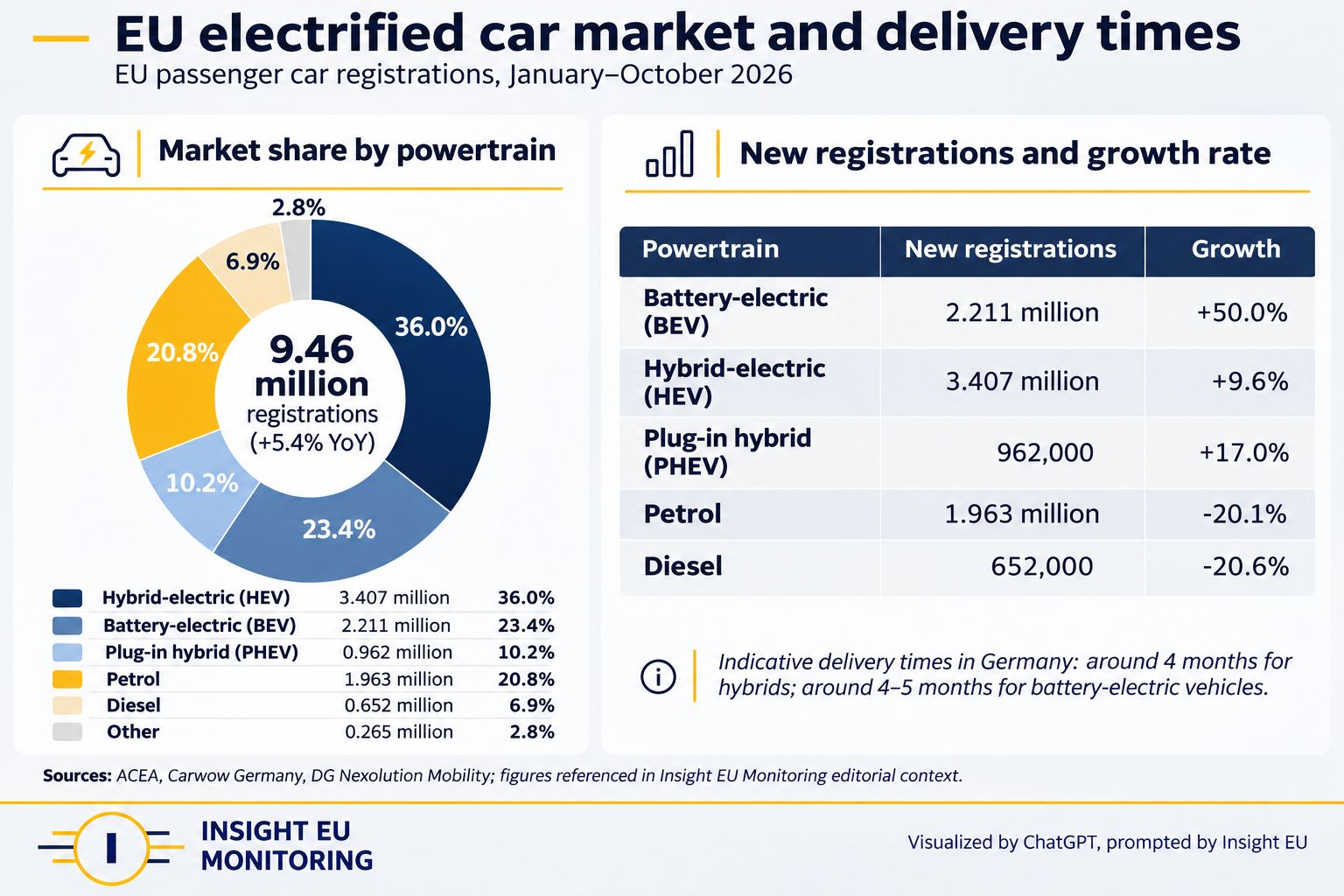
Electrified powertrains continued to drive market growth notably in major European markets, supported by demand-support measures and a broader model offering. Hybrid-electric vehicles remained the most popular choice, while battery-electric and plug-in-hybrid cars accounted for 23.4% and 10.2% of EU registrations, respectively.
New EU car registrations by power source
The EU powertrain mix continued to shift further towards electrified cars. By October 2026, battery-electric cars accounted for 23.4% of the EU market, up from 16.4% a year earlier. Hybrid-electric car registrations captured 36% of the market, remaining the preferred choice among EU consumers. By contrast, the combined market share of petrol and diesel cars fell to 27.7%, compared with 36.5% a year earlier.
Electric cars
In the first ten months of 2026, 2,211,071 new battery-electric cars were registered, capturing 23.4% of the EU market and cementing their position as the second most popular power source choice. Three of the four largest EU markets, which together accounted for 65% of all battery-electric car registrations, recorded strong double-digit growth: France (+79.4%), Germany (+60.7%), and Denmark (+41%). Belgium also posted a more moderate 16.7% increase.
Plug-in-hybrid registrations also expanded, rising to 961,959 units in January-October 2026. Growth was particularly strong in Italy (+73.1%), Spain (+32.3%), and Germany (+11%). As a result, new plug-in-hybrid electric cars accounted for 10.2% of EU registrations, up from 9.2% over the same period in 2025.
October 2026 year-to-date figures also showed new EU hybrid-electric car registrations rising to 3,407,062 units, supported by growth in Italy (+20%) and Spain (+18.7%), alongside more modest gains in Germany (+3.9%). Registrations in France remained broadly stable (-0.1%). Overall, hybrid-electric models accounted for 36% of the total EU market.
Petrol and diesel cars
Demand for conventional powertrains continued to contract. Petrol car registrations fell by 20.1% through October 2026, with declines across all four major EU markets. France saw the steepest decrease, with volumes falling by 36.9%, while other key markets also posted double-digit losses: Germany (-24.5%), Spain (-19.3%), and Italy (-16.6%).
A total of 1,962,607 petrol cars were registered during the period, reducing their market share from 27.4% to 20.8%. Diesel registrations declined by 20.6%, bringing their share of the EU market down to 6.9%, compared with 9.2% one year earlier.
Electrified powertrains continued to drive market growth notably in major European markets, supported by demand-support measures and a broader model offering. Hybrid-electric vehicles remained the most popular choice, while battery-electric and plug-in-hybrid cars accounted for 23.4% and 10.2% of EU registrations, respectively.
Source – ACEA