
Amman, 8 January 2026
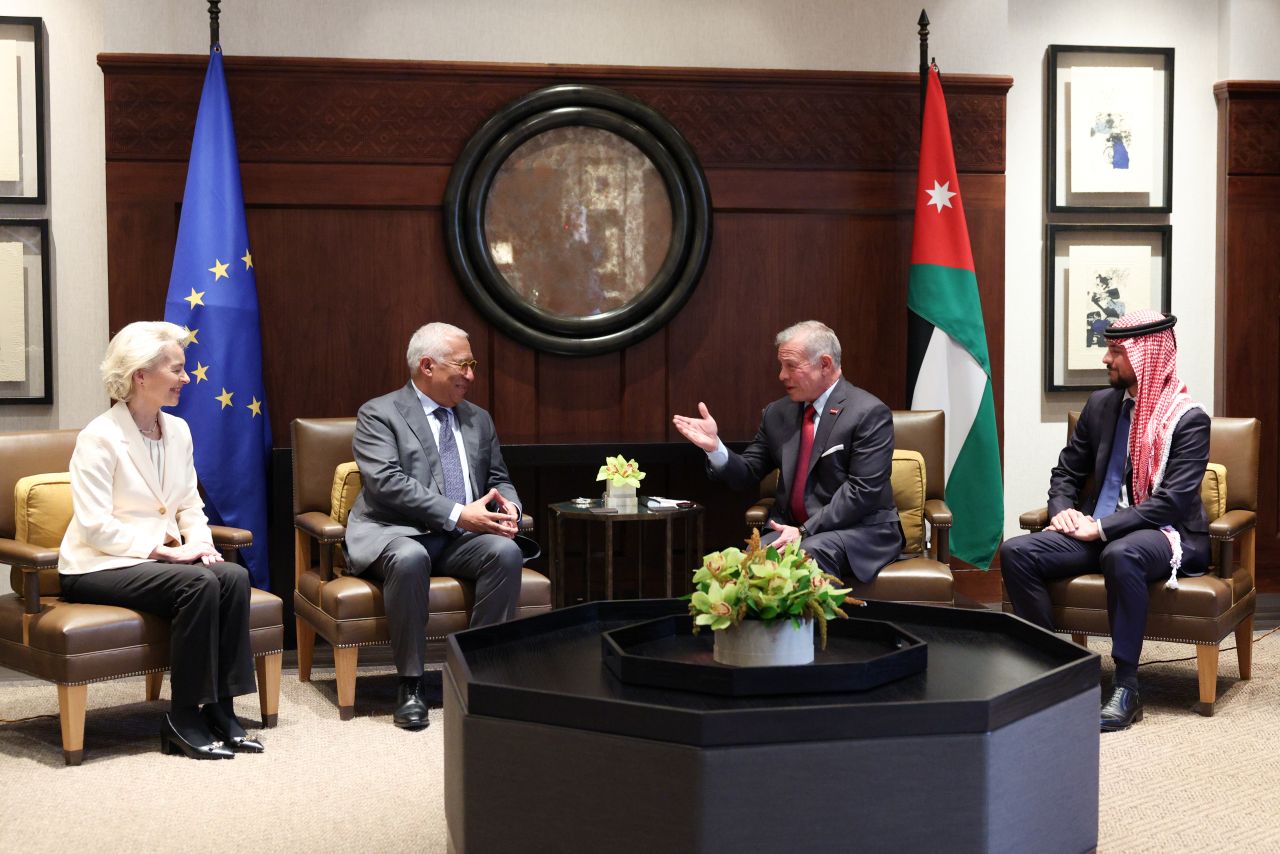
Today, the EU and Jordan are marking a key milestone in their long-standing relationship with a first-ever bilateral Summit. The EU was represented by Commission President Ursula von der Leyen and European Council President António Costa, and Jordan by His Majesty King Abdullah II.
The leaders took stock of the implementation of the EU-Jordan Strategic and Comprehensive Partnership (SCP) signed one year ago and set priorities for the future, including a high-level EU-Jordan Investment Conference scheduled for April 2026. The Summit reaffirmed the EU’s commitment to Jordan as a key strategic partner for stability, prosperity and cooperation in the Middle East and the Mediterranean.
Ursula von der Leyen, President of the Commission, said: “The EU–Jordan partnership is stronger than ever. Today’s first EU–Jordan Summit marks the anniversary of our Strategic and Comprehensive Partnership and the concrete milestones we have delivered together since. From deeper political cooperation and strengthened security dialogue to reforms, investments and opportunities for both citizens and businesses. We are turning commitments into action for stability, resilience and shared prosperity.”
Over its first year, the SCP resulted in concrete deliverables across its five pillars:
- political relations and regional cooperation,
- security and defence,
- economic resilience, trade and investment,
- human capital including education and skills, and
- migration, protection and support to refugees.
The leaders strengthened political ties by deepening discussions and working together to support regional stability. Security and defence cooperation advanced with the new EU support under the European Peace Facility and progress on integrated border management.
On the economic front, the EU supported Jordan’s reform agenda and economic resilience.
In September 2025, the EU adopted and rolled out a Macro-Financial Assistance programme worth €500 million. An additional Macro-Financial Assistance programme will be adopted in 2026, for another €500 million. This programme will include budget support disbursements, and accelerated investment mobilisation, including for the green transition, water, energy and digital connectivity.
The EU and Jordan have also deepened cooperation on people-to-people through education, skills, research and youth mobility programmes, including the Partnership for Research and Innovation in the Mediterranean Area (PRIMA) programme. Furthermore, the EU has sustained its support for Jordan’s exceptional efforts in hosting refugees, ensuring access to services, livelihoods and protection. Cooperation with Jordan will be intensified in the framework of the Pact for the Mediterranean and its upcoming first Action Plan (scheduled for March 2026).
Next steps
In 2026, the Partnership will move into an intensified delivery phase, with key milestones further consolidating cooperation and impact. These include the high-level EU–Jordan Investment Conference (April 2026), and the launch of the first EU–Jordan Security and Defence Dialogue, as well as further dialogue on human rights.
The signature of the first Multi-Sector Budget Support is expected in early 2026 and will unlock key reforms to enhance competitiveness, employment and the business environment in Jordan.
The EU and Jordan will reinforce trade and investments across their borders by signing, at the EU-Jordan Investment Conference of spring 2026, several flagship infrastructure and connectivity projects. This should include the Water Desalination Aqaba-Amman National Conveyance.
Background
Jordan is a key partner for Europe in the Middle East and a cornerstone of regional stability.
The EU and Jordan signed their Strategic and Comprehensive Partnership on 29 January 2025 in Brussels. Commissioner for the Mediterranean Dubravka Šuica and Minister of Planning and International Cooperation Zeina Toukan led the signing ceremony, in the presence of President von der Leyen and King Abdullah.
The Partnership reflects the EU’s long-term commitment to Jordan’s stability, reform agenda and socio-economic resilience and to a shared future of cooperation in the region. It is underpinned by a €3 billion EU financial and investment package for Jordan for the period 2025–2027, comprising €640 million in grants, around €1.4 billion in additional investments, and €1 billion in concessional loans through macro-financial assistance.
For more information
Quote
The EU–Jordan partnership is stronger than ever. Today’s first EU–Jordan Summit marks the anniversary of our Strategic and Comprehensive Partnership and the concrete milestones we have delivered together since. From deeper political cooperation and strengthened security dialogue to reforms, investments and opportunities for both citizens and businesses. We are turning commitments into action for stability, resilience and shared prosperity. Ursula von der Leyen, President of the European Commission
Source – EU Commission
Joint Statement Jordan–EU Summit
Amman, 8 January 2026
We, the leaders of the Hashemite Kingdom of Jordan (hereinafter Jordan) and the European Union, held our first EU-Jordan Summit in Amman, Jordan on 8 January 2026 and concluded the following:
- Today’s Summit marks an important milestone in EU–Jordan relations, elevated to a Strategic and Comprehensive Partnership (SCP) a year ago building on the Association Agreement and on the Partnership Priorities. We reaffirm our willingness to cooperate for long-term stability, peace, security, prosperity, the universal values of democracy, the rule of law and human rights, and to promote joint interests and renew Partnership Priorities. We reaffirm our unwavering commitment to the principles of the United Nations Charter and will cooperate to reinforce effective multilateralism and the rules-based international order with the UN at its core. We underline the need for peaceful resolution of conflicts and the respect for international law and international humanitarian law, condemning all violations of international law, international humanitarian law and human rights law, and recalling our commitment to upholding accountability for violations of international law.
- We welcome the adoption of United Nations Security Council Resolution 2803 of 17 November 2025 and President Trump’s Comprehensive Plan to End the Conflict in Gaza. We call on all parties to implement the above-mentioned Resolution in its entirety, and in line with internationally agreed political and legal principles. We recall the New York Declaration, which stipulates that Hamas must end its rule in Gaza, in accordance with the “One State, one law, one government, one gun” policy of the Palestinian Authority. The catastrophic humanitarian situation in Gaza demands urgent action, and we call for the rapid, safe and unimpeded delivery and sustained distribution of humanitarian aid at scale into and throughout Gaza, and for unimpeded access for the UN and its agencies, and humanitarian organisations, including international NGOs, in accordance with international humanitarian law, and welcome Jordan’s humanitarian efforts in this regard. We reiterate that the only path to a just, lasting and comprehensive resolution of the conflict in the Middle East is the Two-State solution, with the State of Israel and a sovereign viable State of Palestine, living side by side in peace, security, and mutual recognition, in accordance with international law and the relevant UN Security Council Resolutions. We reiterate the importance of implementing the reform programme of the Palestinian Authority, and the strengthening of its civilian police forces including through the mobilisation of EU CSDP missions, so that it can securely and effectively take back control of Gaza. We call on Israel to urgently release withheld clearance revenues and extend the correspondent banking services between Israeli and Palestinian banks, both being necessary to ensure the proper functioning of the Palestinian Authority and the delivery of essential services to the population. We express grave concern over the deteriorating situation in the West Bank, including East Jerusalem, reject and strongly condemn any annexation attempts, settlers’ violence including against Christian communities, settlements which are illegal under international law, unilateral acts or any expulsion or displacement of Palestinians from Gaza or the West Bank. We call on Israel to reverse the E1 settlement plan that further undermines the Two-State Solution. We reiterate our commitment to uphold the historic and legal Status Quo of Jerusalem’s Holy Sites, including with regards to the historic Hashemite Custodianship.
- The EU commends Jordan’s sustained efforts in hosting millions of refugees and its commitment to ensuring their dignified living conditions and access to basic services. The EU reaffirms its continued support to refugees and host communities in Jordan. We remain steadfastly committed to supporting Palestinian refugees in Jordan. We reiterate the essential role of the United Nations Relief and Works Agency for Palestine Refugees in the Near East (UNRWA) in providing vital services.
- We express support to Lebanon’s stability and to the fundamental role played by UNIFIL. We reiterate the need to respect Lebanon’s sovereignty and territorial integrity and call on all parties to fully implement the Resolution 1701 and the ceasefire agreement of November 2024.
- We will continue working together in support of a peaceful and inclusive Syrian-led and Syrian-owned transition, free from harmful foreign interference, with the aim to ensure Syria’s unity, sovereignty, independence and territorial integrity, and the safety and prosperity of its people. We will cooperate to support efforts towards stabilisation, reconciliation, institution building, reconstruction and socio-economic recovery of Syria. Comprehensive transitional justice and security sector reform are key areas to succeed in a transition which protects all Syrians from all ethnic and religious backgrounds without discrimination. We are determined to jointly support Syria’s socio-economic recovery and institution building, including in capacity building and empowerment initiatives, addressing the continuing humanitarian needs in Syria and also contributing to creating the conditions for the return of internally displaced persons and Syrian refugees. The EU endorses and calls for full implementation of the Roadmap announced by Jordan, Syria and the United States to end the crisis in Suwayda and Stabilizing Southern Syria. Acknowledging that the return of Syrians under the appropriate conditions is a key objective of the current Syrian government, and taking note of the UNHCR statements that such conditions are currently not met for large numbers of repatriation, we reaffirm our commitment to continue working with the current Syrian government and UN partners to provide support and services to displaced persons and returnees in Syria, and to ensure that returns are safe, voluntary, dignified and sustainable, while being ready to support those who wish to voluntarily return.
- On Ukraine, we recall the UN General Assembly Resolutions ES-11/1, ES-11/2, ES-11/4, ES-11/6 and ES-11/7 and in this context reiterate the obligation of all States to refrain in their international relations from the threat or use of force. We underscore the need to reach, as soon as possible, a comprehensive, just and lasting peace in Ukraine in line with the principles of the Charter of the United Nations and international law. We underline the need for peaceful resolution of conflicts and the respect for international humanitarian law, recalling our commitment to upholding accountability for serious violations of international law. We reaffirm our support for Ukraine’s independence, sovereignty and territorial integrity within its internationally recognised borders.
- Recognising the particular impact of regional crises on Jordan, and in view of its pivotal role in contributing to regional peace and stability, the EU remains committed to supporting Jordan’s economic resilience and reform agenda outlined in the three-track Modernisation Vision. As announced in January 2025, the EU is notably putting forward a support package of EUR 3 billion. The support package consists of EUR 1 billion in Macro-Financial Assistance (MFA), EUR 640 million in grants and EUR 1.4 billion in public and private investments to be mobilized.
- We reaffirm joint efforts to mobilise private sector investments, including through reforms to improve business and investment environment and the organisation of the EU-Jordan Investment Conference in Jordan in April 2026, and to promote sustainable trade. We reaffirm our agreement to discuss investment facilitation measures to help strengthening our investment. We commit to support integrating the Investment Facilitation for Development Agreement into the World Trade Organisation (WTO). We acknowledge the importance of the multilateral trading system and the need for deep reforms of the WTO.
- The EU and Jordan stand firmly committed to unlocking their trade and bilateral relations, and to enhancing their bilateral cooperation to unleash the full potential of the Free Trade Area of the Association Agreement. Both sides agree to work on the review of the Association Agreement and look into various potentials to update and develop certain parts, in particular issues related to trade and investment relations to better adapt them to today’s challenges.
- The EU and Jordan will explore opportunities on how Jordanian companies could make better use of the simplified Rules of Origin Scheme to support Jordan in the context of the Jordan refugee crisis, while continuing to work on building export capacity and reinforcing their competitiveness. In this regard, both sides will continue discussions on the review of the Rules of Origin Scheme, including in relation to expanding its duration and the list of products.
- We underline the importance of the progress on Jordan’s political modernisation agenda and stress that rule of law, human rights and fundamental freedoms, and good governance are indispensable in fostering stability and sustainable development. We will strengthen cooperation on good governance, as well as on modernising public services, and enhance integrity principles.
- We will continue fostering our dialogue and enhancing cooperation on human rights and fundamental freedoms, including freedoms of expression, media, association and peaceful assembly. We will also step up our engagement to combat discrimination in all its forms, including on the basis of religion or belief, and to promote inter-religious and intercultural dialogue, recognising the essential role played by civil society in advancing democracy, inclusive governance and sustainable development.
- Following the deployment of the 2024 EU Election Observation Mission and its positive assessment and constructive recommendations, we look forward to continuing our work on political and electoral matters.
- We will continue to work jointly on security cooperation, border management, countering organised crime and all forms of smuggling and trafficking, including through enhancing cooperation with EU agencies, CEPOL, Europol and Frontex. We remain committed to countering terrorism and preventing radicalisation and violent extremism, including through the Global Coalition against Da’esh, the Global Counterterrorism Forum and the Aqaba Process on counter terrorism and violent extremism.
- We reaffirm our decision to launch the first EU-Jordan Security and Defence Dialogue in Amman early 2026, to further advance EU support to Jordanian Armed Forces under the European Peace Facility and future Jordanian engagement under the EU’s Common Security and Defence Policy (CSDP).
- We strongly welcome Jordan’s decision to join the Global Energy Transition Forum (GETF), launched by the EU and international partners to foster collective progress on renewable energy and energy efficiency. We reaffirm our strong commitment to the United Nations Framework Convention on Climate Change (UNFCCC) and the Paris Agreement and will work toward transition pathways backed by enabling policies, including exploring opportunities linked to the Carbon Border Adjustment Mechanism. We remain committed to accelerating the global green transition by prioritising cooperation on energy transition, including safe and sustainable low-carbon hydrogen, energy efficiency and cost-effective electricity storage, sustainable transport, sustainable agriculture, critical raw materials and green technologies, while continuing to advance regulatory cooperation and the modernisation of electricity networks. Recognising Jordan’s acute water scarcity, the EU and Jordan will further deepen their cooperation on enhancing the financial sustainability of the sector, promoting sustainable water use and improving wastewater management. We will continue to support initiatives that enhance long-term water security, especially through Team Europe’s contributions to the Aqaba-Amman Water Desalination and Conveyance Project.
- We will foster cooperation in research and innovation, building on Jordan’s signature of the renewed Partnership for Research and Innovation in the Mediterranean Area (PRIMA) and increasing its participation to Horizon Europe. We will continue working together to extend Jordan’s participation to other EU programmes such as Creative Europe.
- The EU supports Jordan’s efforts to equip youth and adults with the skills required to meet labour market needs while promoting inclusivity, notably through Technical Vocational Training (TVET), and both sides will cooperate on vocational training programs that meet EU labour market standards also in view of potential circular mobility within the European labour market, in addition to the EU’s continued support under the international dimension of Erasmus+. Both sides are working together to expand livelihood opportunities for all in Jordan, in particular women and youth, and strengthen the efficiency and accessibility of social protection systems.
- We underline Jordan’s importance in the development of the India-Middle East-Europe Corridor (IMEC). The EU will support energy and digital connectivity, including the Blue Raman cable and future extension of the Medusa Submarine Cable to Jordan, and explore ways to further enhance secure and resilient connectivity, notably by upgrading electricity infrastructure supporting Jordan’s renewable energy potential.
- We welcome the launch of the Pact for the Mediterranean on 28 November 2025 in Barcelona and will advance concrete initiatives in areas of common interest to create new opportunities, tackle common challenges, strengthen a partnership based on mutual trust and joint responsibility and deliver tangible benefits, especially for youth, women and businesses. We commend the joint work carried out by Jordan and the European Union as co-presidents of the Union for the Mediterranean over the past thirteen years.
- Recognising our strategic partnership and commitment to advance our cooperation in all fields, we agreed to hold our next EU-Jordan summit in Brussels in 2028.
Source – EU Commission
Opening remarks by President António Costa at the EU-Jordan summit in Amman, Jordan
Amman, 8 January 2026
Your Majesty, Royal Highness,
I would like first of all to thank you for the warm welcome to President von der Leyen and I at this very first summit between the European Union and Jordan.
One year ago, we signed the Strategic and Comprehensive Partnership. Our strategic and comprehensive partnership is a key milestone. Now more than ever, we are working together as reliable and predictable partners. And our bilateral relations are strong and can only get stronger moving forward.
The Strategic and Comprehensive Partnership is delivering tangible results. We maintain an excellent relationship at political level, with regular contacts at all levels to coordinate and align positions. We work together to advance shared values – peace based international law, democracy and human rights.
The situation in the Middle East, in particular Gaza and the West Bank, have been at the heart of our regular exchanges. Also here today. Together with Jordan and other partners, the EU has offered to support new Palestinian internal security forces to restore order and governance in Gaza. And we will discuss this issue today.
For months, Jordan’s contribution to address the humanitarian crisis through air and land corridors has been truly remarkable, and valued by all. Yet, despite the ceasefire agreement, the humanitarian situation continues to demand urgent action. Other priorities that we will be discussing today are of course the Syrian political transition, and our shared support to Ukraine’s independence and sovereignty.
Our Strategic and Comprehensive Partnership has opened a whole new field for EU-Jordan cooperation, namely security and defense. Our fastest growing cooperation strand is military support through the European Peace Facility. And a new package of €35 million was just adopted in late 2025 for the purchase of an air-defence system – and more is planned in 2026.
The delivery of this advanced technology from Europe will be combined with a structured policy dialogue addressing all military affairs, counter-terrorism, cyber and other threats.
We are advancing steadily on the implementation of the €3 billion support package that combines grants and loans to support Your Majesty’s Modernisation Vision, and for sure, President von der Leyen will develop on this.
We remain committed to supporting Jordan’s economic resilience, and stability. This Summit and the upcoming Investment Conference are key priorities for us. We can only harness the full social and economic dividends of this new Corridor if human capital is growing at the same time. This is why education, research and innovation are the fourth pillar of the Strategic and Comprehensive Partnership.
Lastly, the EU highly values the role played by Jordan in response to repeated refugee crises in the Middle East. As part of the Strategic and Comprehensive Partnership, we will continue to offer a predictable support at scale to help Jordan in assisting host communities and refugees – including Syrian refugees and Palestinian refugees through UNRWA.
One year has passed since the signature of our new Strategic and Comprehensive Partnership – a busy one, an excellent one for EU-Jordan relations. As we take stock of those concrete results, we will use our first Summit to steer further implementation and guide the efforts to bring EU and Jordan even closer together in all fields.
Thank you.
Source – European Coucil: Visit the meeting page
Statement by President von der Leyen at the first EU-Jordan Summit
Amman, 8 January 2026
Your Majesty King Abdullah II, Your Royal Highness,
I want to thank you for your warm welcome here in Amman. You are a key partner for Europe in the Middle East and a cornerstone of regional stability. Therefore, there is a mutual interest to strengthen what is not only a partnership but also a friendship between Jordan and the European Union. It is a relationship that is built on stability, security and prosperity. In times of growing geopolitical challenges, it is good to know that the EU and Jordan stand side by side. Because this is what friends do. Today, this Summit shows how quickly this partnership has moved from vision of the Strategic and Comprehensive Partnership to its delivery. We have three topics that are the main pillars of our partnership.
The first is the political relationship. We have started the Pact for the Mediterranean which will open new opportunities for us. Your work within the Union for the Mediterranean is the perfect foundation to enhance, strengthen and let this new Pact for the Mediterranean grow.
The second very important point is economic stability. Therefore, our partnership is underpinned by EUR 3 billion for 2025 to 2027. There is a lot of good work together, a lot of investment. Together, we have the investment goal of EUR 1.4 billion. So we will be working on this. I am very grateful and thankful for the invitation to the Investment Conference. I am happy to say that I would be very glad to come. This will be an important milestone in the investment target that we have set ourselves.
We also have the third element, which is about investing in regional stability but also the support for the refugees that is outstanding. You have facilitated the delivery of life-saving aid, in particular to the people of Gaza. Here, we really want to thank you. And you have hosted millions of refugees, especially from Syria as well. The aid for refugees from Syria, with a total of 240 million over three years which we had agreed on, may support your efforts. At the same time, we are working intensively together to build the conditions for safe, voluntary and sustainable returns to Syria.
This third pillar is also on our agreement on working more intensely together. This means support from our side, from the European Peace Facility, but also knowing the capabilities on the Jordanian side, so that we use this more for a stronger cooperation in the field of security and defence.
This Summit marks a decisive step forward. I am glad that this relationship has grown and matured so much. Thank you again for the invitation.
Source – EU Commission