
Brussels, 21 November 2026
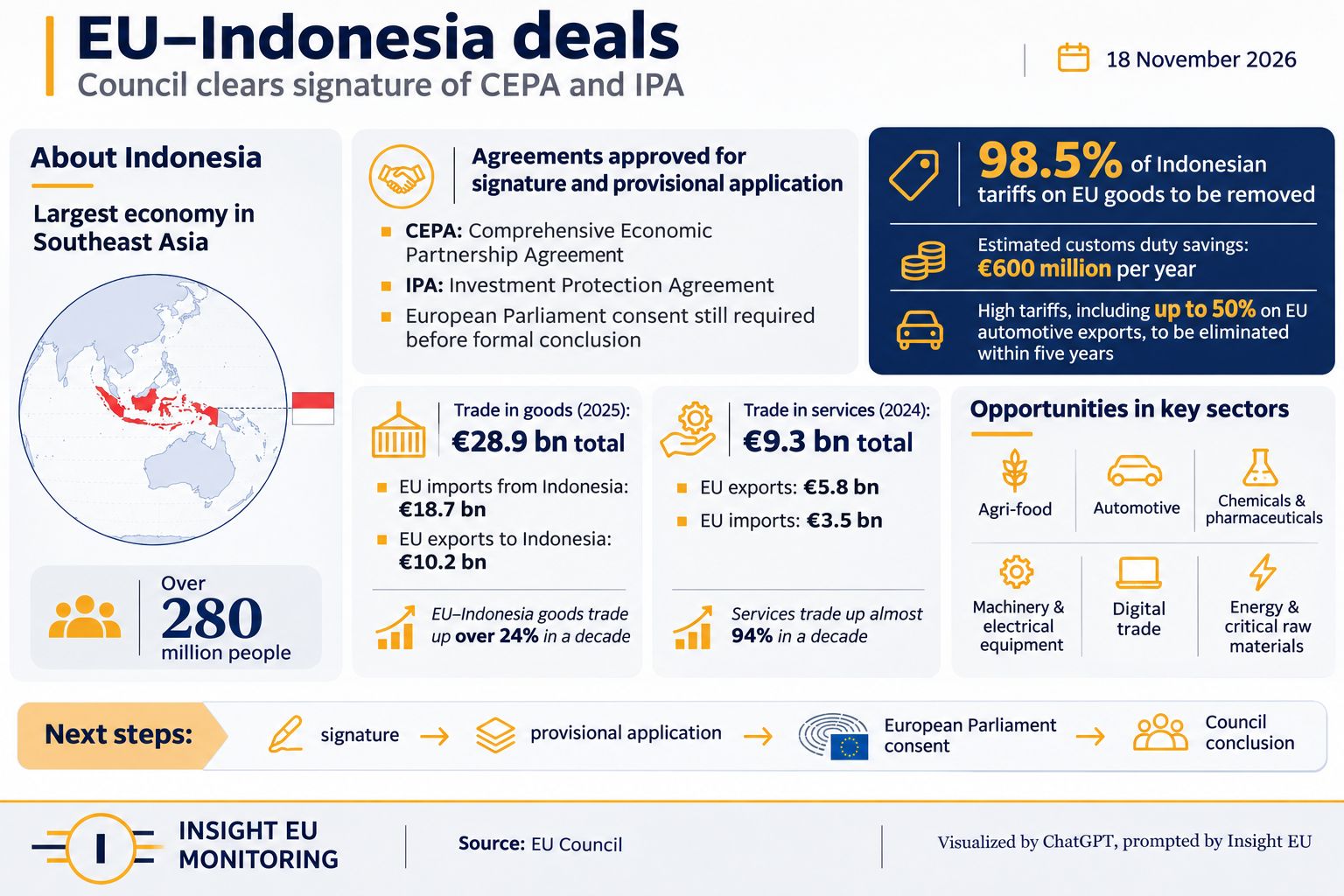
The European Union and Indonesia today signed their Comprehensive Economic Partnership Agreement (CEPA), and Investment Protection Agreement (IPA). These agreements mark a major step forward in advancing the EU’s strategy of diversification and partnerships, strengthening ties with Southeast Asia’s largest economy and the fourth most populous country in the world. They reinforce rules-based trade and provide a stable, predictable framework for trade and investment, while contributing to more secure and resilient supply chains for energy and raw materials.
The agreements will create new opportunities for businesses on both sides and deliver significant economic benefits. EU exports to Indonesia are projected to increase by almost 40% within 15 years, with particularly strong gains in machinery, motor vehicles, and other metals. Indonesian exports of goods and services to the EU are expected to rise by more than 14% over the same period. This will boost economic growth, with the EU’s GDP projected to be €16 billion higher and Indonesia’s €27 billion higher than they would be without the agreement.
The agreements will notably:
- Remove import duties on 98.5% of tariff lines and simplify procedures on EU goods exports to Indonesia, including agrifood exports and key industrial products, helping EU exporters to save over €600 million a year in customs duties;
- Open up new opportunities for EU investments into Indonesia, notably in strategic sectors such as electric vehicles, electronics and pharmaceuticals;
- Allow EU companies to provide services with full ownership in key sectors such as computers services sectors and telecommunications;
- Protect European investments in Indonesia and vice versa against unjustified discrimination, expropriation, or denial of justice in local courts, while respecting each Party’s right to regulate within their territories;
- Ensure respect and fair compensation for intellectual property rights, including the protection of 221 EU geographical indications;
- Strengthen predictable, reliable and sustainable supply chains, including through reduced tariffs, facilitation of critical raw materials exports, environmental impact assessments and enhanced cooperation; and
- Support sustainable growth through a strong Trade and Sustainable Development chapter covering commitments on climate, the environment, workers’ rights and enforceability; setting the Paris Agreement as an essential element of the deal; and including mechanisms for cooperation and dialogue on regulatory and sustainability issues, as well as a dedicated Protocol on palm oil.
Next steps
The two agreements will now require the European Parliament’s consent. The Indonesian authorities are, in parallel, carrying out their own internal ratification procedures. Once the EU and Indonesia have concluded their internal procedures, the agreements will be provisionally applied, likely in early 2027.
For more information
- EU-Indonesia trade agreement
- EU and Indonesia conclude negotiations on free trade agreement
- Factsheet – Main benefits
- Factsheet – Agri-food
- Factsheet – Sustainability
- EU-Indonesia – key elements
- EU-Indonesia trade relations
Quote(s)
2026 is the year that we keep delivering on EU trade. This exciting new agreement with Indonesia shows that our global partners trust us and value what we have to offer. EU-Indonesia trade and investment has vast untapped potential. With these deals in place, we will make rapid progress on delivering real benefits for our peoples and businesses.
Ursula von der Leyen, President of the European Commission
With today’s signature we are once again turning shared ambitions into tangible benefits. This is an important step towards a more prosperous economic future in the EU and Indonesia, opening new doors for businesses and giving momentum to our cooperation in key sectors such as agri-food and advanced manufacturing. At a time of growing global uncertainty, strategic partnerships are a source of resilience.
Maroš Šefčovič, Commissioner for Trade and Economic Security; Interinstitutional Relations and Transparency
Source – EU Commission
Statement by President von der Leyen on the signature of the EU-Indonesia Comprehensive Economic Partnership Agreement and the Investment Protection Agreement
Brussels, 21 November 2026
Ladies and Gentlemen,
I have just spoken to President Prabowo to mark this momentous day for the European Union and Indonesia. Today we sign our Comprehensive Economic Partnership Agreement, along with our Investment Protection Agreement. After nearly ten years of negotiations, we have made it. This is what two partners can achieve when they choose to build together. This is one of the most ambitious deals the EU has concluded in Asia. It connects our Union of 450 million people with the largest economy in Southeast Asia, the fourth most populous country in the world. The Agreement will remove duties on almost all trade between us. This opens new opportunities for European and Indonesian companies, farmers and workers, and especially for small businesses. And it gives companies what they value most: predictability, clear rules, open markets, and a stable framework for trade and investment for years to come. We are also joining forces with a shared vision for the future, based on sustainable growth, resilient supply chains and a clean economic transition for our peoples.
Above all, this agreement shows strong political commitment from Indonesia: to our partnership, and to trade that is open, fair and rules-based. I thank President Prabowo for his outstanding leadership and the clear strategic choice Indonesia has made. And I am very much looking forward to welcoming him to Brussels on 11 December, before we both travel to Miami for the G20. We will keep this momentum going. I also want to extend a special word of thanks to Coordinating Minister Airlangga and Minister Budi who join us today. And of course, to our own Trade Commissioner Maroš Šefčovič. Well done.
Ladies and Gentlemen,
2026 has been a transformative year for European trade policy. We are deepening our partnerships and growing our network of free trade agreements around the world – 45 agreements with 80 partners. This year alone, we signed agreements with Indonesia, Mercosur and soon India; we also concluded negotiations with Australia; we modernised our Global Agreement with Mexico; and reached political agreement with the Philippines. We believe that partnerships based on rules and trust will boost our independence. European companies have a head start in the world’s fastest-growing markets. And at the same time, they shine a spotlight on Europe as the reliable partner of choice.
Let me conclude: this agreement is about the long term. It is a partnership between the world’s largest Single Market and Southeast Asia’s largest economy. Together, we represent a market of 730 million people. This agreement is delivering for the people of Indonesia and of the European Union. It will support growth and create good jobs on both sides: for farmers, manufacturers and small businesses. And now, I am very much looking forward to the signing ceremony.
Source – EU Commission
EU-Indonesia trade: MEPs welcome signing of landmark partnership
Brussels, 21 November 2026
Import duties to disappear on almost all EU-Indonesia goods trade
- New opportunities for businesses, investment and jobs
- Deal brings Indonesia and Southeast Asia closer to the EU and diversifies Europe’s trade ties
Senior trade MEPs welcomed today’s signature of the EU-Indonesia trade deal, saying it will open markets, boost investment and deepen ties with Southeast Asia.
The Comprehensive Economic Partnership Agreement (CEPA) will remove import duties on almost all goods traded between the EU and Indonesia, covering more than 98% of tariff lines.
Because the EU and Indonesian economies are largely complementary, the risk of major disruption or unfair competition between similar sectors is limited. Instead, the agreement is expected to create a more open, transparent and predictable trading area of more than 700 million consumers.
Bernd Lange (S&D, Germany), Chair of Parliament’s International Trade Committee, said:
“With this agreement, we are not only opening up one of the most dynamic markets in Southeast Asia but also taking another important step towards diversifying our trade relations and strengthening ties with a reliable partner. The almost complete elimination of tariffs will create new opportunities for European producers, from machinery manufacturers to farmers, improve their competitiveness and help safeguard jobs in Europe. At the same time, Indonesia will benefit from better access to the European market, increased investment and opportunities for local value creation and job creation. A successful trade agreement must deliver tangible benefits for both sides.”
Iuliu Winkler (EPP, Romania), the Trade Committee’s standing rapporteur for trade relations with Indonesia, said:
“This partnership with Indonesia is much more than just another free trade agreement. It is a strategic instrument that responds to our reciprocal need to reduce risks and diversify supply chains, strengthen economic security and competitiveness, promote free and fair trade, and deepen cooperation on critical raw materials and other resources.”
Closer ties with Southeast Asia
In 2025, the EU was Indonesia’s fourth-largest trading partner, while Indonesia was the EU’s fifth-largest trading partner among ASEAN countries.
The deal is the EU’s third bilateral trade agreement with an ASEAN country, after Singapore and Vietnam, and forms part of the EU’s broader push to deepen economic ties with Southeast Asia.
Negotiations began in 2016 and were finalised on 23 September 2025 after 19 formal rounds. The text then underwent legal revision and translation before the Commission submitted it to the Council in June 2026.
The deal actually consists of two separate agreements: the Comprehensive Economic Partnership Agreement (CEPA) and the Investment Protection Agreement (IPA), which will protect EU and Indonesian investors against discriminatory or unfair treatment.
Next steps
Following signature, the agreements will be submitted to the European Parliament for consent. Parliament can approve or reject them, but cannot amend them. The exact timeline has not yet been agreed.
If Parliament gives its consent, the Council can formally conclude the agreements. Indonesia must also complete its own ratification procedures before the agreements can fully enter into force.
Further information
- European Commission: The EU-Indonesia trade agreement
- European Commission: EU trade relations with Indonesia
- European Commission: Key elements of the EU-Indonesia trade and investment agreements
- European Commission: Text of the EU-Indonesia agreements
- European Parliament: EU-Indonesia Comprehensive Economic Partnership Agreement: procedure file
- European Parliament: EU-Indonesia Investment Protection Agreement: procedure file
Source – EU Parliament