
Beijing, 9 October 2026
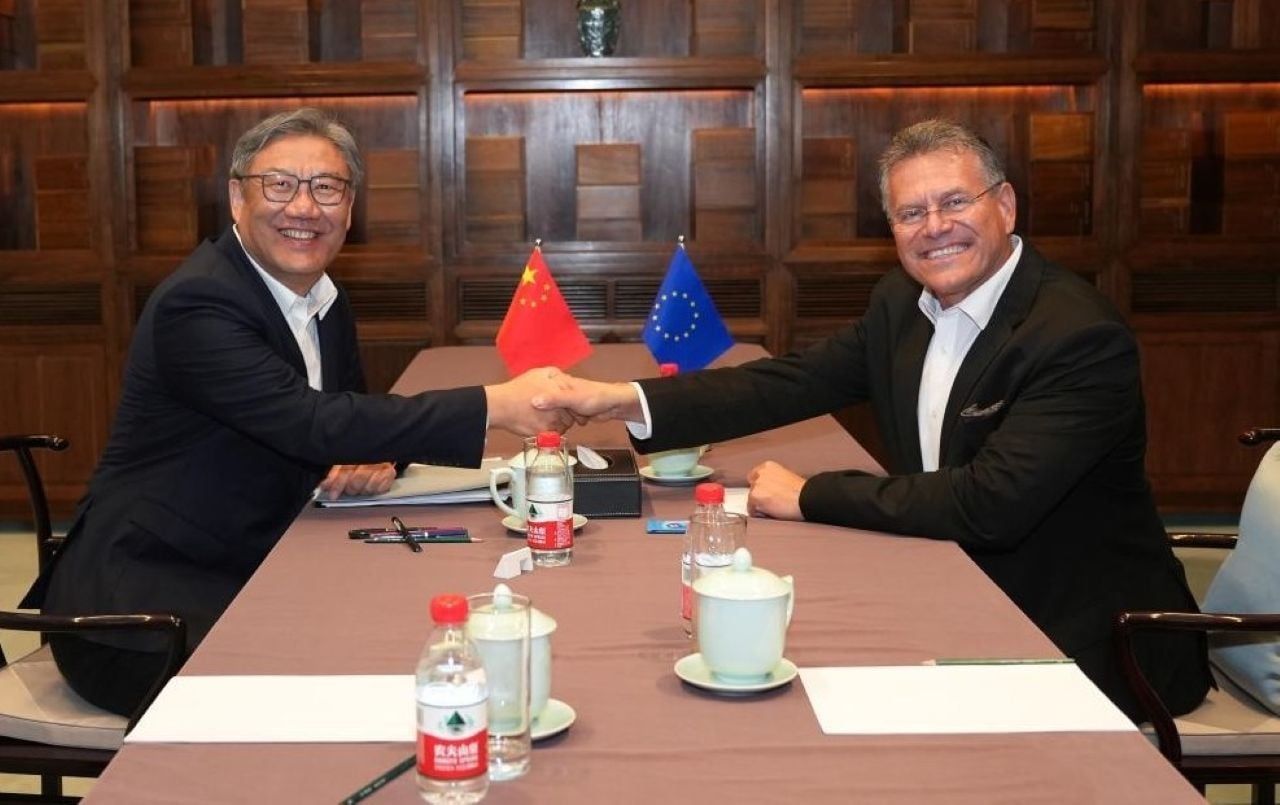
The EU and China reached initial trade understandings during talks in Beijing between Commissioner Maroš Šefčovič and Minister Wang Wentao. Šefčovič also met Chinese Vice-Premier He Lifeng. The outcomes include a potential halving of Chinese hybrid car exports to the EU, lower tariffs on EU goods worth nearly €4 billion and easier rare earth export licensing. Both sides agreed to pursue further negotiations on market access, export controls and WTO reform.
On 8-9 October 2026, Wang Wentao, Minister of Commerce of China, and Maroš Šefčovič, Commissioner for Trade and Economic Security, Interinstitutional Relations and Transparency, of the European Commission, held the second meeting of the EU-China Trade and Investment Consultations (TIC) in Beijing. The two sides had pragmatic and productive discussions, and reached a list of deliverables and understandings (see annex).
As key trading partners, the two sides reaffirmed to properly handling differences under the framework of WTO rules and commit to continue working with the view to stabilise and make the bilateral relationship more balanced. With this objective in mind, the two sides agreed to hold the third TIC ministerial meeting in March 2027. Prior to that, the two sides will maintain close communication, including holding a ministerial video-conference in January.
Annex
Trade and investment balancing
- Both sides will continue, within the framework of WTO rules, to explore the possibility of tariff reductions or elimination for certain goods.
- The two sides will continue to strengthen communication and cooperation under the trade monitoring mechanism, and actively utilise the function of the dialogue mechanism in enhancing mutual understanding.
- Following intensive consultations, both sides have reached an understanding on trade in hybrid vehicles in a WTO compliant manner.
- The two sides recalled the guidance document on the price undertakings of the BEVs anti-subsidy case, and will continue the procedures relating to corporate price undertakings and reviews.
- The two sides will continue to engage in dialogue on the market access of medical devices. The EU welcomes China’s effort to increase import of medical devices from the EU, including through a match-making event during the 9th China International Import Expo (CIIE).
- China will accelerate recognition of the regionalisation principle for eligible EU Member States on the basis of risk assessment. The two sides agreed to carry out exchanges on the methodologies and technologies for disease control, with a view to jointly exploring ways to lift the restrictions on relevant animal products affected by the bluetongue disease from relevant Member States.
- The two sides also agreed to continue technical-level exchanges on computer reservation systems and to follow-up on consultations on their respective cosmetics and pharmaceutical related regulatory frameworks, with the view to further addressing the existing and emerging market access barriers.
- The two sides agreed to engage on a technical dialogue on FSR.
- On the EU guidance on the use of EU funds for clean energy projects involving certain inverters, the EU clarified that its official guidance is country neutral and the two sides will engage in further discussions on this issue.
- The two sides agreed to explore how investment can bring more benefits to their economies and to discuss future-oriented cooperation.
Export controls
- The two sides reaffirmed the need to further strengthen the EU-China Export Control Dialogue, and welcomed increased exchanges and communication on respective export control policies, including through guidance, outreach and trainings.
- The two sides agreed on the importance of improving predictability and stability for global industrial supply chains. China is willing to continue facilitating export licenses for the supply of rare earths and permanent magnets to the EU through the fast-track mechanism. The EU side will continue to work with Member State authorities to facilitate specific priority licences to China among dual-use sectors.
- The two sides reaffirmed their objective to work toward addressing issues of concern in the field of export controls and discussed the possibility to investigate structural facilitation measures for compliant dual-use exports between the EU and China.
- The two sides reached an understanding in the context of the Export Control Dialogue to provide advance warning and to improve the transparency of listing and delisting procedures, and supported steps to delist entities, consistently with their applicable legislation.
IPR
- The EU and China have engaged in resolving systemic intellectual property related concerns with some progress. The two sides agreed on the need to continue the collaboration to address the concerns with some milestones, focusing on efficient and fair intellectual property protection and enforcement, as well as greater transparency and predictability. The two sides agreed to monitor progress through the EU-China Intellectual Property Working Group.
WTO
- The two sides agree to further strengthen bilateral communication and cooperation on WTO reform in an open and constructive manner. The two sides commit to engaging in WTO reform and agree to discuss all related issues, with a view to advancing substantive progress.
Source – EU Commission
Press remarks by Commissioner Šefčovič at the second meeting of the EU-China Trade and Investment Consultations
Beijing, 9 October 2026
“Check against delivery”
Good evening,
As I wrap up my visit to Beijing, let me begin by thanking my counterpart, Minister Wang Wentao, for his time, engagement and hospitality. I also appreciate the opportunity to meet Vice Premier He Lifeng.
I came here with one clear purpose: to start rebalancing the EU-China trade relationship and to make sure this first phase of negotiations under the Trade and Investment Consultations delivers its first tangible outcomes.
You know the context. The trade deficit is a mountain of a challenge for the EU, felt in every Member State. It is unsustainable and it demands a credible path to rebalancing.
We must defend our industries and restore a level playing field that has been distorted by global overcapacity.
Over the last three months, we have worked intensively at every level. We focused on clear priorities and measurable results as a proof of concept.
This is what that engagement has delivered so far:
First, we have reached a shared understanding to moderate China’s exports of hybrids and plug-in hybrids to the EU. This opens the prospect of cutting China’s exports by more than a half.
Second, we have reached a shared understanding to improve access to the Chinese market for a series of EU products through lower MFN tariffs. These range from car parts to olive oil and footwear, totalling almost 4 billion euros in current export value, which would bring at least 225 million euros in duty savings.
Third, we have reached a shared understanding to further facilitate China’s export licensing for rare earths and permanent magnets.
I often say that genuine negotiation deserves a real try. Therefore, I appreciate my counterpart’s engagement.
Having said that, this is far from the end. It is a crucial first step – but only a first step – in the process of rebalancing.
As President von der Leyen has said, dialogue needs results. And where the dialogue cannot deliver, the EU will use its tools to ensure a rebalancing.
Naturally, the President will now assess the outcomes and discuss next steps with leaders at the upcoming European Council. That is where the final decision lies.
With Minister Wang Wentao, we will reconvene at our level by January and organise the third Trade and Investment Consultations in March, to continue the work.
In parallel, our work also goes on in Brussels.
Thank you.
Source – EU Commission
Chinese Government: He Lifeng meets EU Commissioner for Trade and Economic Security Maroš Šefčovič
Beijing, 9 October 2026
He Lifeng, a member of the Political Bureau of the Communist Party of China (CPC) Central Committee and Vice-Premier of the State Council, met with European Commissioner for Trade and Economic Security Maroš Šefčovič in Beijing on the afternoon of 9 October. The two sides exchanged views on China–EU economic and trade relations.
He Lifeng said that China has always attached great importance to developing economic and trade relations with the European Union and is willing to work with the EU to implement the important understandings reached by the leaders of both sides.
He said the two sides should make full use of the China–EU trade and investment consultation mechanism, uphold the newly defined relationship between China and the EU as key trade partners based on stability and balance, maintain continuous dialogue, manage differences appropriately, and promote the sound and stable development of bilateral economic and trade relations.
Šefčovič said that China is an important economic and trade partner of the European Union and that the EU is willing to continue advancing trade and investment consultations, strengthen communication and jointly promote cooperation.
Translation disclaimer: This English translation is provided for informational purposes only. In the event of any discrepancies or legal interpretations, the original Chinese version shall prevail and is the only legally binding text.
Source – Government of China / Xinhua