
Brussels, 29 June 2026
The EU and China have held the first ministerial-level Trade and Investment Consultations in Brussels, agreeing to work on trade and investment balancing, export controls, intellectual property rights and WTO reform, while setting up a joint monitoring mechanism to improve transparency, track trade flows and address market access concerns.
Joint press statement by Commissioner Šefčovič and Minister Wang
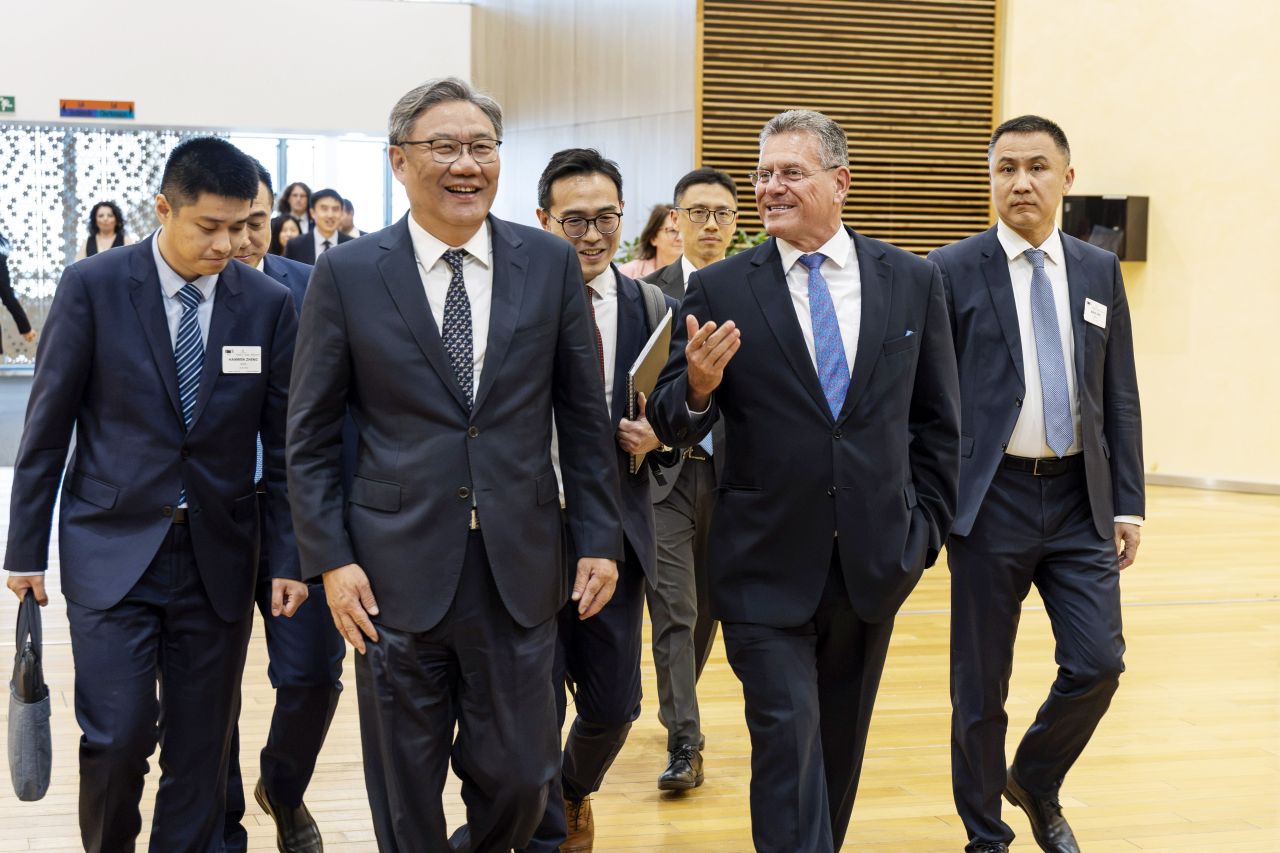
On 29th June 2026, Maros Šefčovič, European Commissioner for Trade and Economic Security and Interinstitutional Relations and Transparency, and Wang Wentao, Minister of Commerce of the People’s Republic of China, held the first meeting of the EU-China Trade and Investment Consultations (TIC) in Brussels.
The EU and China as key trade partners, agree that the main objective of the TIC is to strengthen dialogue at ministerial level on trade and investment policies with the view to stabilise and make our bilateral relationship more balanced.
During the first meeting of the TIC, the EU and noted the importance of addressing the challenges affecting the bilateral trade relationship and agreed to seek practical solutions. Four initial workstreams under the TIC were identified:
- Trade and investment balancing
- Export controls
- IPR
- WTO reform
Commissioner Šefčovič and Minister Wang mandated officials to engage in the four workstreams and agreed to meet again at ministerial level in Autumn 2026.
During the meeting, they also agreed to establish a joint monitoring mechanism to exchange relevant data, monitor trade flows and support technical work with a view to improving transparency, enhancing mutual trust and managing trade frictions.
Both sides also agreed that increased market access measures and initiatives can contribute to the balancing of the trade relationship. Their discussion focussed on possible tariff or non-tariff initiatives to that effect, exchanged lists of market access issues and agreed to continue consultations within the trade and investment balancing work stream with a view to making progress on specific concerns.
Both sides took note of the positive results to date of the EU-China Export Control Dialogue regarding rare earth elements and other critical materials and minerals, and intend to strengthen dialogue in this field. The two sides discussed the value of continued exchanges of information on their respective regulatory frameworks and licensing policies. They acknowledged the need to strengthen the EU-China Export Control Dialogue and agreed on the need for further facilitation efforts aimed at maintaining the stability of global industrial supply chains.
The EU and China underline the necessity of strengthening bilateral cooperation in the WTO, advancing substantive progress on WTO reform, and improving the authority and effectiveness of the WTO. Both sides agree to further strengthen communication and cooperation in the WTO moving forward.
The two sides acknowledged the constructive exchanges in the EU-China Intellectual Property Working Group as the main channel for EU-China intellectual property related discussions at technical level. They discussed and agreed to address a number of systemic intellectual property issues, to enhance the efficiency, fairness and transparency of IP protection and enforcement.
Source – EU Commission
Remarks by Commissioner Šefčovič at EU-China Trade and Investment Consultations Press Point
“Check against delivery”
Good afternoon.
Today, I have the opportunity to host my counterpart from China, Minister Wang Wentao. We held a series of substantive talks as of this morning and will continue later today.
This is my fourth meeting with the Minister, building on our previous engagements. My team also travelled to Beijing to help prepare this visit.
Today’s discussions were intensive, focused and constructive.
My objective from the outset has been clear: to begin balancing the trade relationship between the European Union and China.
The gap is widening. China’s exports to the EU keep rising, while our market share in China keeps shrinking.
This trend is not sustainable. The status quo is not an option.
The EU remains open for business. But we need to defend our industrial base and keep pushing for a level playing field globally, so our industries get a fair shot at competing.
That is why today’s talks – and the ones to follow – matter. They help us avoid unnecessary tension.
I believe we are starting to understand each other better on the structural issues that need fixing in our trade relationship.
This is also reflected in the joint press statement that Minister Wang Wentao and I are issuing, capturing the key takeaways.
So, we are today launching Trade and Investment Consultations – a dedicated platform to tackle, in a structured way, the issues we have identified together, along four strands:
- Trade and investment balancing
- Export controls
- Intellectual property rights
- and WTO reform.
Under the first working group on trade and investment balancing, we have agreed to immediately set up a joint monitoring mechanism of trade flows, as a tool to help balance our trade.
In the context of the second working group, I welcome the Minister’s reassurance that existing export controls on rare earths and permanent magnets will not disrupt EU supply chains. But I have also proposed ways to further ease the licensing process for EU firms.
Progress is built one conversation at a time.
Our teams will now intensify their work – and I will travel to Beijing this autumn to assess progress. They have a clear mandate and an ambitious timeline to deliver tangible results by October.
Thank you.
Source – EU Commission