
Brussels, 8 June 2026
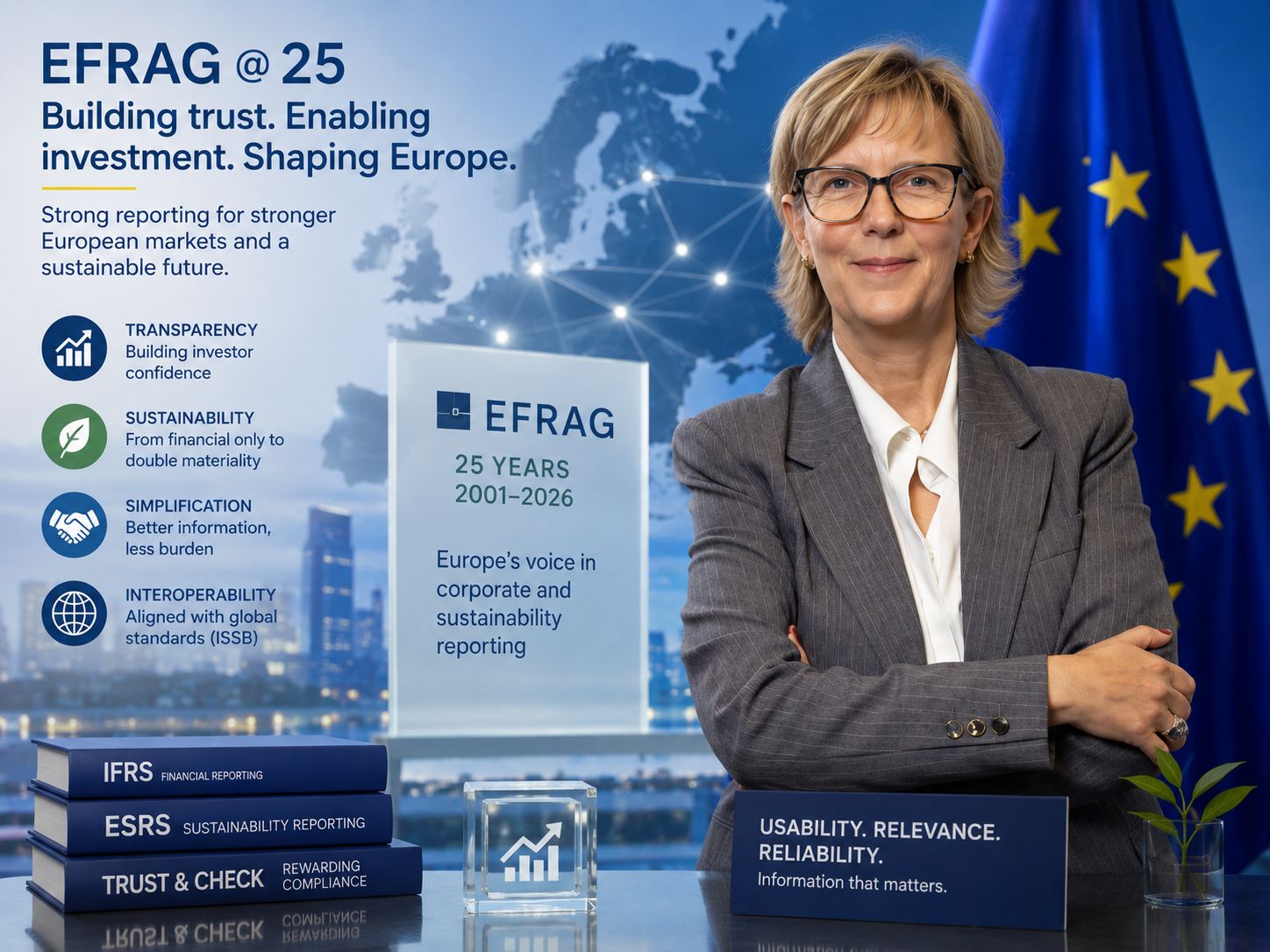
Speaking at EFRAG’s 25th anniversary event in Brussels, EU Commissioner Maria Luís Albuquerque praised the organisation’s role in strengthening financial and sustainability reporting across Europe. She argued that the next phase of corporate reporting should focus on usability, proportionality and interoperability, while supporting the EU’s competitiveness agenda and the development of deeper European capital markets through the Savings and Investments Union.
Main take-aways
- EFRAG has been a cornerstone of European corporate reporting for 25 years, helping implement and assess International Financial Reporting Standards (IFRS) across the EU.
- The Commissioner linked reporting standards to the EU’s competitiveness agenda, arguing that transparent and comparable reporting is essential for stronger capital markets and the Savings and Investments Union.
- EFRAG played a central role in developing the European Sustainability Reporting Standards (ESRS) under the Corporate Sustainability Reporting Directive (CSRD).
- The organisation successfully balanced ambition and practicality, including the principles of double materiality, proportionality and international interoperability.
- Albuquerque defended the EU’s sustainability reporting framework while acknowledging the need for simplification and adaptation through the Omnibus I package.
- The Commission is working with EFRAG on revised ESRS standards and voluntary reporting frameworks aimed at reducing administrative burdens and improving usability.
- Reporting should support investment decisions rather than generate excessive data, the Commissioner stressed, arguing that quality matters more than quantity.
- Greater interoperability with international standards, including ISSB standards, remains a priority to avoid regulatory fragmentation and facilitate global investment.
- The future of reporting lies in integrating financial and sustainability information, creating a coherent picture of corporate performance, risks, resilience and strategy.
- EFRAG’s continued stakeholder engagement and implementation support will be crucial as companies adapt to revised sustainability reporting requirements.
E-Summary by ChatGPT, prompted by Insight EU, based on the speech below
Keynote speech by Commissioner Albuquerque at EFRAG’s annual conference: “25 Years of EFRAG: Leading the Next Era of Corporate Reporting”
Brussels, 8 June 2026
“Check against delivery”
Good afternoon, ladies and gentlemen.
My thanks for inviting me to take part in your anniversary event.
Let me start by congratulating EFRAG on 25 years of shaping and strengthening corporate reporting across Europe and beyond.
When EFRAG was established in 2001, Europe was entering a new phase of financial integration. As capital markets became increasingly international, investors needed a common language to understand company performance and value. EFRAG helped Europe embrace that challenge.
There is an echo of that challenge today.
As we work to build stronger European markets for capital through the Savings and Investments Union, we are once again confronted with the need to overcome fragmentation and create the conditions for capital to move more efficiently across Europe.
Strong markets depend on trust, transparency and comparability, values that have been at the heart of EFRAG’s work for the past quarter century.
Today, I would like to reflect on EFRAG’s contribution to both financial and sustainability reporting, and on the role it can continue to play in the years ahead.
EFRAG’s journey began as the European Commission’s trusted technical adviser on the endorsement of the International Financial Reporting Standards (IFRS).
Its first mission coincided with a decisive moment for European corporate reporting as Europe moved towards the use of IFRS Accounting Standards, and a more harmonised framework for listed companies.
The result was greater transparency and comparability of financial information across the Union and beyond. That greatly contributed to strengthening investor confidence and supporting the development of European capital markets.
Over the years, EFRAG has played a crucial role in assessing whether new or amended IFRS Accounting Standards are aligned with our legal framework and serve the European public good.
The Commission has relied extensively on EFRAG’s technical expertise, stakeholders’ engagement and independent advice throughout this process.
EFRAG’s work has also extended beyond Europe. EFRAG has helped ensure that European perspectives are heard and reflected in international standard-setting discussions, contributing to the development of high-quality global reporting standards.
EFRAG’s mandate expanded with the emergence of the European Green Deal and the Corporate Sustainability Reporting Directive.
The development of sustainability reporting responded to a growing need from investors and other stakeholders for comparable information on factors that increasingly influence companies’ performance, resilience and long-term value.
Climate, nature, social, governance and transition risks can all have tangible financial consequences.
At the same time, there was a real recognition that companies’ impact on society and the environment also matter.
This placed EFRAG at the centre of an important shift in corporate reporting in Europe: from financial only to a “double materiality” perspective.
Against that background, developing the European Sustainability Reporting Standards was no small task.
EFRAG had to balance ambition and usability, double materiality and proportionality, and international interoperability. The result was a set of well-designed and ambitious standards that matched the needs of a rapidly evolving sustainability reporting landscape.
And when the context changed, EFRAG demonstrated the same ability to adapt by supporting the simplification effort under the Omnibus I package.
There is an important lesson in this. Europe has often chosen to lead. As first movers, we inevitably enter uncharted territory. But leadership also means being willing to learn, adapt and improve when experience shows that adjustments are needed. And EFRAG was able to show that leadership.
Reporting is not an objective in itself. Its purpose is to help markets function better, support investment decisions and strengthen trust. The quality of a reporting framework should therefore not be measured by the number of datapoints it generates, but by whether it produces information that is relevant, reliable and useful.
That is the philosophy underpinning our joint work on the revised ESRS and on the voluntary standard.
The revised ESRS will provide a more proportionate framework that can deliver better outcomes in practice. When reporting requirements are clearer and the resulting data is more usable, reporting becomes less of a compliance exercise and more of a strategic tool for decision-making and risk management.
Companies that understand their long-term risks and opportunities are better positioned to remain resilient and competitive. This is particularly true in a world shaped by climate change, technological disruption and geopolitical uncertainty.
And it is equally important that the European framework remains ambitious but interoperable with the wider world, including with the ISSB standards. High-quality reporting should facilitate global investment and comparability, not create unnecessary fragmentation.
EFRAG’s success is ultimately the result of the people behind it.
Over the past twenty-five years, the organisation has benefited from the dedication of many leaders, experts, staff members and stakeholders whose expertise, judgement and commitment have helped build EFRAG’s reputation and credibility.
I would like to thank all those who have contributed to this work, often behind the scenes, and whose efforts have made EFRAG what it is today.
As we look ahead, we must try to anticipate change and we must focus increasingly on developing standards that work effectively in practice.
The next phase of corporate reporting is about making the various disclosure frameworks speak to each other so that sustainability information, financial performance, strategy and risk form one coherent account of the company.
EFRAG’s two pillars – financial and sustainability reporting – should not be seen as separate worlds. Investors, companies and markets need a coherent picture of performance, strategy, risks and resilience.
Good reporting is not necessarily about producing more information. It is about producing information of better quality.
This brings us back to a principle that has appeared throughout most of our recent discussions: usability.
Specifically on sustainability reporting, the immediate priority is to bring the ESRS revision and the voluntary standards work to a successful conclusion, providing companies with the clarity and stability they need to implement the framework with confidence.
EFRAG’s continued engagement with stakeholders will be essential in helping companies navigate this next phase successfully.
Implementation support to companies will be equally important, as it will reinforce the credibility and reliability of the framework.
Ladies and gentlemen,
EFRAG is Europe’s voice in corporate and sustainability reporting.
That mission demands independence and the ability to bring diverse interests together in pursuit of a common goal.
So, as EFRAG celebrates its 25th anniversary, Europe looks to the future, striving to be more competitive, resilient and prosperous. To achieve those objectives, the work of EFRAG will remain as important as ever.
Congratulations on this remarkable milestone.
Thank you and best of luck to the next 25 years of impact and leadership.
Source – EU Commission