
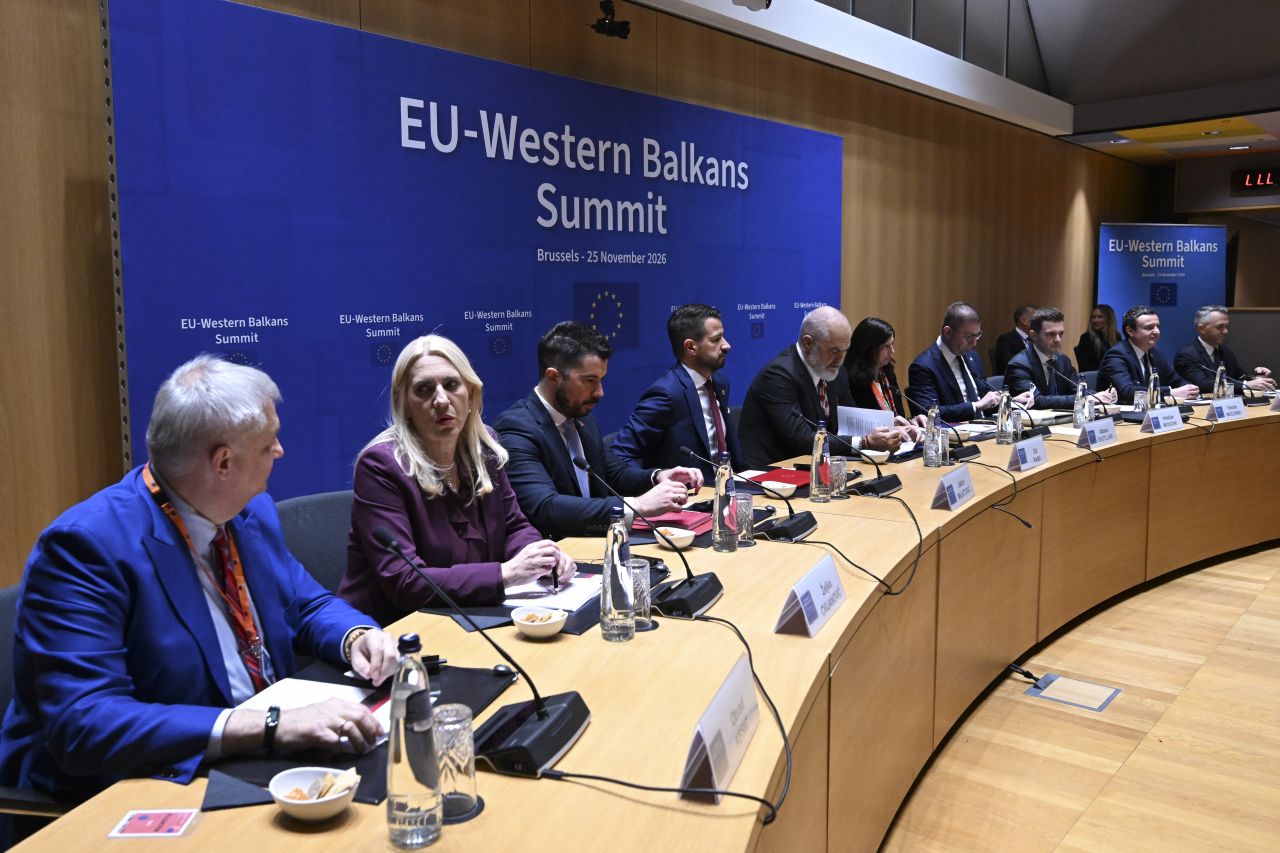
Brussels, 25 November 2026
The EU-Western Balkans summit in Brussels, chaired by President António Costa, highlighted the strategic importance of the relations between the EU and the Western Balkans and the benefits these ties bring to citizens.
My message to all partners is clear: keep up the momentum and deliver on the reforms that will bring you to the European Union.
European Council President António Costa
President of the European Council António Costa represented the EU at the summit, together with the President of the European Commission Ursula von der Leyen. The EU-Western Balkans summit declaration was issued at the end of the summit. All attending partners from the region have aligned with it.
The increasingly unstable geopolitical situation, marked by Russia’s war of aggression against Ukraine, conflicts in the Middle East and intensifying global competition, underscores the need for ever stronger ties between the EU and the Western Balkans.
Brussels Declaration
Progress towards EU membership
The summit provided an opportunity for the EU to reaffirm its commitment to the EU membership perspective of the Western Balkans.
We reiterate our full and unequivocal commitment to the EU membership perspective of the Western Balkans. The future of the Western Balkans is in our Union. Enlargement is a realistic possibility, which should be seized.
Brussels Declaration
The EU reaffirmed the importance of enlargement as a geostrategic investment in European peace, security, stability and prosperity.
The EU called on partners to accelerate decisive and credible reforms and deliver on the commitments necessary to advance on their paths towards the EU, and welcomed the dynamism and progress achieved since the last summit.
The EU also reiterated the importance of the Western Balkans partners’ commitment to uphold European values and principles, urging them to demonstrate this commitment through concrete actions.
Any glorification of war criminals, genocide denial, and revisionism contradicts the most fundamental European values.
Brussels Declaration
The importance of regional cooperation, good neighbourly relations and reconciliation was also underlined.
In this context, the EU reaffirmed its full support for the EU-facilitated Belgrade-Pristina Dialogue on normalisation of relations and encouraged both partners to seize the current political momentum to engage constructively in the Dialogue and to make tangible progress without delay.
Gradual integration and the Growth Plan
Leaders assessed progress in the gradual integration of the Western Balkans into the EU, carried out in a reversible and merit-based manner, and discussed how to advance it further.
Bringing partners closer to the EU already during the enlargement process remains a strategic focus.
Brussels Declaration
In this regard, the EU welcomed the progress on the gradual integration of the Western Balkans partners into the EU single market, which brings concrete benefits for citizens, notably:
- ongoing work to extend the EU’s ‘Roam like at home‘ area to the Western Balkans
- the participation of four partners in the Single Euro Payments Area (SEPA) schemes
- the rollout of regional instant payment systems
- promoting technical exchanges with a view to developing industrial dialogues under the single market highway, extending the EU-Western Balkans green lanes, and modernising and harmonising border crossings
- joining or replicating digital initiatives, such as the EU digital identity wallet, as well as completion of 500 public WiFi hotspots in the region under the WiFi4WB initiative
- establishing the single market academy
EU-Western Balkans relations
Launched in 2023, the Growth Plan aims tofurther integrate the Western Balkans partners into the EU single market, advance regional economic cooperation, and incentivise the necessary EU-related reforms by providing up to €6 billion for reforms and investments.
The EU reiterates its call for the Western Balkans partners to make the most of this unprecedented opportunity as it enters its final phase, through timely implementation of reforms.
The Growth Plan has the potential to speed up socioeconomic convergence between the Western Balkans and the EU, provided that the partners effectively implement the EU-related reforms.
Foreign affairs and security and defence
The EU reiterated its commitment to a comprehensive, just and lasting peace in Ukraine and welcomed Western Balkans partners’ support in this endeavour.
We will continue to invest in multilateralism and cooperate with the Western Balkans partners to uphold international law.
The EU underscored that alignment with the EU’s Common Foreign and Security Policy (CFSP), including implementing and enforcing the EU’s restrictive measures and countering circumvention, remains a strong expression of partners’ strategic choice. The EU commended partners who fully align with the EU’s CFSP and urged those who have not yet done so to follow suit.
Leaders also discussed cooperation:
- in the areas of security and defence, notably via security and defence partnerships and dialogues, and collaboration under the European Peace Facility
- in building resilience to cyber and other hybrid threats, to counter foreign information manipulation and interference
- European Peace Facility (background information)
- Security and defence partnerships (background information)
- Hybrid threats (background information)
Connectivity
The EU will continue to support the strengthening of connectivity, including energy, transport and digital, within the region and with the EU.
The EU will continue to support ongoing efforts to diversify sources and routes of energy supplies, and to contribute to the energy transition and infrastructure in the Western Balkans.
Cooperation in migration management and combating organised crime and corruption
The EU stressed that effective cooperation in the area of migration management remains essential, including EU support to manage migratory challenges along the Western Balkans route.
Further action is needed by the Western Balkans partners to fully align their visa policy with the EU, combat the smuggling of migrants and trafficking in human beings, and further strengthen border management, asylum and reception systems, and returns to countries of origin.
Leaders also discussed advancing joint work on the fight against corruption, drug trafficking and organised crime, as well as preventing and countering terrorism and violent extremism.
Background information
The summit forms part of the implementation of the European Council’s 2024-2029 strategic agenda.
Regular EU-Western Balkans summits have been held since 2018. The previous summit between EU and Western Balkans leaders took place in Tivat in June 2026.
More information
Press releases
- Brussels declaration, 25 November 2026
- Remarks by President António Costa at the press conference following the EU-Western Balkans summit of 25 November 2026
- EU-Western Balkans summit to take place in Brussels on 25 November
Source – European Council
EU – Western Balkans Brussels declaration of 25 November 2026
The EU-Western Balkans summit took place in Brussels, Belgium, on 25 November 2026. The Brussels declaration is available below.
Full text of the Brussels declaration of the EU-Western Balkans summit
Other linguistic versions available:
- Deklaracija iz Brisela, 25. novembra 2026. godine
- Deklaracija iz Brisela, 25. novembar 2026. Godine
- Декларација од Брисел, 25 ноември 2026 година
- Deklarata e Brukselit, 25 nëntor 2026
- Бриселска декларација, 25. новембар 2026. године
Remarks by President António Costa at the press conference following the EU-Western Balkans summit of 25 November 2026
Brussels, 25 November 2026
We have just concluded the European Union-Western Balkans summit – our second summit this year. The frequency of our contacts reflects the intensity of our political engagement with the region. The challenging geopolitical situation only underscores the need for ever closer ties between the European Union and the Western Balkans.
Today’s summit reaffirmed the European Union membership perspective of the Western Balkans.
My message to all partners was clear: keep up the momentum and deliver on the reforms that will bring you to the European Union. Enlargement is a realistic possibility, and it should be seized.
We took stock of what we achieved since our successful summit in Tivat and discussed how to take the gradual integration in the European Union to the next level. Citizens across the region are already feeling the benefits of this approach and we are exploring how to advance even further. And certainly, President von der Leyen will develop on this.
The progress made by Montenegro and Albania proves that the accession to the European Union is not an illusion but a real opportunity for those who engage. This year we began drafting Montenegro’s Accession Treaty – a step we have not taken in more than 10 years. Albania has also started to close negotiating chapters. All other Western Balkans partners can, if they want, make progress in their own accession paths.
This path towards the EU is not just about delivering the necessary reforms. Regional cooperation, reconciliation and good neighbourly relations are key preconditions for European Union accession. I look forward to further progress in resolving bilateral issues.
Challenges rooted in the past must be overcome. It’s time to look forward rather than backwards. Only then can our Western Balkan partners make real progress and assume their responsibilities as future members of a stable, prosperous and united Europe.
The European Union itself is a testament to this approach: it was built on reconciliation and peace, and enlargement has been essential to advancing those goals.
Our Western Balkans partners can count on the European Union. We are your most steadfast partner, and we will remain so.
Statement by President von der Leyen with President Costa following the EU-Western Balkans Summit
Brussels, 25 November 2026
Good evening,
I am convinced that enlargement is a strategic imperative for Europe. Today, the momentum is real. If you look at all the negotiations we have had: we are on track to open and close over 100 chapters this year. This is remarkable progress, and it comes at a crucial moment. The world around us is changing fast. The stronger and the more united Europe is, the better we can face the challenges. So, we must seize this momentum and turn it into progress towards membership. And that requires commitments from both sides.
We are seeing encouraging progress. Montenegro is approaching the finish line of its accession negotiations. And Albania continues to move towards it at an impressive pace. Earlier this month, we presented roadmaps for both countries. They set out clear priorities and milestones for the work ahead, and we want others to follow. At the same time, we are preparing our Union. We have reviewed what enlargement means for our institutions, policies and budget. Because enlargement must be a success for both current and future Member States.
But we should not wait for accession to bring our people and economies closer together. This is what gradual integration and our Growth Plan is all about. We want to give the Western Balkans access to more benefits of our Single Market before membership. So we are opening specific sectors – while the Western Balkan countries introduce reforms to create a level playing field. This reform process is accompanied by European Union funding, and we are seeing the results. Four Western Balkan partners are now part of SEPA. SEPA, the Single Euro Payments Area, makes money transfer fast and at low costs. We are also making progress on Roam Like at Home. Here, the negotiations started last month with Albania, Montenegro, North Macedonia and Kosovo. These are tangible benefits for citizens even before accession. And we want to go further. Early next year, we will launch gradual integration dialogues with every partner, tailormade. We want to identify new opportunities in our Single Market.
As I said, deeper integration goes hand in hand with reforms, and this brings me back to the Growth Plan. This year, implementation has shifted into high gear. A year ago, partners had delivered 38% of the reform steps due. Today, we have already reached 63%. And these are reforms that make a difference. They could unlock another €338 million for Albania, Montenegro and North Macedonia in the coming weeks.
But there is another essential part of this journey. The Western Balkans must also grow closer to one another. And here, too, we see progress. Intra-regional trade has grown significantly. Qualifications are increasingly recognised across borders, regional roaming makes it easier for people to stay connected, and the Green Lanes are making trade faster. This shows why regional cooperation is so important.
Ultimately, the success of enlargement will be measured by what it changes in people’s lives. More opportunities for young people, more businesses able to grow and trade across borders and greater confidence in the future. This is what our European project must deliver. We have a historic opportunity to make it happen. The European Union is ready to do its part. And I am confident that together, we can turn today’s momentum into lasting progress.
Thank you very much.
Source – EU Commission